MPs Pass the Lords Spiritual (Women) Bill – debate transcript

Lords Spiritual (Women) Bill

House of Commons, 19th January 2015


Westminster-abbey3.37 pm

Allocation of Time

The Deputy Leader of the House of Commons (Tom Brake):

I beg to move,

That the following provisions shall apply to the proceedings on the Lords Spiritual (Women) Bill–

Timetable

1.- (1) Proceedings on Second Reading, in Committee, on consideration and on Third Reading shall be completed at this day’s sitting…..

The motion applies to the proceedings on the Lords Spiritual (Women) Bill. The motion timetables all stages of the Bill, guaranteeing six hours debate, with up to four hours on Second Reading and a further two hours for Committee and remaining stages.

This is a short, single-issue Bill that the Government have introduced in response to the recent decision by the Church of England to allow women to be consecrated as bishops. The provisions will fast-track female diocesan bishops in the House of Lords, as current legislation will otherwise mean it would be many years before female bishops could take seats on the Lords Spiritual Benches.

More will be said about the detail of the provisions and the necessity for this legislation when we come to debating the Bill itself. This is an important Bill, strongly supported by both the Government and the Church, and it has broad support across the House. It is a tightly focused Bill with only one substantive clause, and it is for that reason that the motion allocates six hours for debate. I commend the motion to the House. Continue reading “MPs Pass the Lords Spiritual (Women) Bill – debate transcript”

Bishop of Chester takes part in debate on Recall of MPs Bill

On 19th January 2015, the Bishop of Chester, the Rt Revd Peter Forster, took part in the debate on the Government’s Recall of MPs Bill, during the second day of its Committee Stage. He spoke three times during the debate on Lord Hamilton of Epsom’s amendment, which sought to raise the threshold at which a petition against an MP would trigger the recall process, from 10 per cent to 20 per cent. The amendment was withdrawn at the end of the debate.

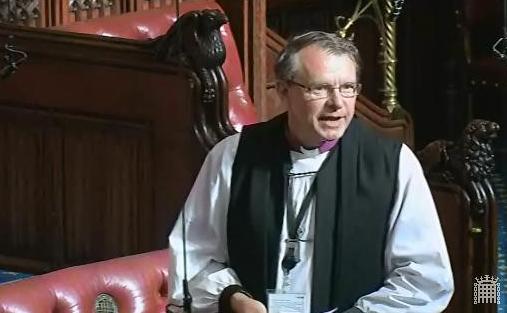
14.03 Bishop of ChesterThe Lord Bishop of Chester: My Lords, I think that only these Benches could participate in these petitions since we have a right to vote in general elections, although there is a convention among us that we do not. I think that the last person who did so was Archbishop Runcie, who simply could not resist voting against Mrs Thatcher. He was found out and promised not to do it again, so there is a convention that we do not do it but we could. Continue reading “Bishop of Chester takes part in debate on Recall of MPs Bill”

Bishop of St Albans – Milk (Written Answer)

On 19th January 2015, the Bishop of St Albans, the Rt Revd Alan Smith, received an answer to a written question on the subject of milk sustainability.

Bishop of St AlbansThe Lord Bishop of St Albans: To ask Her Majesty’s Government what action they are taking to strengthen United Kingdom food security through ensuring that the supply of liquid milk produced in the United Kingdom is sufficient to meet United Kingdom consumer demand, in order to reduce reliance on imported milk. [HL3996]

The Parliamentary Under-Secretary of State, Department for Environment, Food and Rural Affairs (Lord De Mauley): Milk commodity price increases during 2013 stimulated milk production in the UK (also in the EU and across the world). UK milk production for January to November 2014 was 9% up on the previous year and 7% higher than the average seen over the past 10 years. Liquid milk is expensive to transport and has a short lifespan in its raw state. UK imports are at very low levels: around 1% of total UK production. In 2013, the UK imported 132 million litres of raw milk, predominantly intra-trade between the Republic of Ireland and Northern Ireland. Domestic production of liquid milk in the same period was 13.2 billion litres.

(via Parliament.uk)

Church of England Week in Westminster 12th-16th January 2015

Welcome to the Church of England’s weekly round-up of activity in Parliament.

Westminster-abbeyThis week, bishops in the House of Lords took part in debates on the Counter-Terrorism and Security Bill, accident and emergency services, chancel repair liability, maternal and neonatal mortality, and the Assisted Dying Bill. They also asked questions on forced marriage, affordable housing in rural communities, citizenship programmes, Egypt, prostitution, the Somerset Rivers Authority and UK milk production.

Continue reading “Church of England Week in Westminster 12th-16th January 2015”

Divisions – Assisted Dying Bill

On 16th January 2015, a number of bishops took part in divisions in the House of Lords, during the Committee Stage of Lord Falconer of Thoroton’s Assisted Dying Bill.

House of Lords Division Lobby

Continue reading “Divisions – Assisted Dying Bill”

Bishops take part in Committee Stage of Assisted Dying Bill

On 16th January 2015, the Bishop of Carlisle, the Rt Revd James Newcome, and the Bishop of Chester, the Rt Revd Peter Forster, spoke during the Committee Stage of Lord Falconer of Thoroton’s Assisted Dying Bill. Subjects debated included the terminology used in the text and title of the Bill, and clarifications of the relationship between patients and the medical practitioners required to treat them. The debate on the Bill was suspended at the end of the day. The Bill is unlikely to make further progress during the current Parliament. There were also two divisions on the Bill, and more details can be found here.

Continue reading “Bishops take part in Committee Stage of Assisted Dying Bill”

Bishop of Derby: focus on grassroot responses to maternal mortality

On 15th January 2015, the Bishop of Derby, the Rt Revd Alastair Redfern, took part in a question for short debate in the House of Lords, led by Baroness Hayman, on what progress has been made in reducing maternal and neonatal mortality in the developing world; and what plans they have to build on this work post-2015. The Bishop spoke of the situation in India, which has an ecumenical partnership with Derby Diocese, where one-third of global neonatal deaths occur. He noted that poverty, lack of education about basic hygine, attitudes towards women and girls and a lack of necessary infrastructure all contribute to high levels of maternal and neonatal mortality. He spoke of the grassroots responses to these conditions that he had observed in visits to India, and welcomed the partnership between DfID and development agencies such as Christian Aid, which work to channel funds to these effective local efforts.

DerbyThe Lord Bishop of Derby: My Lords, I too congratulate the noble Baroness, Lady Hayman, on securing this debate and on introducing it with such expertise and such a challenging sense of the statistics. Millennium development goals 4 and 5 are not being met and, as other speakers have said, the consequences are horrendous. My contribution will be from my own experience working with people at the grass roots, and I will then tease out what the implications of that experience should be.

I work in the diocese of Derby, in England, and we are twinned with the Church of North India, which extends from Calcutta to Mumbai—the whole of north India is twinned with our diocese in an ecumenical link. I work with people in a number of Indian communities where this issue is enormous. In 2012, one-third of global neonatal deaths happened in India. The highest rate of first-day mortality is in India. That is the context in which we are working with our partners, through whose eyes we discern some factors. Continue reading “Bishop of Derby: focus on grassroot responses to maternal mortality”

Bishop of Derby takes part in debate on chancel repair liability

Bishop of DerbyOn 15th January 2015, the Bishop of Derby, the Rt Revd Alastair Redfern, took part in a short debate in the House of Lords, led by Lord Avebury, on what steps the Government are taking to abolish the liability of private householders and others for chancel repairs. The Bishop put on record that the Church is, in principle, in favour of changing the law. However, he cautioned that the loss of title may cause the local parish financial hardships, and that compensation for the financial loss that would occur must be taken into account. The full transcript of the debate is reproduced below.

Chancel Repairs

Asked by Lord Avebury: To ask Her Majesty’s Government what steps they are taking to abolish the liability of private householders and others for chancel repairs.

Lord Avebury (LD): My Lords, a consensus that reform of the law on chancel repairs is long overdue has emerged from discussions with the church, the Law Commission, the Law Society, the Country Landowners’ Association and the National Secular Society. Since the Chancel Repairs Bill will not make further progress until after the general election, a preliminary debate on the issues is useful now. Continue reading “Bishop of Derby takes part in debate on chancel repair liability”

Bishop of St Albans leads debate on A&E pressures

On 15th January 2015, the Bishop of St Albans, the Rt Revd Alan Smith, led a question for short debate in the House of Lords on the pressures facing accident and emergency services. In his opening speech, the Bishop called for the House to disregard the media frenzy and political partisanship of the past week, and instead take a level-headed look at the issue – moving the debate away from scapegoating ‘inappropriate attender’ and seeking rather to find new ways of linking those within the health system with the most appropriate services for their needs.

Bishop of St AlbansThe Lord Bishop of St Albans: To ask Her Majesty’s Government what is their assessment of the pressures facing accident and emergency services.

The Lord Bishop of St Albans: My Lords, I come to this debate not as a doctor with specialist medical knowledge nor with any special insights into the complex processes which hospital managers have to manage. I approach it as someone from an institution, the church, which has been concerned for healing, in its broadest sense, from its very foundation and I live opposite what is left of the great medieval monastery of St Albans, which for centuries was a centre of healing, with its infirmary and herbarium. In my present role, I have regular contact with the hospitals across Hertfordshire, Bedfordshire, Luton and Barnet, which make up the diocese of St Albans. Continue reading “Bishop of St Albans leads debate on A&E pressures”

Bishop of Ely takes part in debate on A&E services

On 15th January 2015, the Bishop of Ely, the Rt Revd Stephen Conway, took part in the Bishop of St Albans’ debate on the pressures facing accident and emergency services. Speaking to the experiences of Addenbrooke and Hinchingbrooke Hospitals, which is in his diocese, he noted that demand for services was continuing to increase. He called for greater integration and more joined-up working between different parts of the health sector.

14.10.16 Bishop of Ely 1The Lord Bishop of Ely: My Lords, I am very grateful to the noble Lord, Lord McColl, for reminding me how pleased I was to be off my trolley in February 2013, when I was admitted as an emergency patient to Addenbrooke’s Hospital in Cambridge. Were it not for the skill and dedication of the surgeons and nurses—and the grace of God—I would not be here now. Like the right reverend Prelate the Bishop of St Albans, I pay tribute to the dedication of staff in our hospitals, not least Addenbrooke’s, from which no one needing emergency treatment is turned away. Continue reading “Bishop of Ely takes part in debate on A&E services”