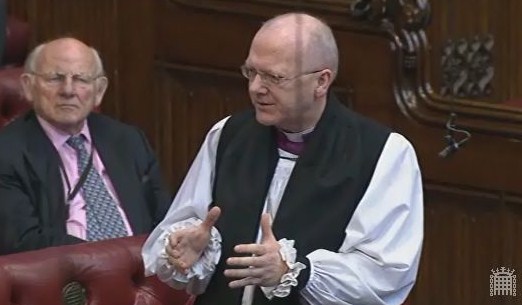
Bishop of Norwich calls for stronger response to tackle growth of food bank use

“When we stigmatise the poor, the unemployed and the vulnerable, we have succumbed to blaming them for their position. However, although some people stigmatise welfare claimants, many others show enormous human and social solidarity by volunteering to help them.”

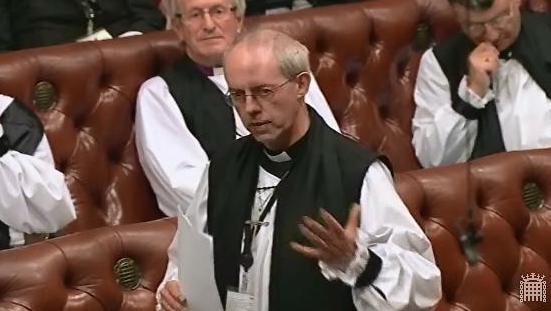
On 6th November 2014, Labour Peer the Rt Hon. the Lord Whitty led a take-note debate in the House of Lords on the cumulative effects of Government economic, public spending and regulatory policies on low income and vulnerable consumers. The Bishop of Norwich, the Rt Revd Graham James, spoke in the debate. He focused his remarks on the rise in the use of food banks across his diocese, and the need for a sustained response to help reduce the use of food banks, including investment in nutrition programmes and reducing the number of delays to welfare payments. He praised those who volunteer and support food banks and other charitable responses, and cautioned some of the language used to describe those who use food banks and other forms of support.

14.06.12 Bishop of NorwichThe Lord Bishop of Norwich: My Lords, I am grateful to the noble Lord, Lord Whitty, for securing this debate, which I enter in no partisan spirit but hope to contribute some reflections from local experience in Norwich of those on low incomes in our city.

It was more than five years ago that I was first approached to become patron of the Norwich food bank, a relatively early one to be established. Its work informs a good deal of what I want to say. The necessity for it was identified before the previous general election as a result of the recession. Suddenly, people who thought themselves reasonably secure were worried. Those who were already insecure became highly vulnerable. That was all very noticeable within our church communities on the housing estates in Norwich, especially in the areas of greatest social deprivation. Continue reading “Bishop of Norwich calls for stronger response to tackle growth of food bank use”

Bishop of Leicester calls for closer co-ordination between faith groups and Government to tackle domestic abuse

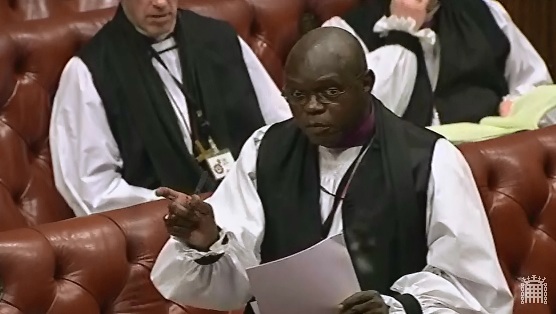
On 6th November 2014, the Bishop of Leicester, the Rt Revd Tim Stevens, took part in a debate in the House of Lords on women facing homelessness, domestic violence and social exclusion, led by Labour Peer Baroness King of Bow. The Bishop focused his remarks on tackling domestic violence, highlighting the need for closer co-ordination between faith groups and local and national government, increasing the availability and quality of training for key institutions such as the police, and asked the Minister to update the House on progress made on the Government’s violence against women strategy and its obligations under international treaties.

14.04.01 Bishop of LeicesterThe Lord Bishop of Leicester: My Lords, as this debate progresses the seriousness and critical nature of this subject is dawning on all of us. I share with other noble Lords a gratitude to the noble Baroness, Lady King, for bringing it to our attention with such eloquence and passion. We all look forward to the maiden speeches of the noble Baroness, Lady Rebuck, and the noble Lord, Lord Farmer, this morning.

Although there are profound links between the three subjects before us, I intend to concentrate on the issue of women facing domestic violence. I do so with considerable caution, even trepidation, because of the horrific stories that have already been brought to our attention, but also as a man who represents a hierarchical position in a patriarchal ecclesiastical institution. Nevertheless, I dare to speak, for three reasons. First, because of the extremely disturbing statistics which others have referred to: an estimated 7% of all women experience domestic violence, according to the 2011-12 figures, equivalent to some 1.2 million victims. There were 88,000 domestic violence cases referred to the Crown Prosecution Service that year, of which more than 64% reached a decision to charge, leading to more than 52,000 convictions. Even more disturbing are the 2013 figures, which indicate that on average 155 women and 103 children were turned away from refuges every day, at the most dangerous and vulnerable moment for them. They were then, of course, faced with returning to an abusive partner. Continue reading “Bishop of Leicester calls for closer co-ordination between faith groups and Government to tackle domestic abuse”

Bishop of Coventry receives answers to questions on Saudi Arabia

On 6th November 2014, the Bishop of Coventry, the Rt Revd Christopher Cocksworth, recieved answers to three written question Saudi Arabia from the Minister of State for the Foreign and Commonwealth Office, Baroness Anelay of St Johns.

13.10 Bishop of CoventryThe Lord Bishop of Coventry: To ask Her Majesty’s Government what is their assessment of freedom of religion or belief in Saudi Arabia and the extent to which discrimination against and restrictions experienced by Shiite Muslims contribute to sectarian unrest and dissent in that country.[HL2365]

The Minister of State, Foreign and Commonwealth Office (Baroness Anelay of St Johns): The British Government strongly supports the right to freedom of religion or belief, which is severely restricted in Saudi Arabia. We make our views well known through the UN Universal Periodic Review Process, in the Foreign and Commonwealth Office Annual Human Rights and Democracy Report, and to the Saudi Arabian authorities. We have made clear the importance of religious tolerance, including for different branches of Islam. There are some long-standing tensions between some Shia communities in the Eastern Province and the Saudi authorities. We continue to monitor developments. We welcome all efforts to increase religious tolerance in Saudi Arabia, including the recent calls by King Abdullah and Saudi religious leaders for greater religious tolerance in the Kingdom. Continue reading “Bishop of Coventry receives answers to questions on Saudi Arabia”

Bishop of St Albans calls on Government to uphold its commitment to zero-carbon homes

On 5th November 2014, the Bishop of St Albans tabled an amendment to the Infrastructure Bill, during its Report Stage, which sought to hold the Government to its commitment to a zero-carbon homes strategy as originally envisaged, including removing exemptions for small construction companies and allowing construction companies to buy themselves out of their obligation to build zero-carbon homes. Following the debate on the amendment, assurances were given tat consultation on the commitment were ongoing, and the Bishop did not press it to a division of the House.

Bishop of St AlbansThe Lord Bishop of St Albans: My Lords, in speaking to Amendment 108A, I should like to thank the noble Lord, Lord Berkeley, for co-sponsoring it. I bring forward this amendment out of concern that the standard proposed in the Bill is significantly lower than that already agreed through cross-industry consensus. I fear that an excessive focus on off-site carbon savings will undermine the effectiveness of the proposals and that an exemption for small sites will create confusion by causing the emergence of a two-tiered regulatory system. It is essential that housebuilders meets the carbon compliance standards that have already been agreed through cross-industry consensus. This was endorsed by the Government back in 2011 and strongly supported by around 70% of those responding to their consultation. I am therefore troubled by the proposal of a new on-site energy performance standard for zero-carbon homes that is lower than the one already agreed. It is not clear why this reduction is necessary. The proposed exemptions from the standard for homes built on small sites and for starter homes would also serve to undermine the main purpose behind the zero-carbon standard: namely, that of prioritising carbon reduction. It is to address the lack of measures necessary to realise the Government’s stated commitment to carbon neutrality that I have tabled this amendment which requires the previously agreed carbon compliance standard to be met on-site before allowable solutions can be undertaken. It also requires all homes to meet that standard, ensuring that no exemptions are allowed. Continue reading “Bishop of St Albans calls on Government to uphold its commitment to zero-carbon homes”

Infrastructure Bill – Division

On 15th November 2014, three bishops voted on an amendment to the Infrastructure Bill, during its Report Stage. The amendment, tabled by Labour peer Lord Adonis, sought to create a National Infrastructure Commission, based on recommendations made by Sir John Armitt in his independent review into national infrastructure for the Labour Party.

House of Lords Division Lobby


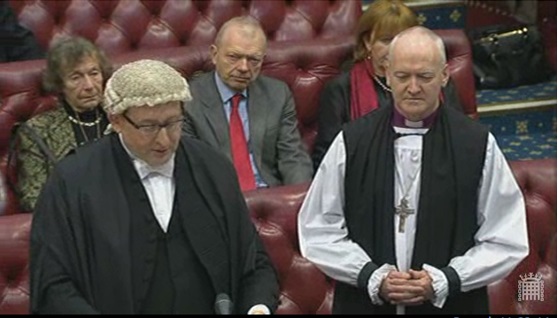
The Bishop of Norwich, the Rt Revd Graham James, the Bishop of Portsmouth, the Rt Revd Christopher Foster, and the Bishop of St Albans, the Rt Revd Alan Smith, voted ‘content’ with the amendment. No bishop voted ‘not content’.

There were Contents: 195 | Not Contents: 235 | Result: Government Win.

(via Parliament.uk)

Bishop of St Albans co-sponsors amendment to protect Public Forest Estate

On 5th November 2014, the Bishop of St Albans took part in a debate on an amendment to the Infrastructure Bill, which he co-sponsored with Baroness Royall of Blaisdon. The amendment sought to guarantee the protection of the Public Forest Estate, following the recommendations made by the Independent Panel on Forestry, which was chaired by the former Bishop of Liverpool, the Rt Revd James Jones. Following the debate on the amendment, the Government agreed to bring forward amendments to the Bill at Third Reading.

Bishop of St AlbansThe Lord Bishop of St Albans: My Lords, I am glad to speak in support of this amendment proposed by the noble Baroness, Lady Royall. I am also glad to pay tribute to her persistence on this matter which I, too, believe is crucial. When the discussions about the future of the forestry estate have come before the public they have made their views absolutely clear that trees, woods and forests are a vital part of the make-up of the English countryside. Although they now cover only 9% of the land area of England, trees have an iconic place in our relationship with the landscape. Whether living in towns, cities, villages or hamlets, many people express affection and deep regard for the well-being of trees in the locality. Protecting the Public Forest Estate will bring many benefits to the public and the environment. I will mention three of them briefly. Continue reading “Bishop of St Albans co-sponsors amendment to protect Public Forest Estate”

Bishop of Truro leads call for stronger regulation on telephone sales of high-cost short-term credit

On 5th November 2014, the Bishop of Truro, the Rt Revd Tim Thornton, sponsored an amendment to the Consumer Rights Bill, during its Committee Stage. The amendment sought to place a duty on the Secretary of State for Business, Innovation and Skills to make regulations to prevent the sale of high-cost short-term credit through unsolicited marketing calls. Following assurances from the Minister, the Bishop withdrew his amendment.

Bishop of Truro 20.6.13The Lord Bishop of Truro: My Lords, Amendment 105C is in my name and those of the noble Lord, Lord Mitchell, and the noble Baroness, Lady Bakewell. I declare an interest: I am chair of the trustees of the Children’s Society, which has co-ordinated this amendment as part of its campaign—of which I am very proud—on the impact of debt on children and families. We produced a report entitled The Debt Trap earlier this year.

In September this year, the Children’s Society launched another report, entitled Playday not Payday, which looked at the effects of the advertising of payday loans on children, and in particular at the telemarketing of payday loans. The report identified a gap in the regulations which allows payday loan companies to use unsolicited marketing calls to offer people payday loans through phone calls and texts. For mortgage products, this type of unsolicited marketing is completely banned by the Mortgage Conduct of Business rules. The Financial Conduct Authority, which regulates payday lenders, said: Continue reading “Bishop of Truro leads call for stronger regulation on telephone sales of high-cost short-term credit”

Bishop of Truro supports child protection amendments to Consumer Rights Bill

On 5th November 2014, the Bishop of Truro, the Rt Revd Tim Thornton, spoke during the Committee Stage of the Consumer Rights Bill, in support of Baroness Howe of Idilcote’s amendment which would require internet service providers and mobile phone operators to provide default adult content filtering. Following the debate, Baroness Howe withdrew her amendment, but suggested that she would re-table it at Report Stage.

Bishop of Truro 20.6.13The Lord Bishop of Truro: My Lords, I support the amendment and am grateful to the noble Baroness for providing a comprehensive and excellent introduction to it. I do not want to repeat the important points that have already been made; I simply want to underline one particularly important point.

These days, we all have a responsibility to take child protection and safeguarding very seriously. Your Lordships may or may not be aware that you cannot be made a bishop in the Church of England unless you have had statutory safeguarding training. The most reverend Primate the Archbishop of Canterbury has made that very clear in all that he has said and done, and that seems absolutely right and proper. Continue reading “Bishop of Truro supports child protection amendments to Consumer Rights Bill”

Bishop of St Albans raises concerns about Work Capability Assessment

On 5th November 2014, Lord McAvoy asked Her Majesty’s Government how many people were awaiting a Work Capability Assessment on the latest date for which figures are available. The Bishop of St Albans, the Rt Revd Alan Smith, asked a supplementary question:

Bishop of St AlbansThe Lord Bishop of St Albans: My Lords, great concern has been expressed by some people about how work capability assessments are being carried out and whether those undertaking them have the right skills and expertise. Indeed, in one anecdotal case, the health professional who undertook a complex mental health assessment was a physiotherapist. If that is the case, surely it cannot be right. What are Her Majesty’s Government doing to ensure that those undertaking the assessments have the right skills and experience to be able to do them properly?

Lord Freud: The important thing about doing these assessments is that someone assesses correctly in terms of capability of performing functions and capability of working; that is, what people are able to do. As I said earlier, we have more specialist professional support going into the system to make sure that those assessments are done accurately.

(via Parliament.uk)

Bishop of Norwich calls for extension of PSVI initiative to Central African Republic

On 4th November 2014, Lord McConnell of Glenscorrodale asked Her Majesty’s Government what support they will provide to the United Nations mission in the Central African Republic. The Bishop of Norwich, the Rt Revd Graham James, asked a supplementary question:

14.06.12 Bishop of Norwich

The Lord Bishop of Norwich: My Lords, given the widespread violation of both women and children in this tragic conflict, will the Minister indicate whether there are ways in which the Government could extend the success of the Preventing Sexual Violence in Conflict Initiative to the Central African Republic?

Baroness Anelay of St Johns: The right reverend Prelate makes a very important point. The work done by my noble friends in the Foreign Office and DfID this summer is bearing good results but we need to be able to take those further forward. I listened to what he said and I will certainly take his views back to the FCO.

(via Parliament.uk)