Archbishop speaks on banking reform, culture and practice

On 8th September 2016 the Bishop of St Albans, Rt Revd Alan Smith, led a debate in the House of Lords: “To ask Her Majesty’s Government what is their assessment of progress towards implementing the recommendations contained within the report of the Parliamentary Commission on Banking Standards, Changing banking for good.” The Archbishop of Canterbury, Most Rev & Rt Hon Justin Welby spoke in the debate, having previously served on the Parliamentary Commission on Banking Standards.

The Bishop of St Albans’ opening speech and the response of the Minister can be read here.  

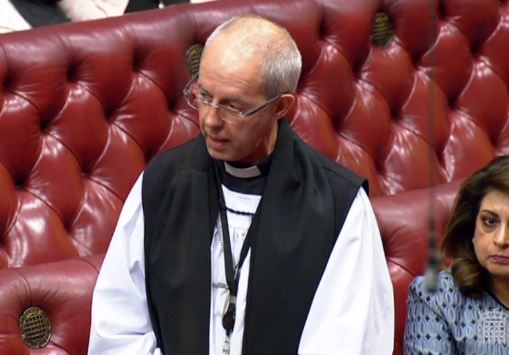
abcbankingstandardsThe Archbishop of Canterbury: My Lords, I add my congratulations to those of other noble Lords on the appointment of the noble Lord, Lord Ashton, as the Minister at DCMS. I have no doubt that we will come across each other again as “C”, “M” and “S” all seem to cover the Church in various forms. I should also say that I served on the Parliamentary Commission on Banking Standards and had the very good fortune to do so with the noble Baroness, Lady Kramer, from whom I learned a great deal. I am also chairman of the Church Commissioners, who were involved in seeking to buy some of the spin-off assets of the Royal Bank of Scotland.

I am grateful to the right reverend Prelate for arranging this debate. I agree entirely with his speech and indeed with the other four speakers that have been made before mine. I shall try to avoid repeating what they said. As we know, and as previous speakers have said, the key issue is banking culture. Culture comes from actions and decisions, and actions and decisions feed into culture. There is no doubt that changes introduced by the Government and the Bank of England have been extensive, and in many cases very effective. However, there are four linked areas, all of them around “too big to fail”, leading to what must be the long-term aim of ensuring that the Government do not have a contingent liability with respect to large banks that would result in them needing to provide support in the event of serious problems, as they had to do in 2008 at such cost. Continue reading “Archbishop speaks on banking reform, culture and practice”

Archbishop asks Government to speed up process of bringing lone children with families in UK across from Calais Jungle camp

On 6th September 2016 Lord Roberts of Llandudno asked Her Majesty’s Government “what plans they have to speed up the reuniting of refugee children in the camps of Calais and Dunkirk with their families in the United Kingdom.” The Archbishop of Canterbury, Most Rev Justin Welby, asked a follow up question:

abccalaisqThe Archbishop of Canterbury: My Lords, the Question has been extremely specifically put about children who have families in this country; this is not about all unaccompanied children. My own diocese of Canterbury has taken on a staff member who is working in the Jungle, in co-ordination with a staff member taken on by the Catholic diocese of Arras. We are still having continual reports of delays for really quite young children who are not being brought across. Does the Minister not agree that where children—particularly young ones—have families in this country there is no reason why they should not be brought across within the day? Continue reading “Archbishop asks Government to speed up process of bringing lone children with families in UK across from Calais Jungle camp”

Archbishop of Canterbury pays tribute to departing Lord Speaker

abc-mcfall-2On 5th September 2016, the Archbishop of Canterbury, the Rt Hon. and Rt Rev. Justin Welby, paid tribute to the outgoing Lord Speaker and Deputy Lord Speaker, Baroness D’Souza and Lord Laming. Archbishop Justin also welcomed the new Lord Speaker, Lord Fowler, and the new Senior Deputy Lord Speaker, Lord McFall, to their roles.
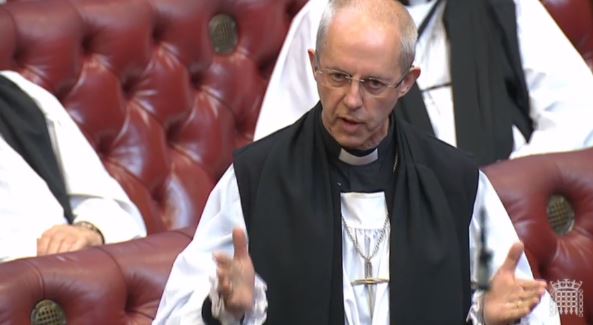

Archbishop of Canterbury: My Lords, on behalf of the Lords spiritual I join in the tributes to the noble Baroness, Lady D’Souza, and to the noble Lord, Lord Laming. The noble Baroness, Lady D’Souza, has been a great friend to the Lords spiritual, who normally arrive with even more trepidation and less familiarity with the processes of a House such as this than anyone else coming here. She has been assiduous in seeing new bishops and advising them, and then advising them later when they did not quite make it—something that I appreciated on more than one occasion. She always did it with the greatest tact and courtesy and I think that we would all say that she was an encourager of great aptitude. Continue reading “Archbishop of Canterbury pays tribute to departing Lord Speaker”

Archbishop of Canterbury asks Government about efforts to restore peace in South Sudan

On 13th July 2016 Baroness Kinnock of Holyhead asked Her Majesty’s Government “what assessment they have made of the resurgence of violence in South Sudan.” The Archbishop of Canterbury, Most Revd & Rt Hon Justin Welby, asked a follow up question:

2ABCEUdebateThe Archbishop of Canterbury: My Lords, I have been in South Sudan twice in the past two years and in Kenya a week ago. Is the Minister encouraging the Government of Kenya to use the powers they have in their area, as most of the leaders of South Sudan have their families, farms and education of their children in Kenya, to encourage them to observe their ceasefire? What are Her Majesty’s Government doing to support the work of the peace and reconciliation commission led by the Anglican Archbishop of South Sudan and Sudan?

Continue reading “Archbishop of Canterbury asks Government about efforts to restore peace in South Sudan”

Archbishop of Canterbury on the future for the United Kingdom after the EU Referendum

On 5th July 2016 the House of Lords debated a motion “That this House takes note of the outcome of the European Union referendum.” The Archbishop of Canterbury, Most Revd & Rt Hon Justin Welby, spoke in the debate. His speech is below in full, followed by extracts from the speeches of other Peers. 

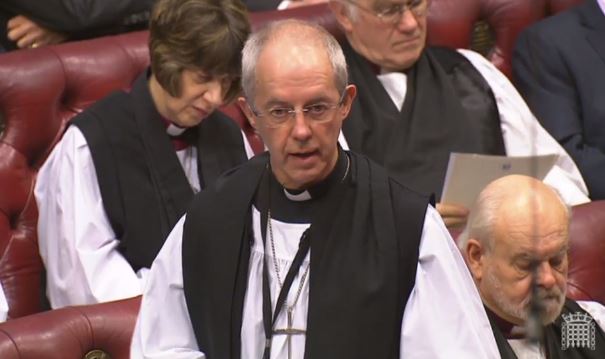
2ABCEUdebateThe Archbishop of Canterbury:  My Lords, the events of the past two weeks have led to some of the most traumatic and dynamic changes that we have known. The course of the campaign was robust—as it properly should be on such great issues—but at times veered over the line on both sides: it was not merely robust but unacceptable. Through such comments were created cracks in the thin crust of the politeness and tolerance of our society, through which, since the referendum, we have seen an outwelling of poison and hatred that I cannot remember in this country for very many years. It is essential, not only for this House but for the leaders of both sides and throughout our society, to challenge the attacks, xenophobia and racism that seem to have been felt acceptable, at least for a while.

Just over a week ago, at Lambeth Palace, at the breaking of the fast of Ramadan, I shared an iftar with the new Mayor of London, Sadiq Khan, and the Chief Rabbi. There were more than 100 young people of every faith and of no faith there. That sense of hope and energy for the future carried us through the rest of the week. It is there and we can reach for it. If, however, we are to thicken the crust through which the cracks have come, if we are to move to a place where we are not yet speaking of reconciliation but beginning to get on a path where in future healing and reconciliation will begin to happen, we need to beware. St Paul, in his letter to the Galatians, says to them at one point:

“Love one another, cease to tear at one another, lest at the end you consume one another”.

We are in danger of doing that in the way that our politics is developing at the moment. If we are to tackle that, we have to put in place some fundamental issues to be capable of creating the agile, flexible, creative, entrepreneurial and exciting society—full of the common good and of solidarity and love for one another—which is the only way that this country will flourish and prosper for all its citizens in the world outside the European Union of the future. Continue reading “Archbishop of Canterbury on the future for the United Kingdom after the EU Referendum”

Home Affairs Select Committee hears from Archbishop of Canterbury and Bishop of Durham – transcript

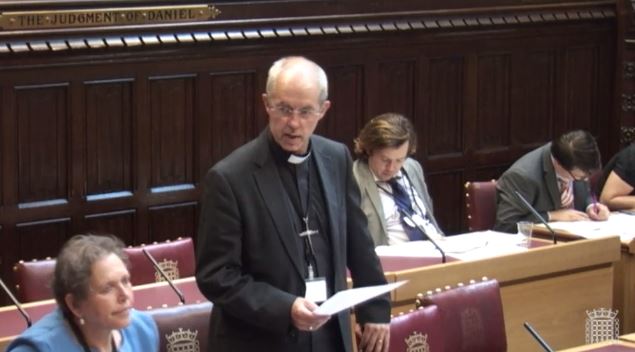
On Tuesday 7th June the Archbishop of Canterbury, the Most Revd and Rt Hon Justin Welby and the Bishop of Durham, the Rt Revd Paul Butler gave evidence to the Home Affairs Select Committee in the House of Commons. They were asked questions on the migrant crisis, asylum support, the EU and faith community relations. HASC160607

The full transcript is available below or can be watched here – The Works of the Immigration Directorates (Q1 2016)

Continue reading “Home Affairs Select Committee hears from Archbishop of Canterbury and Bishop of Durham – transcript”

Archbishop asks Government about peace-building and reconciliation in Burundi

On the 20th and 21st April 2016 the Archbishop of Canterbury, Most Revd and Rt Hon Justin Welby, received three written answers to questions he had tabled to Government about peace-building and reconciliation in Burundi. This followed his recent visit to the country.

Archbishop of CanterburyThe Lord Archbishop of Canterbury: To ask Her Majesty’s Government what steps they are taking to support the President of Tanzania, Benjamin Mkapa, in his efforts to mediate in Burundi.

Baroness Anelay of St Johns: The UK strongly supports the East African Community-led dialogue; it is crucial to finding a sustainable political solution in Burundi. We welcome their decision to appoint the former President of Tanzania, Benjamin Mkapa, as Facilitator of the Burundi Dialogue. Continue reading “Archbishop asks Government about peace-building and reconciliation in Burundi”

Archbishop calls on Government to do more for unaccompanied children at Calais ‘Jungle’ camp

On 1st March 2016  Baroness Sheehan asked Her Majesty’s Government “what views they have expressed to the government of France about the bulldozing of the south section of the Calais “Jungle” camp.” The Archbishop of Canterbury, Most Revd & Rt Hon Justin Welby, asked a follow up question:


Archbishop of CanterburyThe Archbishop of Canterbury: My Lords, while we would all agree that the situation is difficult for the French authorities, I am sure we also feel that it is significantly more difficult for the 300 unaccompanied children. I recently visited the Marsh Academy near Romney Marsh and saw a school and community fostering and caring with the utmost compassion for significant numbers of unaccompanied children. Given that example, does the Minister agree that issues of compassion should easily trump those of administrative efficiency and tidiness, and narrow definitions of family links, and that we should, therefore, take more children very quickly?
Continue reading “Archbishop calls on Government to do more for unaccompanied children at Calais ‘Jungle’ camp”

Archbishop – no right not to be offended by frank assertions about faith

On Wednesday 3rd February 2016 Lord Wallace of Saltaire asked Her Majesty’s Government “what progress has been made by the review into funding for extremist interpretations of Islam within the United Kingdom, including from overseas sources, announced by the Prime Minister on 2 December 2015 with the declared intention that it would report by the spring of 2016.” The Archbishop of Canterbury, Most Revd and Rt Hon Justin Welby, asked a follow up question:

Archbishop of CanterburyThe Archbishop of Canterbury: My Lords, it is widely agreed that all statements that tend towards causing hatred, contempt and violence towards other faiths should not be permitted, but does the Minister nevertheless agree that it is not extremist in any way, and should in fact be encouraged, for there to be statements that are frank and categorical assertions of faith or no faith, and that there is no right not to be offended or hurt by such statements? Continue reading “Archbishop – no right not to be offended by frank assertions about faith”

Archbishop of Canterbury speaks in Lords debate on action against ISIL in Syria

On the 2nd December 2015 the Archbishop of Canterbury, the Most Revd and Rt Hon. Justin Welby, spoke during the House of Lords debate on ISIL in Syria. The Archbishop’s speech is reproduced in full below and can be watched here. The Bishop of Coventry also spoke in the debate.

AbpCanterbury021215The Archbishop of Canterbury: My Lords, I add to the welcomes given to the noble Lord, Lord Hague of Richmond, and note his perfect timing in bringing his immeasurable wisdom and experience to our debates. I look forward very much to his contribution.

To my mind, the “just war” criteria have been met. However, while they are necessary, they are not by themselves sufficient in action of this kind, where we can end up doing the right thing in such a wrong way that it becomes the wrong thing. To my mind, there are three components that currently need more emphasis and are to some extent missing. In this role, through visiting all 38 provinces of the Anglican communion, through the constant contacts that we have with Muslim and Christian leaders in the region, as recently as three weeks ago in a conference at Lambeth Palace, I am constantly reminded that this is a global issue to which we are applying local solutions. Continue reading “Archbishop of Canterbury speaks in Lords debate on action against ISIL in Syria”