
Archbishop of Canterbury supports “second reserve power” amendment to Banking Reform Bill

“The amendment—and this is why the element of culture is so important—increases vastly the voltage of the ring-fence. If it has to be used, like much of these forms of regulation, it will have failed to some degree. But it says that, if the industry loses its way in ethics and culture, as it did in the early years of this century, there is catastrophe in regulatory terms.”

On 8th October 2013, the Archbishop of Canterbury, the Most Revd. and Rt Hon. Justin Welby, spoke on the first day of the Committee Stage of the Financial Services (Banking Reform) Bill. He spoke in support of Lord Turnbull’s amendment, based on the recommendation made by the Parliamentary Commission on Banking Standards, which sought to introduce a second reserve power to “implement full separation” of “the [banking] sector as a whole.” The Archbishop described the amendment as a rational extension to existing provisions. He stated that it would reinforce a change of culture and act as a permanent reminder to the banking industry of the danger of slipping back into previous norms of behaviour. The Government argued against the amendment, having previously rejected the Commission’s recommendation in its First Report. The amendment was subsequently withdrawn. 
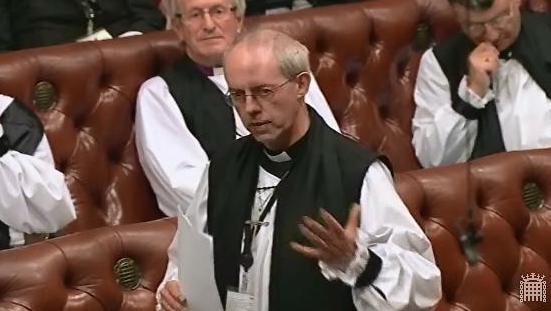
Archbishop of CanterburyThe Archbishop of Canterbury: My Lords, I apologise that I, too, was not here for Second Reading as I was at the funeral of a close friend. I speak as a member of the PCBS [Parliamentary Commission on Banking Standards], having had the privilege of a year of lessons from the other members, especially noble Lords here today, and the great pleasure of being rung up by the noble Lord, Lawson, quite frequently at weekends, to explain how I should think about a particular subject, which he has done with great eloquence as well today.

I agree entirely with the speeches made by the noble Lord, Lord Turnbull, twice, and both speeches by the noble Lord, Lord Lawson, which have put the position very clearly. It must be a very long time—and my experience of this House is very limited—since a solution to a major problem was put forward with such a noticeable lack of enthusiasm. Almost everyone who has spoken about the ring-fence has damned it with faint praise, to put it at its most polite. The noble Baroness, Lady Cohen, simply eliminated it quite quickly and very clearly. We are in danger of getting lost in looking at the regulation and forgetting what the regulation is trying to do. This is about a question of a culture and ethics, not detailed rules. We all remember Bob Diamond, the chief executive of Barclays, saying that culture is what happens when no one is looking. Continue reading “Archbishop of Canterbury supports “second reserve power” amendment to Banking Reform Bill”

Archbishop of Canterbury speaks during debate on use of chemical weapons in Syria

“In civil wars, those who are internal to the civil conflict fight for their lives, necessarily. Those who are external have a responsibility, if they get involved at all, to fight for the outcome. That outcome must be one that improves the chances of long-term peace and reconciliation.”

On 29th August 2013, the House of Lords was recalled to take note and debate the use of chemical weapons in Syria. The Archbishop of Canterbury, the Most Revd and Rt Hon. Justin Welby, spoke during the debate. He urged that all intermediate steps before opening fire should be taken and expressed concern that intervention from abroad would declare open season on Christian communities in the country and wider region, which have already been devastated. He argued that such a consequence needed to be balanced against the consequences of inaction and that intervention would have  to be effective in preventing any further use or promotion of chemical weapons and make it more possible for Syria and the Middle East to be places without millions of refugees.

Archbishop of CanterburyThe Archbishop of Canterbury: My Lords, I welcome very much the opportunity to speak later in this debate because of the extraordinary quality of many of the contributions that have been made and how much one can learn by listening to them. Like many noble Lords I have some experience in the region, partly from this role that I have and from recent visits and contact with many faith leaders of all three Abrahamic faiths, and through 10 years of, from time to time, working on reconciliation projects.

I do not intend to repeat the powerful points that have been made on international law, which is itself based on the Christian theory of just war. That has been said very eloquently. However, I want to pick up a couple of points. First, it has been said, quite rightly, that there is as much risk in inaction as there is in action. In a conflict in another part of the world—a civil conflict in which I was mediating some years ago—a general said to me, “We have to learn that there are intermediate steps between being in barracks and opening fire”. The reality is that, until we are sure that all those intermediate steps have been pursued, just war theory says that the step of opening fire is one that must only be taken when there is no possible alternative whatever under any circumstances. As the noble Lord, Lord Alli, just said very clearly and very eloquently, the consequences are totally out of our hands once it has started. Continue reading “Archbishop of Canterbury speaks during debate on use of chemical weapons in Syria”

Bishop of Birmingham speaks in debate on Banking Reform Bill

“I and my colleagues on these Benches trust that the industry will wholeheartedly embrace a professional standards process, with independent leadership and all the practical things that we will talk about in the next few minutes and days; and that step by step—with any necessary amendments to the Bill and a full adoption in the autumn of the parliamentary commission’s recommendations—we will all take responsibility for achieving a healthy, vigorous, profitable and accessible but virtuous banking system.”

On 24th July 2013, the Bishop of Birmingham, the Rt Revd David Urquhart, took part in the Second Reading debate of the Government’s Financial Services (Banking Reform) Bill. He welcomed the practical themes in the bill and the opportunity it provided to develop structures with a new culture that would enable the common good to develop in society.

01.04.14 Bishop of BirminghamThe Lord Bishop of Birmingham: My Lords, I am grateful to the noble Lord, Lord Eatwell, for his kind remarks about members of the banking commission who sit in this House, not least my friend the most reverend Primate the Archbishop of Canterbury, who, sadly, is not in his place today but fully intends to be so many times in the autumn when the commission’s work will be discussed in this House in more detail. Perhaps I can partially stand in his place as we spent many years in different parts of the oil industry before entering another sort of multinational work.

We appreciate the practical themes in the Financial Services (Banking Reform) Bill and the opportunity that it provides to implement the recommendations of the Vickers report and, more recently, of the Parliamentary Commission on Banking Standards. As the Community Investment Coalition put it, the Bill provides an opportunity,

“for Britain to continue as a leading global financial centre, while at the same time protecting ordinary working people”.

I thought that that conveyed rather well the complexity of the issues with which we are dealing. Continue reading “Bishop of Birmingham speaks in debate on Banking Reform Bill”

Vote – Marriage (Same Sex Couples) Bill

On 4th June 2013, nine bishops took part in a division during the Second Reading debate of the Government’s Marriage (Same Sex Couples) Bill. 

House of Lords Division Lobby

Crossbench Peer Lord Dear moved, as an amendment to the motion that the bill be now read a second time, to leave out from “that” to the end and insert “this House declines to give the bill a second reading”.

Nine bishops voted “content” with Lord Dear’s amendment. They were: the Archbishop of Canterbury, and the Bishops of Birmingham, Bristol, Chester, Coventry, Exeter, Hereford, London and Winchester. A further five bishops attended but abstained from the vote. No bishops voted “not content.”

There were: Contents: 148 | Not Contents: 390 | Result: Government Win

(via Parliament.uk)

Marriage (Same Sex Couples) Bill – Archbishop of Canterbury’s speech in the Lords

On 3rd June 2013 the House of Lords considered the Government’s Marriage (Same Sex Couples) Bill at its Second Reading. The Archbishop of Canterbury, Most Revd & Rt Hon Justin Welby, spoke in the debate and his remarks are below, with extracts from speeches made by Peers where reference is made.

Archbishop of CanterburyThe Archbishop of Canterbury: My Lords, the initial proposals published at the end of the autumn have needed much work to get them into today’s form. Much of that work has been done through detailed legal effort and discussion. I am deeply grateful to the DCMS teams and especially to the Secretary of State for the thoughtful way in which she has listened and the degree to which she has been willing to make changes in order to arrive at the stage we have reached today. Continue reading “Marriage (Same Sex Couples) Bill – Archbishop of Canterbury’s speech in the Lords”