On 8th January 2015 the Bishop of Chester, Rt Rev Peter Forster, asked an oral question on importing electricity.
Continue reading “Bishop of Chester asks Government about electricity imports”

On 8th January 2015 the Bishop of Chester, Rt Rev Peter Forster, asked an oral question on importing electricity.
Continue reading “Bishop of Chester asks Government about electricity imports”
On 16th December 2014, Lord Hoyle asked Her Majesty’s Government whether they have any plans to reintroduce a dog licensing fee. The Bishop of Chester, the Rt Revd Peter Forster, asked a supplementary question:
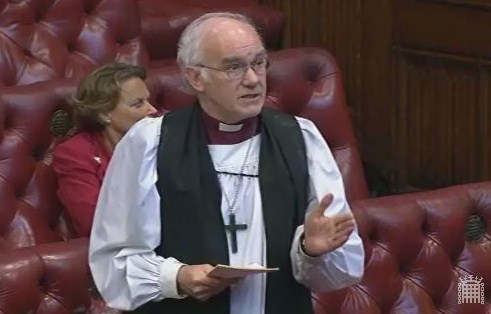 The Lord Bishop of Chester: My Lords, I am one of those who wear a dog collar in this House—and for the privilege of doing so I have to be licensed. But as far as I am aware, no fees have been paid. Might I suggest that enough is enough?
Lord Mackenzie of Framwellgate (Non-Afl): My Lords, the right reverend Prelate has stolen my thunder, in a sense. I was going to ask: because of the increasing number of dangerous dog incidents, would it not be worth having a look at licensing the owners? Continue reading “Bishop of Chester speaks during question time on dog licensing”

On 9th December 2014, four bishops took part in divisions on the Government’s Criminal Justice and Courts Bill, during ‘ping-pong’ between the House of Lords and the House of Commons. The amendments dealt with secure colleges and judicial review. Bishops previously voted in favour of amendments on judicial review, and details can be found here.
Continue reading “Criminal Justice and Courts Bill – Divisions”
On 9th December 2014, Lord Alton of Liverpool asked Her Majesty’s Government, following the decision of the High Court that the consultation on mesothelioma legal fees was unlawful, and the lack of new funding for mesothelioma research, what is their policy with regard to combating mesothelioma and supporting victims. The Bishop of Chester, the Rt Revd Peter Forster, asked a supplementary question:
The Lord Bishop of Chester: My Lords, I encourage the Minister to answer the first part of the Question asked by the noble Lord, Lord Alton, about why the percentage of the precept was reduced from the promised 3% to 2.2%.On 10th November 2014, the Bishop of Chester, the Rt Revd Peter Forster, took part in the Report Stage of the Government’s Infrastructure Bill. He asked the Minister a number of questions regarding the UK’s carbon reduction commitment, carbon capture by power stations, and the UK’s strategy for oil and gas extraction. The amendments that the Bishop spoke to were withdrawn following the brief debate.
The Lord Bishop of Chester: My Lords, can I ask the Minister when she responds to comment on two points? First, if we are now to be committed in this legally strengthened way to the maximum economic exploration of our oil and gas reserves, how do the Government see that to be compatible with the commitment under the Climate Change Act to reduce our emissions to only 20% of the 1990 level by 2050 without also having a strategy for carbon capture and storage, which I think lies behind the amendment?
Secondly, the amendment refers to the economic extraction of our hydrocarbons—I have never yet heard any reliable estimate of what the additional cost will be of having carbon capture and storage on a typical power station, be it a coal station or a gas station. What level of increase per kilowatt hour—in a unit that can be easily understood—is anticipated if carbon capture and storage is required on such stations? That impacts on what is economically recoverable. Continue reading “Bishop of Chester presses Government on carbon capture during Infrastructure Bill debate”
“To regard the English-Scottish relationship as simply the primary and maximal example of broader devolved relationships in the UK would be to invite a repetition of recent errors of judgment.”
On 29th October 2014, the Bishop of Chester, the Rt Revd Peter Forster, took part in a House of Lords debate on devolution following the Scottish referendum, led by Baroness Stowell of Beeston. The Bishop reflected on his own experiences of studying and living in Scotland, and the relationship between England and Scotland. He urged caution in how politicians and the public approach matters of devolution and nationhood, noting that the post-referendum landscape was a good opportunity to renew the Union, whilst respecting cultural differences and political realities.
The Lord Bishop of Chester: My Lords, bishops need to tread warily when discussing matters Scottish. Although I am thoroughly English by birth and background, I can, I think, claim rather closer connections with Scotland than some whom I observe wearing the kilt at the Chester Caledonian Association dinners which I regularly attend.
Let me explain. I have a Scottish wife—my one and only wife, I hasten to add—and two Scottish degrees, all three from Edinburgh. I trained for ordination in Scotland as somebody sponsored by the Scottish Episcopal Church, and I have owned a house in Scotland for 25 years and will happily retire there in a few years’ time. I am Anglican co-chair of the current Church of England-Church of Scotland ecumenical conversations. So tread I shall, if nevertheless warily. If I have learnt one thing in my discussions with the Church of Scotland, it is that were the Kirk ever to contemplate having bishops, which remains, I think, doubtful, they would need to be very different from English bishops to be acceptable. Continue reading “Bishop of Chester takes part in debate on devolution and the Scottish referendum”
On 28th July 2014, two bishops took part in a division of the House of Lords on Crossbench Peer Baroness Boothroyd’s Motion to Regret on the role of the Leader of the House of Lords.
Baroness Boothroyd moved that this House welcomes the appointment of Baroness Stowell of Beeston as Leader of the House of Lords, but regrets the decision of the Prime Minister to diminish the standing of the House by failing to make her a full member of the Cabinet; and requests that the Prime Minister reconsiders this decision.
The Bishop of Chester, the Rt Revd Peter Forster (who also spoke during the debate) and the Bishop of Sheffield, the Rt Revd Steven Croft, voted ‘content’ with the motion. No bishop voted ‘not content’.
There were: Contents: 177 | Not Contents: 29 | Result: Government Defeat
(via Parliament.uk)
On 28th July 2014, former speaker of the House of Commons, and Crossbench Peer the Rt Hon. the Baroness Boothroyd, moved a Motion to Regret in the House of Lords. The Motion stated:
That this House welcomes the appointment of Baroness Stowell of Beeston as Leader of the House of Lords, but regrets the decision of the Prime Minister to diminish the standing of the House by failing to make her a full member of the Cabinet; and requests that the Prime Minister reconsiders this decision.
The Bishop of Chester, the Rt Revd Peter Forster, took part in the debate on the motion. He spoke of the way in which power is distributed throughout the contemporary political system and how this distribution of power may need to be reconsidered if the public are to be re-engaged with the political process.
The Lord Bishop of Chester: My Lords, I want to associate these Benches fully with both sides of the Motion; first, the welcome to the noble Baroness in her role as Leader of the House and, secondly, the regrets that have been expressed already in our debate. Rather than focus on the details, I shall make a few comments about the wider symbolic significance of these events. A healthy society distributes power. The banking crisis arose partly because power got too concentrated in certain institutions and in a certain section of the financial community. Government, if it is about nothing else, is about the exercise of power. We have to accept and acknowledge that, and not try to deny it. The exercise of power calls for clear leadership, which is right, too. Continue reading “Bishop of Chester speaks during debate on constitutional role of Leader of the House of Lords”
On 28th July 2014, the Bishop of Chester, the Rt Revd Peter Forster, took part in a short debate in the House of Lords on the Government’s response to the Farrell Review of architecture and the built environment. He supported the relaxing of planning laws, to enable people to have a greater say in the built environment in which they live. He also argued that architects should play a more significant role in issues of planning, cautioning that houses built in the past 20 years risked becoming the slums of the future.
The Lord Bishop of Chester: My Lords, reference to the Tower of Babel earlier stimulated me to speak in the gap, and I believe that there is time to do so. Skyscrapers are quite ambiguous—they work in some places but not in others. Why does the Shard work but the Cheesegrater look completely out of place? Maybe that is just my own subjective judgment. Why do some cities that have no need of skyscrapers feel they want them? Some cities in Australia that have all the space they could possibly want still have an instinct to build skyscrapers. It indicates how important the environment is for us. We see no skyscrapers in Paris or Rome. The urban planners there do not allow them. Continue reading “Bishop of Chester highlights impact of built environment on well-being of society”
On 21st July 2014, the Bishop of Chester, the Rt Revd Peter Forster, spoke during the Committee Stage of the Criminal Justice and Courts Bill. He spoke in support of an amendment to make assault on workers selling alcohol a specific criminal offence. Following the debate on the amendment, it was withdrawn without being put to a division of the House.
The Lord Bishop of Chester: My Lords, I have considerable sympathy for the amendment, although I wonder how it will interact with the remainder of the law on assault if this is criminalised in a specific way. I declare an interest in that I used to be a publican. When I was employed in a university, one of the members of staff had to go down to the magistrates’ court and swear that they were a fit person to keep order. That is the only time when I have been into a court of law in my life, and the magistrates were not quite sure that this young clergyman would be able to do so. My main task was to prevent the students drinking the profits rather than sorting out any brawls. Continue reading “Bishop of Chester supports amendment to Criminal Justice and Courts Bill”
 The Church of England in Parliament
You must be logged in to post a comment.