
 On 21st March the House of Lords considered the Government’s Immigration Bill at Report Stage. Labour Peer Lord Dubs tabled an amendment to require the Secretary of State to make arrangements for relocating 3,000 unaccompanied refugee children to the UK, from other countries in Europe. The Bishop of Chelmsford, the Rt Revd Stephen Cottrell, co-sponsored the amendment, speaking and voting in support. In the subsequent Division the amendment was agreed by 306 votes to 204.
Continue reading “Immigration Bill: Bishop of Chelmsford supports amendment to provide for unaccompanied refugee children”
Tag: children
Bishop of Worcester speaks on importance of maternal care and calls for extension of married couples’ tax allowance
On 17th March 2016 the Earl of Dundee led a short debate “To ask Her Majesty’s Government what steps they are taking to promote ongoing maternal care for children.” The Bishop of Worcester, Rt Revd John Inge, spoke in the debate:
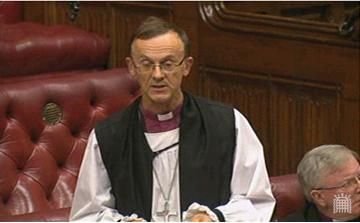 The Lord Bishop of Worcester: My Lords, I am also grateful to the noble Earl for securing this debate because I am utterly convinced about the importance of ongoing maternal care for children. I speak as the father of two adopted children. I have learned through experience and study how crucial is the relationship that children have with their mother. It is an essential and defining part of the process of perinatal life that a bond is formed between child and mother, regardless of the latter’s conscious attitude towards her baby. Continue reading “Bishop of Worcester speaks on importance of maternal care and calls for extension of married couples’ tax allowance”
Bishop of Durham calls on Government to speed up reception of unaccompanied refugee children
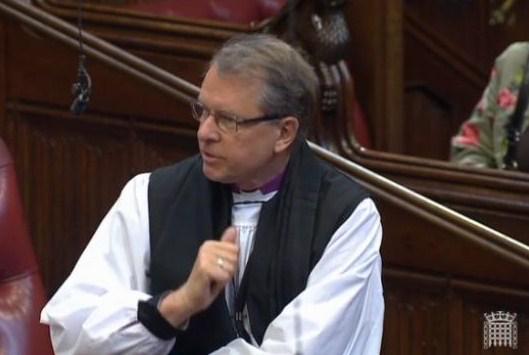 On 16th March 2016 Lord Ashdown of Norton-sub-Hamdon asked Her Majesty’s Government “what is their assessment of the current refugee crisis in Europe in the light of the regional election results in Germany that indicate gains for the anti-migrant Alternative für Deutschland party.” The Bishop of Durham, Rt Revd Paul Butler, asked a follow up question:
The Lord Bishop of Durham: My Lords, does the Minister support the speeding-up of the reception of unaccompanied minors who have a family reunification right to come to this country? Will the Government explore further reunifications and accepting more unaccompanied minors into this country?
Archbishop calls on Government to do more for unaccompanied children at Calais ‘Jungle’ camp
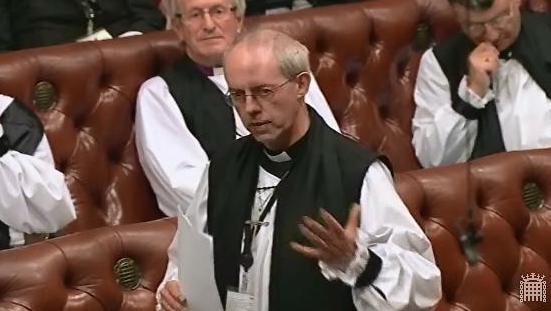
On 1st March 2016 Baroness Sheehan asked Her Majesty’s Government “what views they have expressed to the government of France about the bulldozing of the south section of the Calais “Jungle” camp.” The Archbishop of Canterbury, Most Revd & Rt Hon Justin Welby, asked a follow up question:
 The Archbishop of Canterbury: My Lords, while we would all agree that the situation is difficult for the French authorities, I am sure we also feel that it is significantly more difficult for the 300 unaccompanied children. I recently visited the Marsh Academy near Romney Marsh and saw a school and community fostering and caring with the utmost compassion for significant numbers of unaccompanied children. Given that example, does the Minister agree that issues of compassion should easily trump those of administrative efficiency and tidiness, and narrow definitions of family links, and that we should, therefore, take more children very quickly?
Continue reading “Archbishop calls on Government to do more for unaccompanied children at Calais ‘Jungle’ camp”
Bishop of Rochester asks about unaccompanied refugee children
On 8th February 2016, Lord Roberts of Llandudno asked the government “what action they are taking to relieve the situation of unaccompanied refugee children.” The Bishop of Rochester, the Rt Revd James Langstaff, asked a follow up question.
 The Lord Bishop of Rochester: My Lords, as one of the bishops from Kent, may I take the Minister back to his previous answer? In fact, some 1,300 unaccompanied refugee children are housed in Kent, and the local authorities and the voluntary agencies are under very significant pressure. May I push him a little as to whether, in the light of the somewhat unencouraging response from other local authorities, Her Majesty’s Government intend to do anything else to ensure a more effective national dispersal programme—given that we are talking not just about this moment, but about the likely 10 years that will be needed to get a young person from the point of arrival to full integration, with all the work in education, language and healthcare needed to go with that, and the considerable investment required? Some assurance would help my colleagues in Kent. Continue reading “Bishop of Rochester asks about unaccompanied refugee children”
Immigration Bill: Bishop of Norwich supports amendments on welfare of child refugees
On the 3rd February 2016 the House of Lords considered the Government’s Immigration Bill in committee. The Bishop of Norwich, Rt Revd Graham James, spoke in support of an amendment to clause 34 of the Bill, related to appeals and certification of human rights claims. The Bishop spoke about the need for the new legislation to better identify and protect childrens’ best interests.
 The Lord Bishop of Norwich: My Lords, I rise from these Benches to support Amendment 227 in the name of the noble Lord, Lord Rosser, and others.
The briefing note on Clause 34 to which the noble Baroness, Lady Lister, referred is a model of clarity. It was certainly very informative to me. It made clear, as the noble Baroness said, the statutory duty on the Secretary of State,
“to have regard to the need to safeguard and promote the welfare of any child in the UK who … may be affected by any immigration decision”—
that duty is not in doubt—and that,
“the best interests of the child are a primary consideration”.
While I understand that a primary consideration may not be the only one, I do not understand how a primary consideration can be set aside even if it is in some way qualified. If it is trumped by other factors, it does not seem to be a primary consideration. So there must be a risk that Clause 34 unamended could undermine the Secretary of State’s statutory duty. Continue reading “Immigration Bill: Bishop of Norwich supports amendments on welfare of child refugees”
Bishop of Chelmsford supports Bill to raise age of criminal responsibility
On 29th January 2016 the House of Lords debated at Second Reading the Age of Criminal Responsibility Bill – a Private Member’s Bill introduced by Liberal Democrat Peer Lord Dholakia. The Bishop of Chelmsford, Rt Revd Stephen Cottrell, spoke in the debate, supporting the objective of the Bill to raise the age of criminal responsibility from 10 to 12 years. The Bill was given a Second Reading and proceeded to its next parliamentary stage.
 The Lord Bishop of Chelmsford: My Lords, in rising to support the noble Lord, Lord Dholakia—and, indeed, pledging the support of the church to this campaign—I need to declare an interest: I was a child once and got into some scrapes. Now I am a parent and in the work I do hardly a week goes by when I am not in schools. Indeed, last year I had the sad but very moving honour of opening a garden of remembrance in the diocese where I serve in east London for young people who were the victims of, indeed had been killed by, knife crime. So I do not underestimate the seriousness of the crimes that we are talking about, nor the fact that children and young people do commit them. Continue reading “Bishop of Chelmsford supports Bill to raise age of criminal responsibility”
Welfare Reform Bill: Bishop of Durham supports 2 child limit exemptions
On 27th January 2016 the Bishop of Portsmouth, the Rt Revd Christopher Foster, proposed an amendment at Report Stage to the Government’s Welfare Reform and Work Bill. The amendment, supported by Labour, Liberal Democrat and Crossbench Peers, set out exemptions from the two-child limit for new claimants of tax credit and universal credit for kinship carers, bereaved parents, those fleeing domestic violence and disabled children. The Bishop of Durham supported the amendment and his speech is below. During his response to the amendment the Minister Lord Freud offered a number of concessions, most notably on kinship carers, and as a result the amendment was not put to a vote.
The Lord Bishop of Durham: My Lords, I would like to tell two stories that illustrate why I believe two of these exemptions are important. A good friend of mine and his wife were unable to have children, and they put themselves forward as adoptive parents. They went through the rigorous process—this was a few years ago—and with great pride entered a room with several of us who had our own children and presented a piece of paper that said, “I have been authorised to become a parent in a way that none of you ever have”. Continue reading “Welfare Reform Bill: Bishop of Durham supports 2 child limit exemptions”
Welfare Reform Bill: Bishop of Portsmouth proposes exceptions to the two child limit
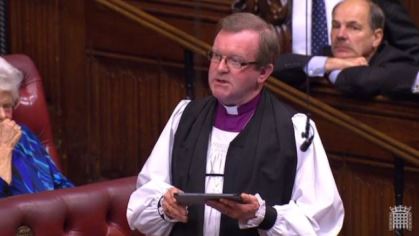 On 27th January 2016 the Bishop of Portsmouth, the Rt Revd Christopher Foster opened the second day of Report Stage on the Government’s Welfare Reform and Work Bill with an amendment in his name. The amendment, supported by Labour, Liberal Democrat and Crossbench Peers, proposed exemptions from the two-child limit for new claimants of tax credit and universal credit for kinship carers, bereaved parents, those fleeing domestic violence and disabled children. During his response to the amendment the Minister Lord Freud offered a number of concessions, most notably on kinship carers, and as a result the Bishop did not press the amendment to a vote. A full transcript of the Bishop’s opening and closing remarks, the Minister’s response and an intervention from the Bishop of Durham, are below.
Church Commissioner’s speech in MPs debate on regulating out-of-school education settings
On the 20th January 2016 Sir Edward Leigh, MP for Gainsborough, hosted a Commons debate on the regulation of out-of-school education settings. The Rt Hon Caroline Spelman, the Second Church Estates Commissioner, spoke twice during the debate, urging a more proportionate policy in order to avoid unintended consequences. The Minister for Schools Mr Nick Gibb responded to the debate for the Government and his remarks are included below.
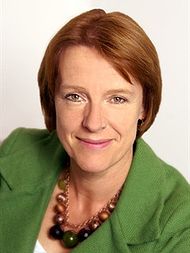 Mrs Caroline Spelman (Meriden) (Con): Like, I am sure, many others present, I have had to go through the process of a Criminal Records Bureau check, which is now a Disclosure and Barring Service check. Does my hon. Friend agree that it is an important butonerous process? Sometimes, one has to be checked more than once, because it does not transfer to another activity that one might undertake with children if one is foolish enough to do a full weekend with the Sunday school. It is a very rigorous process, and if it was applied to the people who teach children Islam in all teaching environments, it would be a very good tool to deal with any excess problem that there might be.
Sir Edward Leigh: I agree with my right hon. Friend. We should be using DBS checks if, for instance, people are trying to teach extremism, jihadism or whatever in an out-of-school setting or at home. We should use intelligence and existing powers to deal with the problem, not try to take a great sledgehammer to crack a nut. Continue reading “Church Commissioner’s speech in MPs debate on regulating out-of-school education settings”
 The Church of England in Parliament
You must be logged in to post a comment.