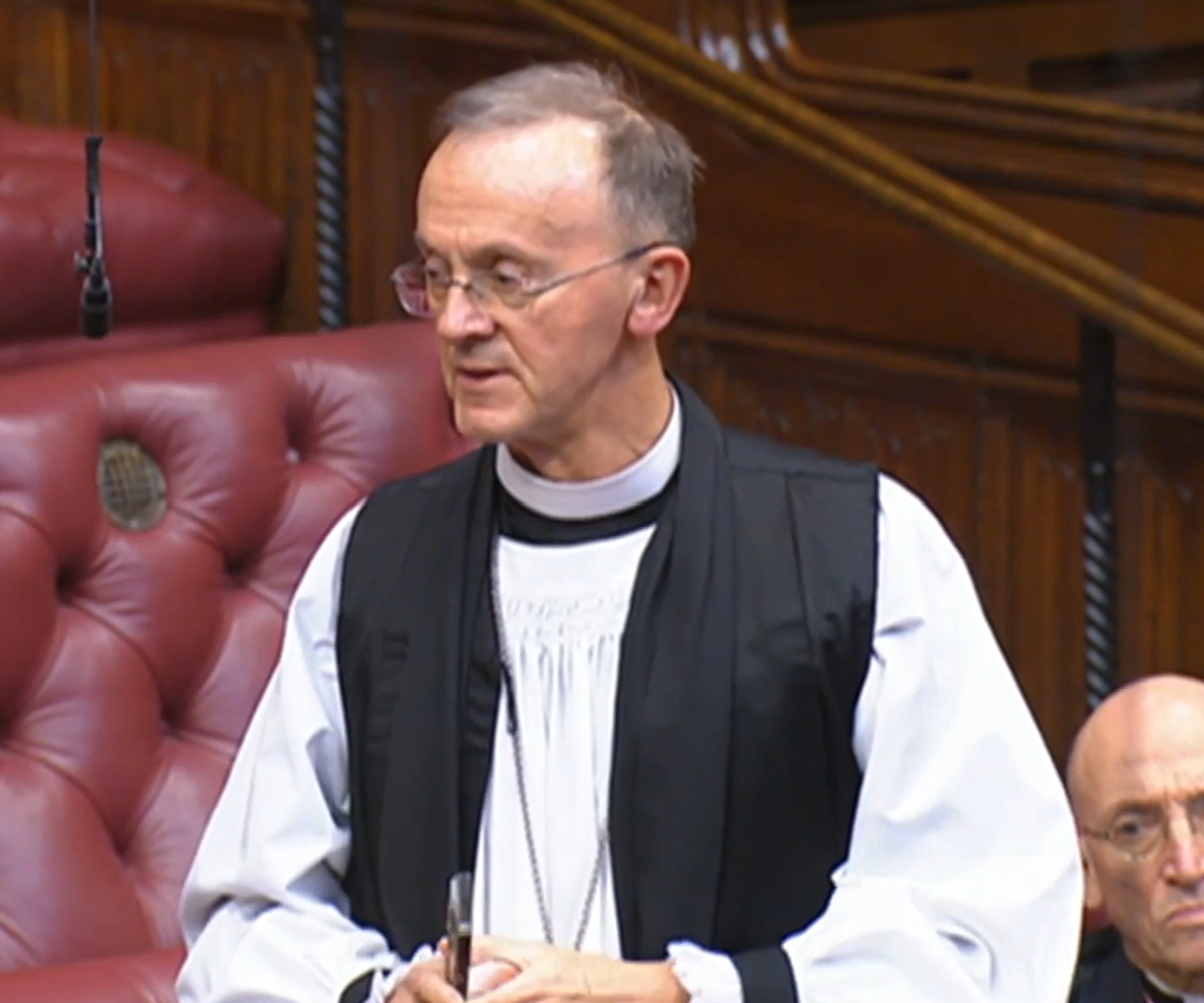
Bishop of Lincoln asks about impact of debt and mental ill-health on social mobility

The Bishop of Lincoln received the following written answer on 19th September 2025:

The Lord Bishop of Lincoln asked His Majesty’s Government what assessment they have made of the report Drowning in debt, published by Christians Against Poverty in July, and in particular its findings on the impact of debt cases and associated mental ill-health on social mobility.

Continue reading “Bishop of Lincoln asks about impact of debt and mental ill-health on social mobility”

Bishop of Leicester asks about engagement with work on debt cancellation

The Bishop of Leicester asked a question about the Jubilee 2000 Campaign on 17th July 2025, during a wider discussion on debt relief and cancelling international debt:

The Lord Bishop of Leicester: My Lords, this year marks the 25th anniversary of the Jubilee 2000 campaign—a remarkable coming together of tens of millions of people from around the world, which led to around $130 billion of debt being cancelled across 36 countries. It allowed those countries to reinvest in education, healthcare and poverty alleviation. The Pope has also declared this year a year of Jubilee and set up a commission to look at international debt relief. What are the Government doing to learn from the Jubilee 2000 campaign and to engage with faith communities and charities working in this sector?

Continue reading “Bishop of Leicester asks about engagement with work on debt cancellation”

Bishop of St Albans asks about debt advisory services

The Bishop of St Albans received the following written answer on 14th May 2025:

The Lord Bishop of St Albans asked His Majesty’s Government,

  • following the publication of polling data on 11 April by Christians Against Poverty, Employment and financial difficulty, what assessment they have made of the levels of problem debt among full-time workers, and what measures they are taking to support full-time workers who are in financial difficulty
  • following the publication of polling data on 11 April by Christians Against Poverty, In-person debt advice, what plans they have to address the scale of problem debt.
  • following the publication of polling data on 11 April by Christians Against Poverty, In-person debt advice, what steps they are taking to expand access to and fund free debt advice services authorised by the Financial Conduct Authority.
Continue reading “Bishop of St Albans asks about debt advisory services”

Bishop of Sheffield asks about international debt and development

The Bishop of Sheffield received the following written answers on 2nd December 2024:

The Lord Bishop of Sheffield asked His Majesty’s Government what steps they are taking to ensure that the Official Development Assistance budget for 2025–26 is spent on development overseas rather than on in-donor refugee support expenses.

Continue reading “Bishop of Sheffield asks about international debt and development”

Bishop of St Albans asks about poverty and debt

The Bishop of St Albans received the following written answers on 24th October 2024:

The Lord Bishop of St Albans asked His Majesty’s Government, with regard to the finding in the Christians Against Poverty report Under the rubble of debt and poverty, published in May, that 59 per cent of their new clients had incomes below the poverty line, what steps they will take to reduce the number of individuals living below this threshold.

Baroness Sherlock (Lab, DWP): This government is committed to tackling poverty.

Continue reading “Bishop of St Albans asks about poverty and debt”

King’s Speech Debate: Bishop of Worcester makes valedictory speech on the topic of international development

The Bishop of Worcester gave his valedictory speech on issues facing the field of international development, in particular the problem of debt, during the Kings Speech Debate on 25th July 2024:

The Lord Bishop of Worcester: My Lords, I join others in welcoming the Ministers to the Front Bench and begin this valedictory speech by saying what a privilege it has been to serve in your Lordships’ House for the last 12 years. I thank all noble Lords and staff on the estate for all they do and their hard work.

After my maiden speech, a fellow Peer asked me how it had gone. “Oh, they were very nice and kind”, I responded. “Yes”, he retorted; “I have never known a place where courtesy is used as such an effective weapon”. I have experienced much unweaponised courtesy and civility here. I have consistently encountered humanity at its best, and I thank your Lordships, whatever their political affiliation, for their impressive devotion to the common good.

In this final intervention, I will concentrate my brief remarks on development issues, which have been a passion of mine throughout my adult life. While I recognise the imperative for defence spending and the need to be ready for war, I hope that the Government will pay equal attention to development, which is an indispensable contributor to peace and human flourishing.

Continue reading “King’s Speech Debate: Bishop of Worcester makes valedictory speech on the topic of international development”

Bishop of Southwark asks about regulation of identity tracing agencies used in debt recovery

The Bishop of Southwark received the following written answer on 9th May 2024:

The Lord Bishop of Southwark asked His Majesty’s Government what plans they have to regulate identity tracing agencies in relation to the recovery of debt.

Baroness Vere of Norbiton (Con, Treasury): The Government wants to see fair treatment of individuals in problem debt, and there is a range of work underway across government and regulators to promote responsible practices for debt recovery.

Continue reading “Bishop of Southwark asks about regulation of identity tracing agencies used in debt recovery”

Bishop of St Albans asks about higher education finances

The Bishop of St Albans received the following written answer on 15th April 2024:

The Lord Bishop of St Albans asked His Majesty’s Government:

  • what assessment they have made of the PwC report UK Higher Education Financial Sustainability Report, published in January.
  • what plans they have to support universities who are facing bankruptcy.
  • what assessment they have made of the levels of debt in UK universities.
Continue reading “Bishop of St Albans asks about higher education finances”

Bishop of Leicester asks about overseas debt management

The Bishop of Leicester asked a question on support for a joined up approach across government, civil society, charities & faith institutions to support lower and middle income countries in management of debt on 12th March 2024:

The Lord Bishop of Leicester: My Lords, as a country we carry a weighty moral debt to many low and middle-income countries, given our history. This moral debt is borne by business as well as government, and indeed by charities and faith institutions. Will the Government revisit the International Development Committee’s report on debt relief and the evidence supplied by the Jubilee Debt Campaign and Make Poverty History, to consider again how all sectors may work together to ensure a joined-up approach to supporting these countries?

Continue reading “Bishop of Leicester asks about overseas debt management”

Bishop of Leicester calls for reconsideration of debt to help developing nations combat climate change

The Bishop of Leicester spoke in a debate on the impact of climate change on developing nations on 11th January 2024, highlighting the relationship between debt and dealing with climate change:

The Lord Bishop of Leicester: My Lords, I too am grateful to the noble Baroness, Lady Northover, for the opportunity to debate this hugely significant subject. I too am looking forward to the maiden speech by my right reverend friend the Bishop of Winchester, who has real expertise in this area.

When it comes to thinking about the impact of climate change on developing nations, the injustices at play are twofold. First is the fact that those nations that are being and will yet be most affected by climate change are those that have contributed least to the crisis. Secondly, much of the funds that fuelled our Industrial Revolution, wherein were sown the seeds of climate change, were generated by extracting and exploiting the resources of many of those regions, most devastatingly, of course, through the transatlantic chattel slave trade.

Our moral debt is as great as the climate emergency we face, so I was pleased to see that the Government’s international development White Paper, published in November, included “tackling climate change” in its title. I was also most encouraged to read the Government advocating for a move away from donor-recipient models of aid towards partnerships built on mutual respect, putting greater value on the voice, perspectives and needs of developing nations, as well as supporting local leadership. The paper hearteningly states:

“We will engage with humility and acknowledge our past”.

Continue reading “Bishop of Leicester calls for reconsideration of debt to help developing nations combat climate change”