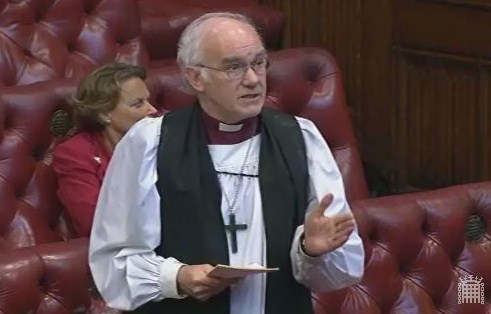
Bishop of St Albans receives written answers on financial education

On 16th June 2014, the Bishop of St Albans, the Rt Revd Alan Smith, received answers to two written questions on financial education.


Bishop of St AlbansFinancial Services: Education

The Lord Bishop of St Albans: To ask Her Majesty’s Government how they intend to ensure that financial education is taught, to a high standard, in non-state-maintained secondary schools.

The Parliamentary Under-Secretary of State for Schools (Lord Nash): Independent Schools in England do not have to follow the national curriculum, though they do have to have a curriculum which gives pupils experience in linguistic, mathematical, scientific, technological, human and social, physical and aesthetic and creative education.

We will shortly be consulting on strengthening the standards which independent schools must meet, but there are no plans to introduce a requirement on financial education.

Continue reading “Bishop of St Albans receives written answers on financial education”

Birmingham schools inspections – Bishop of Norwich on impact of religious education

In the House of Lords on 9th June 2014 the schools minister Lord Nash repeated the Statement made by the Secretary of State for Education on schools in Birmingham. After the Statement, the Bishop of Norwich, Rt Rev Graham James, asked a question of the minister:

The Lord Bishop of Norwich: My Lords, the Minister may not be aware that earlier this afternoon in his maiden speech, the right reverend Prelate the Bishop of Chelmsford said that good religious education is one of the best ways of countering religious extremism. I would be interested to know whether the Minister agrees. Given that none of the schools subject to these inspections in Birmingham were faith schools—although listening to our discussion, you would have thought otherwise—does it not seem that appropriate, well balanced and enriching religious education may have been an area of neglect? Continue reading “Birmingham schools inspections – Bishop of Norwich on impact of religious education”

Ethos and education: the Bishop of Chelmsford makes maiden speech in House of Lords

“…it is impossible to understand and inhabit the modern world, especially in east London, without a critical appreciation of faith and, even more than that, a mature spiritual, moral, social and cultural worldview. Moreover, good religious education has been shown to be one of the best ways of countering religious extremism” – Bishop of Chelmsford, 9/6/14

14.06.09 Chelmsford 2

The Bishop of Chelmsford, Rt Rev Stephen Cottrell, made his maiden speech on 9th June 2014, during the debate on the Queen’s Speech. He spoke of the importance of religious education and the positive role played by church schools. He also welcomed Government proposals in the Queen’s Speech for tackling the emotional abuse of children. The speech can also be watched on Parliament Live TV.

The Lord Bishop of Chelmsford (Maiden Speech): My Lords, I think that the correct medical term for my condition is imposter syndrome. I have suffered from that for a long time. How could a boy from Southend who was not brought up going to church and who, aged 11, fell the wrong side of the line and went to a secondary modern school end up sitting on these red Benches and speaking in this House? Because of this, I want to say something today about the place of education in the life of our nation. Continue reading “Ethos and education: the Bishop of Chelmsford makes maiden speech in House of Lords”

Bishop of Norwich calls for greater co-ordination between schools and NHS to support young carers

Baroness Wheeler asked Her Majesty’s Government how they will ensure Clinical Commissioning Groups’ strategies and implementation plans support carers and take account of their needs and aspirations.

The Bishop of Norwich asked a supplementary question:

The Lord Bishop of Norwich: My Lords, the census revealed a substantial increase in young carers, some of whom may not even recognise the term but are simply doing what is expected in their family. Does the Minister agree that CCGs should consult and connect with schools to ensure that those noble but often vulnerable young adults get the support they deserve?
Earl Howe: I fully agree with the right reverend Prelate. The Government’s carers strategy sends out a strong message that education, health and young carer services should work together with families better to identify and support young carers, to prevent them taking on harmful caring roles. Young carers’ education, development or employment opportunities should not be diminished because of their caring role, and the right reverend Prelate may like to note that one of the initiatives recently put in train has been to recruit school nurses who are reaching out to schools to ensure that young carers’ needs are recognised in schools.

(via Parliament.uk)

Free Schools – independent or interdependent? Question from Bishop of Oxford

In the House of Lords on 14th May 2014, Baroness Jones of Whitchurch asked Her Majesty’s Government “what early intervention measures they are putting in place to reduce the educational and financial implications of failing free schools.” The Bishop of Oxford, who chairs the Church of England’s Board of Education, asked a supplementary question:

Bishop of Oxford

The Lord Bishop of Oxford: My Lords, given that prevention is better than costly cure, can the Minister let us know what is being done to make sure that free schools are established as groups of interdependent schools, rather than independent and autonomous units? Can he let us know how what we have learnt from the academies programme—that we need to get schools grouped together in multi-academy trusts—is being transferred to free schools?

Lord Nash: The right reverend Prelate makes an extremely good point. Although it is true that a number of outstanding schools have been established entirely independently, the way forward is the school-to-school support model, with schools operating in local clusters and secondaries working with their primaries. We are taking this learning, which has been very successful in the academy movement, into the free schools movement.

(via Parliament.uk)

Apprenticeships – Written Questions

On 6th May 2014, the Rt Revd Alan Smith, Bishop of St Albans, recieved answers to two written questions on the subject of apprenticeships.

14.03 Bishop of St AlbansThe Lord Bishop of St Albans: To ask Her Majesty’s Government what percentage of apprentices enter into employment with the company to which they were apprenticed after their apprenticeship scheme has finished.

Lord Ahmad of Wimbledon (Con): We publish information on learning outcomes on the Further Education Choices website to help better inform learner choices. This website presents information on learner outcomes with any employer as well as other destinations:

http://fechoices.skillsfundingagency.bis.gov.uk

Continue reading “Apprenticeships – Written Questions”

Bishop of Oxford announces retirement

11.12.15 Bishop of Oxford11th April 2014: The Diocese of Oxford has announced that Rt Rev John Pritchard will retire as Bishop of Oxford on 31st October this year. Bishop John, who chairs the Church of England’s Board of Education and leads for the Bishops in the House of Lords on education & church schools, will also cease to be a member of the Lords on that date. Continue reading “Bishop of Oxford announces retirement”

Apprenticeships and Professional Registration- Written Question

On 9th April 2014 the Bishop of St Albans received an answer to a written question on apprenticeships:

Question Asked by The Lord Bishop of St Albans:

14.03 Bishop of St AlbansTo ask Her Majesty’s Government what steps they have taken to link apprenticeships to professional registration in order to establish recognised industry standards for apprenticeship and traineeship schemes. [HL6576]

Lord Ahmad of Wimbledon (Con): We are reforming Apprenticeships by putting employers in the driving seat of designing new Apprenticeship standards. These will include skills and any specific requirements for professional registration, so that on completion a successful apprentice can achieve professional registration where appropriate.

Traineeships are a flexible programme aimed at providing young people with skills and experience they need to be able to compete for Apprenticeships and other sustainable jobs. At the core of Traineeships are work preparation training, English and maths and a work experience placement with an employer. Links to professional registration are not a requirement for Traineeships, but providers have the flexibility to add additional content which could include sector-specific training or qualifications where these are publicly funded.

(via Parliament.uk)

Maiden speech by the Bishop of Portsmouth – Higher Education

On 9th April 2014 the Bishop of Portsmouth, Rt Rev Christopher Foster, gave his maiden speech in a House of Lords debate to take note of Higher Education in the UK.

14.04.09 Portsmouth maiden speech 1

Bishop Christopher focused his remarks on his diocese, the important role of Portsmouth University, access for international students and on local economic disadvantage. His speech in full is below: Continue reading “Maiden speech by the Bishop of Portsmouth – Higher Education”

Higher Education: a public good for the common good – speech by Bishop of Winchester

There is need for public investment in universities, otherwise what is currently a public good will again become a private good, affordable to a few.” – Bishop of Winchester, 9/4/14 

Bishop of Winchester

On 9th April 2014 the House of Lords debated a Government motion to take note of Higher Education in the UK. The Bishop of Winchester, lead bishop for HE, spoke about the work of the Church of England in the field through its Cathedrals Group of universities, as well as the ethos and purpose of Higher Education. Continue reading “Higher Education: a public good for the common good – speech by Bishop of Winchester”