Bishop of Leicester calls for greater access to renewable heating technologies for those most in need

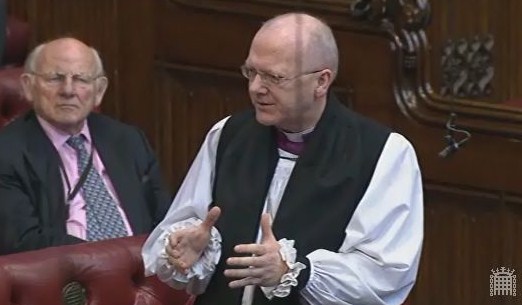
On 29th January 2015, The Earl of Courtown asked Her Majesty’s Government what they are doing to ensure that the benefits of lower oil prices are passed on to consumers, particularly in rural areas. The Bishop of Leicester, the Rt Revd Tim Stevens, asked a supplementary question:

14.04.01 Bishop of Leicester
The Lord Bishop of Leicester: My Lords, will the Minister tell us what Her Majesty’s Government are doing to ensure that those on low incomes and living in the coldest homes are able to benefit from renewable heating technologies?
The Parliamentary Under-Secretary of State, Department of Energy and Climate Change (Baroness Verma): I am grateful to the right reverend Prelate for his question, because this Government have, through many measures, not only tried to respond to people living in very inefficient homes in urban areas, but also looked at how to reach out to people who are often off grid and help support them through the renewable heat incentive and other measures. I am very happy to write to the right reverend Prelate about a number of measures undertaken by this Government.

Bishop of Chester asks Government about electricity imports

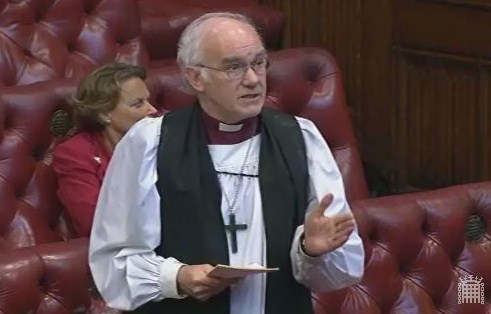
On 8th January 2015 the Bishop of Chester, Rt Rev Peter Forster, asked an oral question on importing electricity.

Continue reading “Bishop of Chester asks Government about electricity imports”

Bishop of St Albans – Energy Prices (Written Answer)

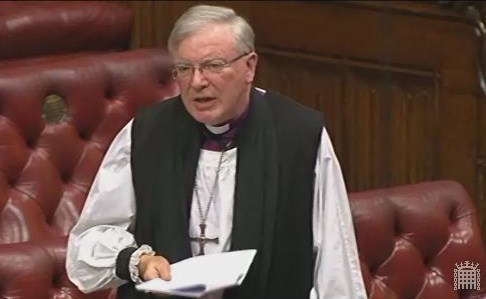
On 27th November 2014, the Bishop of St Albans, the Rt Revd Alan Smith, receieved an answer to a written question on energy prices.

Bishop of St AlbansThe Lord Bishop of St Albans: To ask Her Majesty’s Government what were the outcomes of the round-table event convened by Ofgem on 29 October on price differences between various payment methods for domestic consumers of electricity and gas, particularly in relation to addressing the higher fuel costs of pre-payment meters.[HL2852]

The Parliamentary Under-Secretary of State, Department of Energy and Climate Change (Baroness Verma): There was general agreement at the workshop that payment differentials was a complex issue and that any changes to the rules would create winners or losers with no clear benefit to vulnerable groups. For example, of households who were fuel poor in England in 2012, around 48% paid for their electricity and 40% paid for their gas through direct debit and around 27% paid for their electricity and 20% paid for their gas through prepayment meters. Changing rules in favour of pre-payment meter customers would make direct debit customers worse-off. Continue reading “Bishop of St Albans – Energy Prices (Written Answer)”

Infrastructure Bill – Division

On 10th November 2014, the Bishop of Lichfield, the Rt Revd Jonathan Gledhill, took part in a division of the House of Lords, on an amendment to the Government’s Infrastructure Bill.

House of Lords Division Lobby

Amendment 113G

Labour Peer Baroness Worthington moved amendment 113G, to insert the new clause Underground access: environmental protection, which sought to create new regulations for the extraction of oil and gas through the process known as fracking.

The Bishop of Lichfield voted ‘not content’. No bishop voted ‘content’.

There were Contents: 141 | Not Contents: 237 | Result: Government Win

(via Parliament.uk)

Bishop of Chester presses Government on carbon capture during Infrastructure Bill debate

On 10th November 2014, the Bishop of Chester, the Rt Revd Peter Forster, took part in the Report Stage of the Government’s Infrastructure Bill. He asked the Minister a number of questions regarding the UK’s carbon reduction commitment, carbon capture by power stations, and the UK’s strategy for oil and gas extraction. The amendments that the Bishop spoke to were withdrawn following the brief debate.

14.03 Bishop of ChesterThe Lord Bishop of Chester: My Lords, can I ask the Minister when she responds to comment on two points? First, if we are now to be committed in this legally strengthened way to the maximum economic exploration of our oil and gas reserves, how do the Government see that to be compatible with the commitment under the Climate Change Act to reduce our emissions to only 20% of the 1990 level by 2050 without also having a strategy for carbon capture and storage, which I think lies behind the amendment?

Secondly, the amendment refers to the economic extraction of our hydrocarbons—I have never yet heard any reliable estimate of what the additional cost will be of having carbon capture and storage on a typical power station, be it a coal station or a gas station. What level of increase per kilowatt hour—in a unit that can be easily understood—is anticipated if carbon capture and storage is required on such stations? That impacts on what is economically recoverable. Continue reading “Bishop of Chester presses Government on carbon capture during Infrastructure Bill debate”

Bishop of St Albans asks Government about fuel costs and pre-payment meters

On 23rd October the Bishop of St Albans, Rt Rev Alan Smith, received a written answer to a question about addressing the higher fuel costs imposed by pre-payment meters.

Bishop of St AlbansAsked by The Lord Bishop of St Albans

To ask Her Majesty’s Government what were the outcomes of the round-table discussions convened by Ofgem over the summer with suppliers, consumer representatives, parliamentarians and the Government, particularly in relation to addressing the higher fuel costs imposed by pre-payment meters.[HL2157] Continue reading “Bishop of St Albans asks Government about fuel costs and pre-payment meters”

Bishop of Newcastle speaks in debate on wind farming in Northumberland

On 15th October 2014 Baroness Quin led a short debate in the House of Lords on the Government’s assessment of the extent of onshore wind farming in the county of Northumberland. The Lord Bishop of Newcastle, the Rt Revd Martin Wharton, contributed to the debate, making the case for an increased focus on the development of alternative forms of renewable energy outside the county of Northumberland.
14.03 Bishop of NewcastleThe Lord Bishop of Newcastle: My Lords, last Friday I took a relatively short train journey from Waterloo to Winchester, in the heart of the Hampshire countryside. The journey took little more than an hour, about the same time as it takes me to travel through my diocese from Newcastle to the Scottish border. There was a striking difference between those two train journeys. Obviously, there was no beautiful coast or even the odd castle on my trip to Hampshire, and yet to me the most striking difference was that there was not a wind turbine—let alone a wind farm—in sight at all. This is hardly surprising when you consider that Northumberland now has more wind power capacity installed than 16 counties in the south of England put together. It is then hardly surprising that a recent survey claimed that 70% of the British public support onshore wind. The truth is that 70% of the British public live in places where they will never have to put up with the sight or the sound of a wind turbine, unlike the people who happen to live in the beautiful county of Northumberland. During my time as bishop, wind farms have proliferated across the countryside to an alarming degree.

The level of Northumberland’s contribution to the Government’s onshore wind targets has been disproportionately high, as we have heard. We contribute more than 10% of all England’s wind energy but consume just over 0.5% of England’s electricity. Nobody should accuse us of nimbyism. It is hardly surprising then that the message from this short debate is simply: enough is enough. The good people of Northumberland have had enough of onshore wind farms. That point has finally, if belatedly, been recognised by DCLG in recent guidance, which states that it does not mean that,
“the need for renewable energy … overrides environmental protection and the planning concerns of local communities”. Continue reading “Bishop of Newcastle speaks in debate on wind farming in Northumberland”

Bishop of St Albans asks Government About Effect of Energy Pre-Payment Meters on Vulnerable Customers

On 15 September 2014, the Bishop of St Albans, the Rt Revd Alan Smith, received answers to two written questions on the subject of energy companies, pre-payment meters and impact on vulnerable customers. Continue reading “Bishop of St Albans asks Government About Effect of Energy Pre-Payment Meters on Vulnerable Customers”

Bishop of St Albans – Energy Prices and Supermarket Competition (Written Answers)

On 8th September 2014, the Bishop of St Albans, the Rt Revd Alan Smith, received answers to two written questions on energy prices and supermarket competition.

Energy: Prices

Bishop of St AlbansThe Lord Bishop of St Albans: To ask Her Majesty’s Government what consideration they have given to encouraging energy companies to use income-differentiated tariffs as a means of addressing fuel poverty.

The Parliamentary Under-Secretary of State, Department of Energy and Climate Change (Baroness Verma): Energy suppliers provide direct bill support for low income households through the Government’s Warm Home Discount scheme. As the original impact assessment for the scheme made clear, the scheme grew in part out of a concern about affordability of energy bills and accessibility of appropriate tariffs for those on low incomes. The scheme is now hugely successful. This year the Warm Home Discount will give eligible low-income bill payers £140 money off their energy bills, helping over 2 million people including 1.4 million of Britain’s most vulnerable pensioners. Continue reading “Bishop of St Albans – Energy Prices and Supermarket Competition (Written Answers)”

Bishop of St Albans: Energy Meters (Written Answers)

On 18th August 2014, the Bishop of St Albans, the Rt Revd Alan Smith, received answers to two written question on energy meters for lower income households.

Bishop of St AlbansThe Lord Bishop of St Albans: To ask Her Majesty’s Government what assessment they have made of the impact of the use of prepayment meters on the ability of lower income households to pay their energy bills.

Baroness Northover: Since 2010, all major suppliers have voluntarily equalised tariffs between prepayment customers and standard credit customers but the price differential between customers using pre-payment meters (PPM) and those paying by direct debit can be more than £100 for a dual-fuel customer.

Whilst paying by PPM is more common among fuel poor than non-fuel poor households, a majority of fuel poor customer pay by other payment methods.

Of households who were fuel poor in England in 2012, around 27% paid for their electricity and 22% paid for their gas through PPM. Continue reading “Bishop of St Albans: Energy Meters (Written Answers)”