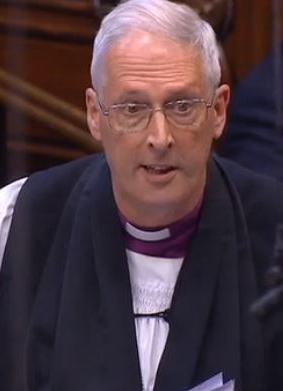
Bishop of Southwell and Nottingham asks about government support for environmental partnerships and land restoration

The Lord Bishop of Southwell and Nottingham received the following written answer on 8th November 2022:

The Lord Bishop of Southwell and Nottingham asked His Majesty’s Government what assessment they have made of the partnership between the conservation interests of the RSPB and the business Tarmac in the restoration of reedbeds at Langford Lowfields on the banks of the River Trent; and what steps they are taking to help landowners restore land in similar, environmentally-beneficial ways.

Continue reading “Bishop of Southwell and Nottingham asks about government support for environmental partnerships and land restoration”

Bishop of Oxford asks about government support for behaviour change on the pathway to net-zero

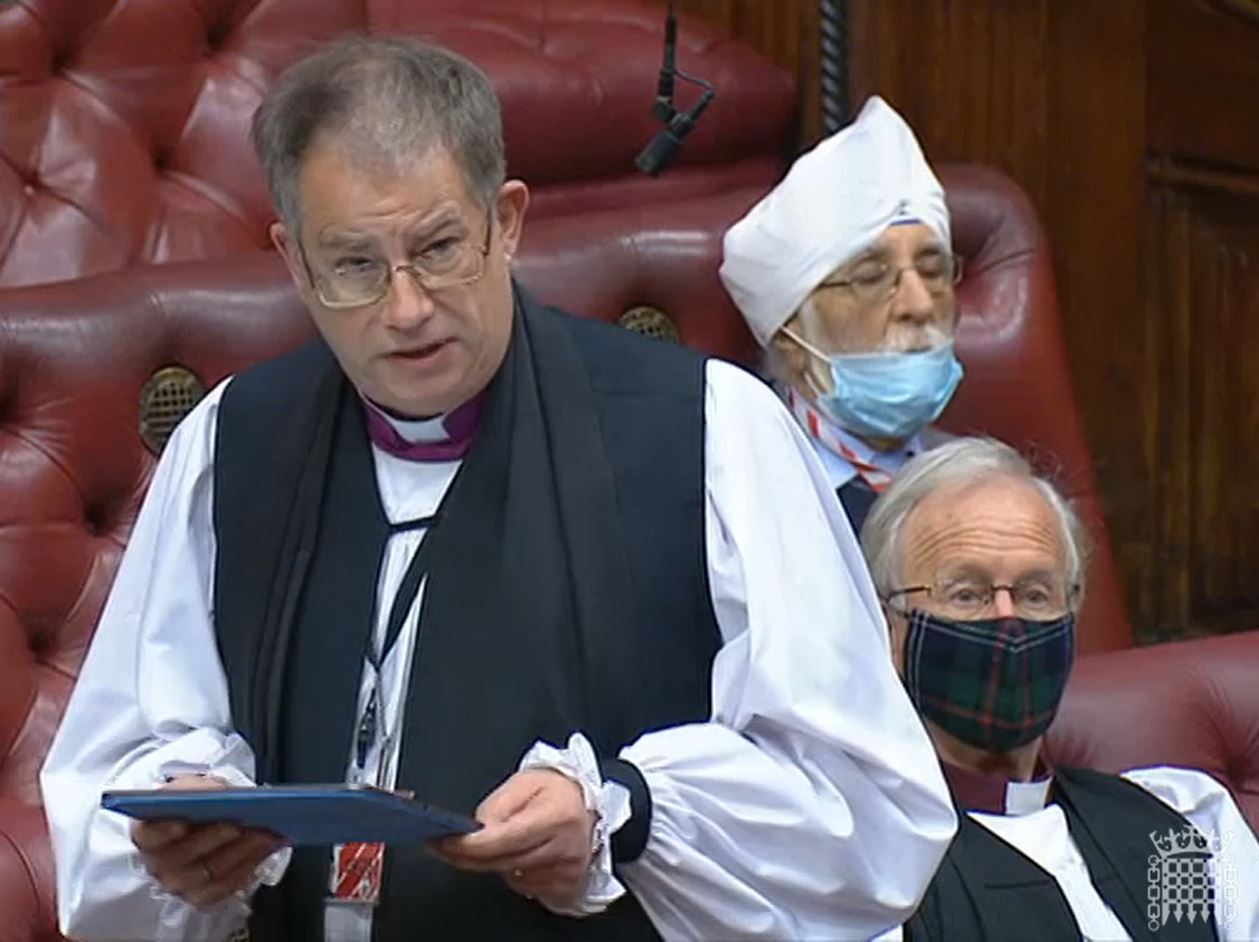
The Bishop of Oxford tabled a question for short debate on 20th October 2022, concerning the pathway to net zero emissions:

The Lord Bishop of Oxford: To ask His Majesty’s Government what steps they will take to support behaviour change as part of the pathway to net zero emissions.

My Lords, I appreciate the time given to this debate, despite all that is happening elsewhere in Westminster today. We face many challenging issues as a country and a world, but none is more serious than climate change and the environmental crisis. The context of our debate is the real prospect of global heating of more than 1.5 degrees by the middle of the century, with escalating extreme weather events in the UK and across the world, rising sea levels, devastating fires and floods, significant loss of life and damage to infrastructure, wars over scarce resources, shifting patterns of harvest, an increase in zoonotic disease and a massive displacement of people as large parts of the earth become uninhabitable.

Your Lordships may well have seen the final episode this week of BBC documentary “Frozen Planet II”, detailing the effects of global warming on people and wildlife. The most sinister pictures for me were of the small bubbles of trapped methane being released in great quantities from the permafrost, with devastating consequences for the earth.

Continue reading “Bishop of Oxford asks about government support for behaviour change on the pathway to net-zero”

Bishop of St Edmundsbury and Ipswich speaks about the economy and the environment

The House of Lords debated a motion to take note of the government’s Economic Growth Plan on 10th October 2022. The Bishop of St Edmundsbury and Ipswich spoke in the debate:

The Lord Bishop of St Edmundsbury and Ipswich: My Lords, I add my congratulations to the noble Baroness, Lady Gohir, and look forward to working with her. I also add my lament at the departure of our dear right reverend friend, who has to me also been a great friend and a great encourager.

Two of the most important lessons many of us learned during the pandemic were, first, that we were all in it together and that none of us was immune, and secondly, that no one should be left behind, which meant focusing on the most vulnerable, with all of us sharing the load. As His Majesty’s Government embarks on this bold and, I believe, risky economic experiment, I urge that those two lessons be heeded, for we ignore them at our peril.

Continue reading “Bishop of St Edmundsbury and Ipswich speaks about the economy and the environment”

Bishop of St Albans asks about heatwave impact on agriculture

The Bishop of St Albans asked the following question on 21st July 2022:

The Lord Bishop of St Albans asked: My Lords, it is right that we think about the effect on human beings, but these high temperatures have a huge effect on our agricultural sector, particularly on livestock. Extreme heat reduces milk yields from cattle, for example, and reduces fertility and increases the number of miscarriages.

What work is being done by government scientists to prepare our agriculture industry if this continues, and what advice is being given in the short term to help our first-class British agriculture sector adapt and continue to provide the food as it does so well?

Continue reading “Bishop of St Albans asks about heatwave impact on agriculture”

Energy Bill: Bishop of Carlisle calls for more community-led energy generation

On 19th July 2022 the House of Lords debated the Government’s Energy Bill at its Second Reading:

The Lord Bishop of Carlisle: My Lords, I take many of the cogent and very well-informed points that have already been made in this debate, not least the one made by the noble Lord, Lord Howell, on the need for international co-operation. Even so, I welcome all three pillars of this Bill. Its stated direction could offer at least a step forward towards the goal of net-zero carbon.

I suggest in particular two rather domestic but, I hope, practical areas that could, in my view, do with further development in the Bill; namely, local renewable energy generation, as raised by the noble Baroness, Lady Hayman, and carbon capture, which has been addressed by the noble Lord, Lord Whitty, and the noble Baroness, Lady Sheehan.

In both cases, I hope noble Lords will forgive special reference to Cumbria, where I live. It is currently engulfed in a very contentious debate about the Woodhouse Colliery near Whitehaven that is not nearly as straightforward as it might first appear. Cumbria also has the “energy coast”—originally coal, then nuclear and now, increasingly, renewables. It has the Walney Extension offshore wind farm, which has more than 20% of the UK’s wind farm generating capacity. What is more, as a county, we have more than 50% of all the potential small-scale hydropower generation in the north-west.

Continue reading “Energy Bill: Bishop of Carlisle calls for more community-led energy generation”

Bishop of St Albans speaks in support of Climate and Ecology bill

On 15th July 2022, the Climate and Ecology Bill, a Private Member’s Bill, was considered at Second Reading in the House of Lords. The Bishop of St Albans spoke in the debate – his speech is below, along with contributions from other peers:

The Lord Bishop of St Albans: My Lords, I too thank the noble Lord, Lord Redesdale, for this Bill. I know he has made many contributions about diversity in the past. I seem to remember that red squirrels are something we have discussed on a number of occasions, and I am glad he still works on that.

This debate is taking place at a crucial moment in our country’s battle against climate change. Despite the circumstances that have led to a change of Prime Minister, there was at least genuine confidence in the urgency and seriousness with which he was approaching the issue of climate change—he spoke out on a number of occasions. Therefore, it seems all the more extraordinary that, in the current events going on, we are hearing virtually nothing from candidates who want to be the next Prime Minister about this vital area. It is as if the only thing that matters is taxation. Taxation is important for all sorts of reasons, but where are the prophetic voices speaking about where we must be for the sake of vital future generations?

Continue reading “Bishop of St Albans speaks in support of Climate and Ecology bill”

Bishop of St Albans calls for action on sewage disposal in rivers and coastal waters

On 7th July 2022, the House of Lords debated a motion put forward by Lord Oates on Sewage Disposal in Rivers and Coastal Waters. The Bishop of St Albans spoke in the debate – the Bishop’s speech is below along with contributions by other peers:

The Lord Bishop of St Albans: My Lords, I too thank the noble Lord, Lord Oates, for achieving this important debate. Many of the horrifying facts and statistics have been laid out with great clarity before your Lordships’ House.

I live in the city of St Albans, which is built next to the ancient Roman city of Verulamium. We have a 17-mile chalk stream which runs through the city called the River Ver, based on its Roman name; it flows eventually into the River Colne. We have a thriving local group of activists, the Ver Valley Society, which was set up and continues to work with great vigour to protect this really important chalk stream—it is really a stream rather than a river.

In 2021, the sewage treatment works at the top of the river spilled for 2,646 hours—just over 100 hundred days, so nearly a third of the year. Not only was that appallingly bad for this unique ecosystem—chalk streams and chalk rivers are mainly found here in this country—it was also bad because of the residual nitrate in the aquifer and it has led to a very poor state of the chalk stream. Insects at the bottom of the food chain are not as plentiful as they once were. Likewise, aquatic plant life is also suffering. It is unacceptable for this lovely, delightful small river, that many of us walk along regularly for leisure, that goes through our park, to be treated so badly.

Continue reading “Bishop of St Albans calls for action on sewage disposal in rivers and coastal waters”

Bishop of Manchester asks a question on the Food Strategy White Paper

On 7th July, the House of Lords discussed the Food Strategy White Paper. The Bishop of Manchester asked the following question:

The Lord Bishop of Manchester: My Lords, the National Food Strategy that was produced last year found that the UK’s current appetite for meat was unsustainable and that the intake needed to fall by 30% within 10 years to help the environment. I would be grateful if the Minister could clarify what role exists for vegetarian and vegan food in the Government’s strategy. It does not appear to be set out, not least when it comes to aligning with the Government’s net-zero strategy.

Continue reading “Bishop of Manchester asks a question on the Food Strategy White Paper”

The Bishop of St Albans asks about food security

The Lord Bishop of St Albans

On 13th June 2022, the Bishop of St Albans tabled a question regarding food security and carbon emissions – the Bishop of Southwark spoke on his behalf:

The Lord Bishop of St Albans asked Her Majesty’s Government what assessment they have made of the effects on food security of allowing corporations to purchase arable land to offset their carbon emissions; and what plans they have to limit the amount of arable land that can be used for this purpose.

The Lord Bishop of Southwark

The Lord Bishop of Southwark: My Lords, I beg leave to ask the Question in the name of the right reverend Prelate the Bishop of St Albans, who has been unavoidably detained in his diocese and sends his apologies.

Lord Benyan (Con, Under-secretary of State – Department for Food, Environment and Rural Affairs): My Lords, I declare my farming interests as set out in the register. This Government are committed to safeguarding food security, as highlighted by the food strategy published today. I am very conscious of the issue raised, and we already have several protections in place, such as requirements for public consultations on any large new woodland as part of environmental impact assessments. I am also working closely with Her Majesty’s Treasury and BEIS to develop robust standards for green finance investments, and will set out the next steps in the forthcoming months.

Continue reading “The Bishop of St Albans asks about food security”

Bishop of Oxford asks about zoonotic diseases

On 24th May 2022, the Bishop of Oxford asked a question during a debate on establishing a zoonosis research centre in the UK:

The Lord Bishop of Oxford: My Lords, I am sure the Minister is aware that the rapid increase in zoonotic diseases has its roots in the environmental crisis: deforestation, habitat destruction, intensive farming and unregulated trade in wild animals. Therefore, as well as the vital areas of medical research and response to disease, how are the Government focusing their intervention on prevention as well as diagnosis and cure?

Continue reading “Bishop of Oxford asks about zoonotic diseases”