
Bishop of Wakefield responds to Government statement on the situation in Ukraine

The Lord Bishop of Wakefield: My Lords, perhaps I may focus my question on Ukraine. It seems to me that there are some senses—not exactly repetitions—in which we are seeing replayed some of the things that were not resolved in the early 1990s with the collapse of the Soviet Union. I remember that at that time I was working at Lambeth as the archbishop’s foreign secretary, as it were, and on one occasion the telephone was brought to me in the bath. There was a call from the gatekeeper telling me that Mr Gorbachev was in captivity in the Crimea and he thought that I ought to know so that I could do something about it. Some very good and quite low-key, and low-cost, initiatives were taken by Her Majesty’s Government at that time to support the development of democracy in the various republics that resulted from the collapse of the Soviet Union, including Ukraine. Can we be reassured that, once things become a little more stable, those sorts of initiatives might be looked at again? I am suggesting not carbon copies but that sort of thing.

My other point is that only the churches never recognised the division of Europe. The Conference of European Churches always worked across Europe. There are very serious divisions in the churches in the Ukraine, often reflecting some of the fragmentations that exist in the country as a whole. Again, that is another area where Her Majesty’s Government might work with others to see how one moves towards a more democratic situation.

Lord Wallace of Saltaire: My Lords, I continue to learn how close church links can be across national boundaries. I was in Armenia some months ago and was met by a very chatty archbishop, who seemed to know almost every bishop I had ever met in this country. However, we all know that the Orthodox Church in and across the former Soviet Union is a very complex and divided entity, and not all its branches are committed to anything that we would recognise as a liberal approach to organised religion. Sadly, the different branches of the church in Ukraine represent that rather well.

(via parliament.uk)

Bishop of St Albans raises plight of Roma communities in Parliament (Written Question)

The Lord Bishop of St Albans asked Her Majesty’s Government what analysis they have made of reports of the forced evictions of Roma communities in Cluj-Napoca, Romania; and whether they will discuss the matter with the government of Romania and ask that government to enforce the decision of the Cluj-Napoca County Court that evictions targeting the Roma community are illegal.

The Senior Minister of State, Department for Communities and Local Government & Foreign and Commonwealth Office (Baroness Warsi) (Con): Our Embassy in Bucharest has been monitoring this issue closely (along with other forced evictions of Roma e.g. in Eforie Sud and Baia Mare). We understand that the Cluj-Napoca Court recently ruled the forced eviction in December 2010 illegal. However this decision is not final and is subject to appeal. We have raised wider concerns about social inclusion of the Roma with the Romanian government on 28 January. With regard to this specific case, the British Embassy will visit Cluj on 11 February and will raise the issue of forced evictions with the local government. They will also launch a partnership with a local NGO to develop projects aimed at preventing disadvantaged Roma children leaving school before the minimum age. The UK government does not condone unjustified evictions of any community.

(via parliament.uk)

Bishop of Wakefield raises concerns about Islamophobia in Georgia

The Lord Bishop of Wakefield asked Her Majesty’s Government: what representations they are making to the Government of Georgia regarding Islamophobia in that country; and what steps they are taking to ensure freedom of religion and the rights of minority groups there.

Baroness Warsi: My Lords, the UK raises human rights issues on a regular basis with the Georgian Government, both bilaterally and through multilateral institutions such as the EU, the OSCE and the Council of Europe. We have not made any recent representations regarding Islamophobia, but we continue to follow minority rights closely, including through our embassy’s work in Tbilisi and its regional travel. We fund a local NGO to maintain an inter-religion working group, which involves a variety of faith groups, including Muslims.

The Lord Bishop of Wakefield: My Lords, last year, I was fortunate to spend a couple of nights with a Muslim family in Batumi, and the next morning I met the president of the semi-autonomous region there, Mr Archil Khabadze. I pressed the question to him of why there was only one mosque for something like 110,000 out of the 150,000 people, that being the number of Muslims in the city. He said that at that time they would take immediate steps to find more land made available for Muslims in that city. I said that I would be coming back in the next three months to open the mosque with other religious groups. Would Her Majesty’s Government please press the authorities to make sure that the local administration there is asked to fulfil the promise that they made; otherwise, these very open Muslims will soon become radicalised.

Baroness Warsi: The right reverend Prelate raises a really important issue. His Question prompted me to go away and do some research, and I was quite intrigued to find out that just over 10% of Georgia’s population are indeed Muslim—a much larger percentage than in our own communities. The right reverend Prelate will be aware that one of the challenges in Georgia is that the Muslim community is not particularly well engaged politically and therefore does not really put its head above the parapet. I have become aware of low-level discrimination and tensions towards the Muslim community there, but as Georgia moves towards closer EU integration part of its requirement is to fulfil its obligation to bring in anti-discrimination laws.

(via parliament.uk)

The Bishop of Chester responds to Government statement on Sri Harmandir Sahib

The Lord Bishop of Chester: My Lords, the noble Lord, Lord Desai, made the point that using force to resolve a situation is nearly always counterproductive and has results that you do not anticipate. Are there two additional lessons from this? First, the speed with which this report has been produced is commendable. I think of the Chilcot inquiry that we are still waiting for. This has been done in a few weeks and it seems to me to be a lesson for other situations in which a bit more speed can help the reconciliation process. Secondly, is one of the lessons that understanding religious sensitivities is something the modern world can find hard to do? One thinks of Ariel Sharon going to the Temple Mount and starting the second intifada, with all the consequences that have flowed from that. Is that a lesson that we should draw from these events?

Baroness Warsi: I thank the right reverend Prelate for his warm words in relation to the way in which this inquiry was conducted quickly. It was certainly part of the clear remit set by the Prime Minister at the outset. The right reverend Prelate makes an important point. To understand the sentiment within the British Sikh community it is important to understand the significance of Sri Harmandir Sahib; the significance of the timing of Operation Blue Star; the implications in relation to the damage that was done to Sri Harmandir Sahib; and the basis of some of the concerns that were being raised by the dissidents. It is an important point. This is the challenge that I have in a sometimes aggressively secular world; some of these sensitivities are not properly explored and understood.

(via parliament.uk)

Bishop of Worcester calls for gender equality to be at heart of next generation of development goals (Written Question)

The Lord Bishop of Worcester asked Her Majesty’s Government what steps they are taking to include a robust gender mainstreaming goal in the post-2015 Millennium Development Goals.

Baroness Northover: The UK has been clear in its advocacy for a standalone post-2015 goal on gender equality and girls’ and women’s empowerment as well as ensuring that these issues are mainstreamed in the goals and targets in the framework to be agreed by the United Nations.

We are working with others across the international community, including civil society, to ensure that this is achieved.

(via parliament.uk)

Bishop of Wakefield highlights Church’s role in preventing sexual violence in the DRC

Lord McConnell of Glenscorrodale asked Her Majesty’s Government what is their assessment of recent developments in the Democratic Republic of the Congo.

The Bishop of Wakefield asked a supplementary question:

The Lord Bishop of Wakefield: My Lords, I am sure that the Minister will be aware that my colleague and friend the most reverend Primate the Archbishop of Canterbury is visiting the DRC today with the Minister for Africa. Could she inform the House of the work of Her Majesty’s Government, currently being promoted by them, in the protection of women in the DRC, particularly from gender-based violence?

Baroness Warsi: The Minister for Africa will have meetings with the most reverend Primate the Archbishop of Canterbury and the Archbishop of the DRC, particularly to support HEAL Africa, a project which aims to support women who have been subjected to sexual violence.

(via parliament.uk)

Bishop of Wakefield calls for Government to support investment in Georgia

Lord Harries of Pentregarth asked Her Majesty’s Government what is their assessment of the current situation in Georgia

The Bishop of Wakefield asked a supplementary question:

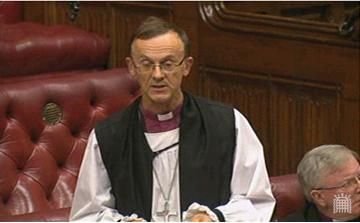
The Lord Bishop of Wakefield: My Lords, I begin by declaring an interest as the Church of England’s lead bishop on Georgian affairs. Last year, I had the good fortune to meet the outgoing President Saakashvili and, independently, some of his associates. I then met a number of members of the present Government. The antagonism could be felt in both directions and was seriously affecting stability and development. The previous Government had done some good work on corruption, tax collection and so on. If the economy is to prosper, the next thing that needs to happen is a building up of the infrastructure. Can Her Majesty’s Government assure noble Lords that the new Government will do that?
Lord Wallace of Saltaire: My Lords, on my last visit to Tbilisi I had lunch with MPs from both the governing party and the opposition party. That would not have been possible in Armenia or Azerbaijan. One has to put these things in perspective. Yes, of course we are assisting with developing the infrastructure in Georgia. The European neighbourhood partnership is putting a lot of money into Georgia and, of course, BP and other foreign investors are also assisting with the development of the country.

(via Parliament.uk)

The Bishop of Wakefield asks question about humanitarian assistance in Gaza

Baroness Falkner of Margravine asked Her Majesty’s Government what assistance they have given to the people of Gaza over the last three months.

The Bishop of Wakefield asked a supplementary question:

The Lord Bishop of Wakefield: My Lords, following Egypt’s closure of the tunnels, which has already been referred to, will the Minister give an assurance that the Department for International Development will adjust its aid package accordingly, to try to address some of the terrible suffering to which we have already heard reference?

Baroness Northover: The United Kingdom and the EU are putting in a massive amount of assistance, which is much needed in Gaza for the reasons the right reverend Prelate has given. Gaza has suffered a lot from the closure of the tunnels. However, the tunnels themselves help to fund Hamas and this is an opportunity to encourage Israel to open the borders there and to support the moderate elements in Gaza. Certainly, at the moment, the international organisations are saying that the underlying causes of the problems need to be addressed. The immediate shortages are being dealt with adequately.

(via Parliament.uk)

Archbishop of York urges European co-operation in response to crisis in Central African Republic

On 16th January 2014, Baroness Berridge asked Her Majesty’s Government what is their response to the failure of the transition government and the growing crisis in the Central African Republic.

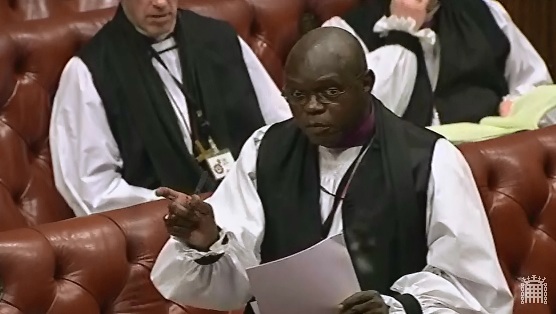
Archbishop of YorkThe Most Revd and Rt Hon John Sentamu, Archbishop of York, asked a supplementary question:

The Archbishop of York: My Lords, does the Minister agree that the scale of the crisis is very large? I am grateful for what the Government are doing in response to this particular crisis, but will they use their offices in the European Union to make sure that all nations take part in dealing with this rather appalling situation? I am not confident that the African Union actually has the capacity to deal with the situation, much as it is on the ground. I hope the Minister can give us some comfort by confirming that the Government are talking to our European allies to ensure that whatever is needed is provided. Otherwise, we will end up with genocide and pictures on our television screens that will make all our stomachs churn day by day.

Continue reading “Archbishop of York urges European co-operation in response to crisis in Central African Republic”

Bishop of Worcester speaks in debate on Middle East Peace Process

“I would describe myself as a pro-Palestinian Zionist, wholeheartedly committed to the right of Israel to exist securely, and equally committed to the right of the Palestinian people to a viable state in which they can flourish. Reaching that is crucial to a wider Middle East peace settlement.” – The Bishop of Worcester

WorcesterOn 14th January 2014, the Bishop of Worcester took part in a debate on what role the European Union is currently playing in efforts to reach a wider Middle East peace settlement. He focused his comments on new EU guidelines on Israeli settlements in East Jerusalem and the West Bank. Continue reading “Bishop of Worcester speaks in debate on Middle East Peace Process”