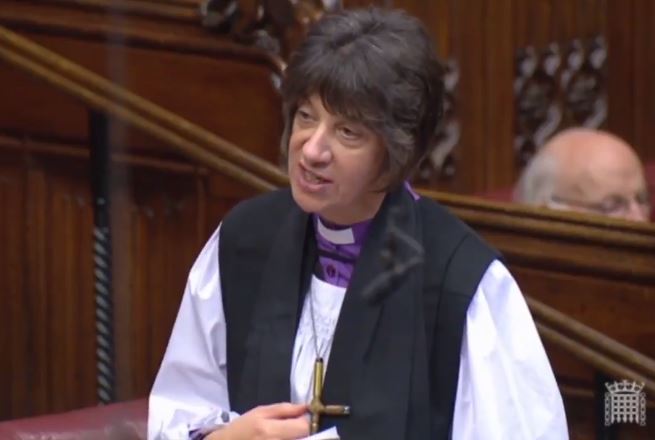
Bishop of Gloucester asks Government how Domestic Abuse Bill will meet needs of children

On 9th March 2020 Baroness Sanderson of Welton asked the Government “what funding has been allocated for a public information campaign to accompany the Domestic Abuse Bill.” The Bishop of Gloucester, Rt Revd Rachel Treweek, asked a follow-up question:

The Lord Bishop of Gloucester: I thank the Minister for mentioning children. Given that the Bill will inform the way that people engage with domestic abuse, what provision will be made to ensure that the needs of children are properly highlighted to enable a child-focused response? Continue reading “Bishop of Gloucester asks Government how Domestic Abuse Bill will meet needs of children”

Bishop of Gloucester asks Government what is being done to support diversion and alternatives to custody for women

On 27th February 2020 the House of Lords debated a motion from Lord Bates, “to ask Her Majesty’s Government what assessment they have made of the findings of the Checkpoint programme, run by Durham Constabulary, to reduce reoffending rates and custodial sentences.” The Bishop of Gloucester, Rt Revd Rachel Treweek, spoke in the debate:

The Lord Bishop of Gloucester: My Lords, I too would like to thank the noble Lord, Lord Bates, not least for his important mention of mercy, which is so important to me in my Christian faith. I too would like to commend the work of the Checkpoint programme, especially on behalf of my right reverend friend the Bishop of Durham, who also wanted to pay tribute to Ron Hogg—so it is good to have heard that. Continue reading “Bishop of Gloucester asks Government what is being done to support diversion and alternatives to custody for women”

Bishop of Gloucester leads debate on early years interventions to support children and families

On 27th February 2020 the Bishop of Gloucester, Rt Revd Rachel Treweek, led a debate in the House of Lords on improving early years interventions to support children and families. Her opening speech and that of the Minister responding is below, and the whole debate including the speeches of all others taking part can be seen here.

Children and Families: Early Years Interventions

Motion to Take Note

The Lord Bishop of Gloucester: That this House takes note of the case for improved early years interventions to support children and families. Continue reading “Bishop of Gloucester leads debate on early years interventions to support children and families”

Bishop of Gloucester responds to Government plans to end early release for terrorist offenders

On 24th February 2020 the House of Lords considered the Government’s Terrorist Offenders (Restriction of Early Release) Bill at its Second Reading (and remaining stages). The Bishop of Gloucester, Rt Revd Rachel Treweek, spoke in the debate:

The Lord Bishop of Gloucester: My Lords, I am grateful to those contributing to this subject today who have far greater knowledge than I do, and I will aim to keep my comments brief.

Certainly, if a society that relies on government to deliver justice has lost confidence in the current system, it is right that we try to address those fears, and we must look at the bigger picture. I share concerns already expressed about the manner in which this legislation has been brought before the House, and particularly the very short time that we have to consider it.

If the justice system is to serve the common good and the flourishing of people and place, there needs to be an emphasis on a radical mutual responsibility, in which we are all truly responsible for one another. Offenders must be expected to take responsibility for their actions. This should be about not only taking the consequences and punishments imposed by a criminal justice system but having the opportunity to take responsibility for past actions, and the possibility of taking responsibility to restore their relationship with society.

Continue reading “Bishop of Gloucester responds to Government plans to end early release for terrorist offenders”

Lords approve Church of England (Miscellaneous Provisions) Measure

On 30th January 2020 the House of Lords considered the Church of England (Miscellaneous Provisions) Measure, a piece of church legislation that was introduced by the Bishop of Gloucester, Rt Revd Rachel Treweek. A short debate also took place on a motion to regret the Measure, tabled by Lord Trefgarne, which was subsequently withdrawn. The Measure was passed.

Moved by The Lord Bishop of Gloucester
That this House do direct that, in accordance with the Church of England Assembly (Powers) Act 1919, the Church of England (Miscellaneous Provisions) Measure be presented to Her Majesty for the Royal Assent.

The Lord Bishop of Gloucester: My Lords, although the provisions contained in this Measure are miscellaneous, some of them are nevertheless important. Rather than go through the Measure section by section, it might be helpful if I just mention some of the more significant provisions at this point.

Section 2 implements a recommendation from Dame Moira Gibb’s report following her review of the Church of England’s response to the abuse committed by Peter Ball. One of the report’s recommendations was for the introduction of a national register of clergy with permission to officiate. That recommendation has been further developed and Section 2 will now require there to be a national ministry register. Every clerk in holy orders who has authority to exercise ministry in the Church of England will have to be included in the register. There is also provision for the creation of a register of licensed lay people, and bishops will be required to provide details to the Archbishops’ Council on a regular basis so that the national registers are kept up to date. A form of the register that omits personal contact information will be published by the council and be accessible to the public free of charge.

Continue reading “Lords approve Church of England (Miscellaneous Provisions) Measure”

Bishop of Gloucester and Archbishop of York ask Government about support for looked after and adopted children

On 28th January 2020 the Bishop of Gloucester, Rt Revd Rachel Treweek, asked a question she had tabled to Government, on support for looked after and adopted children. She and the Archbishop of York, Most Revd and Rt Hon John Sentamu, asked follow-up questions and the transcript is below:

Looked-after and Adopted Children
Question

The Lord Bishop of Gloucester: To ask Her Majesty’s Government what plans they have to review support for children looked after by local authorities and those children who are adopted.

The Parliamentary Under-Secretary of State, Department for Education (Lord Agnew of Oulton) (Con): My Lords, we are committed to undertake a review of the care system. We are already implementing substantial reforms to improve outcomes for this most vulnerable group of children and young people. Alongside the reforms, we are providing councils with an additional £1 billion for adult and children’s social care in every year of this ​Parliament. The review will allow us to go further in ensuring that children and young people have the support that they need. Continue reading “Bishop of Gloucester and Archbishop of York ask Government about support for looked after and adopted children”

Bishop of Gloucester responds to Queen’s Speech – the needs of children and vulnerable women

On 9th January 2020 the Bishop of Gloucester, Rt Revd Rachel Treweek, spoke in the Queen’s Speech debate, about children and vulnerable women:

The Lord Bishop of Gloucester: My Lords, I begin by congratulating the noble Baroness, Lady Blower, on her excellent maiden speech.

I shall focus on children and vulnerable women; I draw noble Lords’ attention to my entry on the register of interests. My headlines are that we need policy that supports and enables early intervention and effective partnerships. Experiences that we have at an early age shape who we are. The Children’s Society has been measuring children’s well-being for more than a decade, and during much of that time children’s well-being has been in decline. This is not simply about children; it is about how we shape the sort of communities we want to see. Continue reading “Bishop of Gloucester responds to Queen’s Speech – the needs of children and vulnerable women”

Bishop of Gloucester says more investment and impetus needed in female offender strategy

On 3rd October 2019 the House of Lords debated a motion from Crossbench Peer Lord Ramsbotham, ‘That this House takes note of the case for reforming the management and treatment of offenders in prison and the community.’ The Bishop of Gloucester, Rt Revd Rachel Treweek, spoke in the debate:
The Lord Bishop of Gloucester: My Lords, I, too, am grateful to the noble Lord, Lord Rambsotham, for bring forward this debate and I am glad to be speaking in it.

I have a particular interest in women’s interaction with the justice system as the lead Bishop on women’s prisons, and I have been carefully following the progress of the female offender strategy. The strategy was published in June 2018, and it prioritised earlier intervention, community-based solutions, and effective, decent custody for women who have to be there. There has been widespread consensus in this House and beyond that community-based provision for most women offenders offers both cheaper and more effective rehabilitation than prison. Continue reading “Bishop of Gloucester says more investment and impetus needed in female offender strategy”

Bishop of Gloucester asks Government what consultation takes place with religious communities to inform asylum decision making

On 9th April 2019 the Bishop of Gloucester, Rt Revd Rachel Treweek, received written answers to two questions about asylum decisions and consultation with religious communities:

The Lord Bishop of Gloucester:

(i) (HL14943) To ask Her Majesty’s Government what processes they operate for monitoring and reviewing decisions on asylum claims.

(ii) (HL14942 ) To ask Her Majesty’s Government what consultation they have undertaken with religious communities to inform decision-making processes for asylum claims.

Continue reading “Bishop of Gloucester asks Government what consultation takes place with religious communities to inform asylum decision making”

Bishop of Gloucester asks Government about progress on female offenders strategy

On 31st January 2019 the Bishop of Gloucester, Rt Revd Rachel Treweek, asked a question she had tabled to Government on its female offender strategy:

Female Offender Strategy

The Lord Bishop of Gloucester: To ask Her Majesty’s Government what progress they have made in implementing the female offenders’ strategy.

The Advocate-General for Scotland (Lord Keen of Elie) (Con): My Lords, the Female Offender Strategy, published in June 2018, outlines the Government’s long-term vision for improving outcomes for female offenders in custody and in the community. The strategy sets out a programme of work that contains a number of commitments that will take some years to implement. A new women’s policy framework was published last December, and my noble friend Lord Farmer’s review of family ties for female offenders is expected to report in the coming weeks.

The Lord Bishop of Gloucester: My Lords, I welcome that information from the Minister, which follows many positive commitments to the female offender strategy. However, we are still awaiting news of residential pilots, action to strengthen links between probation services and women’s centres, the report from the noble Lord, Lord Farmer, and a national concordat. Given that many of the strategy’s commitments have no clear timescales—indeed, in some cases the suggested deadline has already passed—how does the Minister plan to effectively monitor progress and stay on track?

Continue reading “Bishop of Gloucester asks Government about progress on female offenders strategy”