Bishop of St Albans calls for pan-European strategy on immigration and asylum seekers

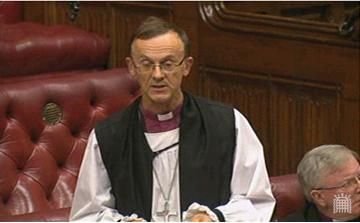
On 30th October 2014, the Parliamentary Under-Secretary of State for the Home Office, Lord Bates, repeated a Government statement concerning search and rescue for migrants and refugees. The Bishop of St Albans, the Rt Revd Alan Smith, asked a supplementary question:

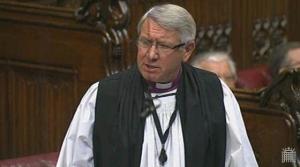
Bishop of St AlbansThe Lord Bishop of St Albans: My Lords, it is clear that we are all deeply worried about this terrible situation. Just last weekend, a family drowned off our own coasts and the horror was felt right across our country. There were serious discussions about whether we needed more people on duty to look after them. There is a deep sense of worry where people put themselves in such danger. I do not think that any of us believe that people are putting their families at risk—sometimes, they are huge, extended families; one was reported earlier this week on television—thinking, “Oh, well, it does not matter if we are likely to drown because we might be saved”. That would seem to me incredible. Surely we need a much more coherent, pan-European strategy underlying the whole question of immigrants and asylum seekers, and we should try to get some agreement on how we can address it. However, I would lament us withdrawing from anything that would help people in such dire circumstances.

Lord Bates: I understand the right reverend Prelate’s point. I should make the point again for the benefit of the House that we are not withdrawing from anything; this was something for which the Italian Government had responsibility, and they have decided to phase it out. The right reverend Prelate is absolutely right that more needs to be done to establish a co-ordinated approach, which was indeed the purpose of the Justice and Home Affairs Council meeting on this specific issue held on 9 and 10 October. One of the outcomes of that meeting was Operation Triton, which we have pledged resources to, in addition to all the other things that we are trying to do to help in the countries from which these people are fleeing for their lives.

(via Parliament.uk)

Impact on children and families of immigration removals: Bishop of St Albans questions Government

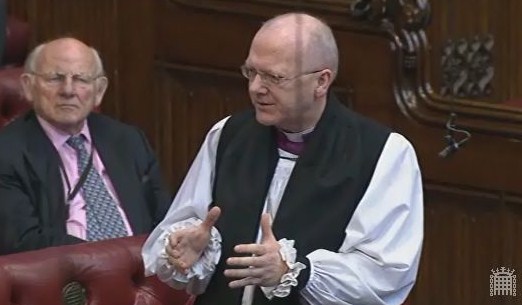
On 18th June 2014 Lord Roberts of Llandudno asked the Government “what assessment they have made of the report Cedars: two years on by Barnardo’s; and what plans they have to implement the recommendations made in that report.” The Bishop of St Albans, Rt Rev Alan Smith, asked a supplementary question:Bishop of St Albans

The Lord Bishop of St Albans: My Lords, the Chief Inspector of Prisons has written a subsequent report on Cedars. It describes a worrying incident where an arrest team arrived in full protective clothing and spent three minutes battering down the door of a house; there was no awareness of whether there was a child or children in the house, which could have been deeply traumatic for those young people. Does the noble Baroness agree that we need to have a full review of arrest procedures to try to prevent such situations?

Baroness Williams of Trafford: I thank the right noble Prelate for his question. I am sorry—I was so focused on the answer that I forgot the right reverend Prelate’s title. I think that there are lessons learnt from situations like that, and I know that refresher training is going on. I hope that, again, the specialist teams will provide that more consistent journey and that the lessons learnt will enable a better arrest and removal procedure in future.

(via Parliament.uk)

Vote – Immigration Bill

On 12th May 2014, the Rt Revd John Pritchard, Bishop of Oxford, took part in a division on the Government’s Immigration Bill, during the ‘ping pong’ stage of the Bill.

House of Lords Division Lobby

Labour Peer Baroness Smith of Basildon moved Motion B1, as an amendment to Motion B, to leave out from “House” to end and insert “do insist on its Amendment 18.” The amendment sought to refer the question of when and how the citizenship of a naturalised British citizen can be withdrawn to a Joint Select Committee. The amendment had originally been tabled by Lord Pannick and passed during Report Stage in the House of Lords.

The Bishop of Oxford voted ‘content’ with Baroness Smith’s motion. No bishop voted ‘not content.’

There were Contents: 193 / Not Contents: 286. Result: Government Win

(via Parliament.uk)

Votes: Immigration Bill (trafficking, citizenship)

House of Lords Division Lobby

Bishops took part in two votes in the House of Lords on amendments to the Government’s Immigration Bill at its Report Stage on 7th April 2014. In both cases the amendments passed, meaning the Government was defeated. Continue reading “Votes: Immigration Bill (trafficking, citizenship)”

Bishop of St Albans speech marking International Roma Day

On 2nd April 2014 Baroness Whitaker tabled a question for short debate: ‘ to ask Her Majesty’s Government what plans they have to mark International Roma Day.’

The Bishop of St Albans gave a speech highlighting the work being undertaken in Luton in support of the Roma community in the diocese of St Albans, He also focused on the need to improve educational opportunities for Roma children.

14.03 Bishop of St Albans

The Lord Bishop of St Albans: My Lords, I thank the noble Baroness, Lady Whitaker, for securing this debate, Continue reading “Bishop of St Albans speech marking International Roma Day”

Bishop of Leicester urges greater consideration of child welfare in immigration cases

The Bishop of Leicester spoke during Report Stage of the Immigration Bill, speaking in favour of Baroness Lister’s Amendment 21. The amendment sought to reduce the threshold at which a child becomes a material factor in a parents’ immigration case from seven to four years. The amendment was not moved, with the Minister giving assurances that the Bill would not have a negative impact on the safeguarding or welfare of children in the United Kingdom.
LeicesterThe Lord Bishop of Leicester: My Lords, I want just to assure your Lordships that as the noble Baroness, Lady Lister, suggested, I support Amendment 21 in spirit. I also support it in practice. It seems that the arguments, from any understanding of child development, are clearly overwhelming. I speak as a former chair of the Children’s Society and as a member of the commission that published the A Good Childhood report on behalf of the Children’s Society some four or five years ago, which was based on the evidence of more than 20,000 children, many of them very young children. They made it very clear, even at the age of five or six, that friendships were an absolutely primary part of their understanding of their well-being. This is documented and spelt out in that report, as indeed it is in many other more academic reports. I would be happy to support this amendment as it stands or even if it is reduced to fewer years. On the basis of any understanding of child development, the argument for a cut-off period of four years seems overwhelming. I hope the Minister will be able to respond positively to the amendment.

Lord Wallace of Tankerness: …The noble Baroness, Lady Lister, talked about her experience of losing friends at the age of four, and that was echoed by the right reverend Prelate the Bishop of Leicester, but let us face it: many parents move with their children around the country or out of the country for work or other temporary purposes, and the family leaves to return home or move elsewhere. When a family comes to the United Kingdom for a temporary purpose, they cannot and should not expect to settle permanently in the UK, and should not be able to do so unless they meet the rules for doing so. It is essential that the public interest in controlling immigration and protecting the public be properly weighed in the balance, even when children are involved. We believe that Clause 18 strikes the right balance in this regard…

(via Parliament.uk)

Votes – Immigration Bill

Three bishops took part in two vote in the House of Lords yesterday (1st April 2014), on  amendments to the Government’s Immigration Bill, during its Report Stage.

House of Lords Division Lobby

Continue reading “Votes – Immigration Bill”

“Problematic” UK visa and immigration system affecting international work of churches – speech by Bishop of Chester

when we try to get the visa and immigration authorities to tell us what we have to do as a diocese and what the conditions are, we find that letters get lost. My colleague who deals with this is in despair. We write letters but nothing comes back. Time is ticking away and the training curacy of the chap I am talking about is coming to an end.” – Bishop of Chester

Lord Steel of Aikwood tabled a question for short debate: ‘to ask Her Majesty’s Government what is their assessment of the operation and accountability of UK Visas and Immigration. The Bishop of Chester raised some examples of failures in the system.

The Lord Bishop of Chester:

14.03 Bishop of ChesterMy Lords, I associate myself very closely with all that has been said, although the second half of the contribution from the noble Lord, Lord Phillips, focused a bit too much on mammon for my level of expertise. However, I take him as an authority on that aspect. The introduction the noble Lord, Lord Steel, gave, was powerful and shocking in equal measure, and made the case on its own. I can say to the noble Baroness, Lady Neville-Jones, that I am aware of the Hereford situation; indeed, clergy are among those who are able to come under the scheme she mentioned.

Continue reading ““Problematic” UK visa and immigration system affecting international work of churches – speech by Bishop of Chester”

Immigration Bill – Bishop of Newcastle raises concern about potential for discrimination by landlords

During the committee stage of the Government’s Immigration Bill in the Lords on 12th March 2014, the Bishop of Newcastle drew attention to the potential impact of measures in clause 16 that require nationality checks on potential tenants by private landlords. The Bishop asked the Minister whether the need for private landlords to have regard to a code of practice was in itself robust enough to prevent discrimination against migrants or those of foreign name or appearance.14.03 Bishop of Newcastle

The Lord Bishop of Newcastle: My Lords, perhaps I may also ask for some clarification. One of my concerns about this part of the Bill is that many landlords will simply not rent to anyone who seems to be foreign or who does not hold a British passport for fear of getting it wrong and being fined. I am afraid that that will inadvertently result in further racial discrimination and provide a charter for those unscrupulous landlords who are racist.

In response to the consultation, the Government accepted that the new rules might provoke landlords to discriminate against people they perceive to be foreign rather than to conduct proper checks. They also recognised the risk that vulnerable people might be impacted. So, in relation to the code of practice and the associated guidance which will make it clear that the checks do not allow landlords to act in a manner inconsistent with the UK’s equality legislation, is that in itself sufficient? It simply requires landlords to read the code and adhere to it without any redress at all if they do not. Continue reading “Immigration Bill – Bishop of Newcastle raises concern about potential for discrimination by landlords”

Immigration Bill: Archbishop of York and Bishop of St Albans Debate Amendments in Committee

The Archbishop of York and the Bishop of St Albans both spoke during the first day of the Committee Stage of the Government’s Immigration Bill on 3rd March. The amendments they debated involved policy relating to immigration removals, holding facilities, use of force, effect on families and children, and the appeals process. Their interventions can be found in full below, with links to the corresponding sections of Hansard on the UK parliament website, where the full exchanges involving other members  of the House can be seen. Continue reading “Immigration Bill: Archbishop of York and Bishop of St Albans Debate Amendments in Committee”