On 11th March the Bishop of Leicester, Rt Rev Tim Stevens took part in three Divisions of the House on amendments to the Government’s Small Business, Enterprise and Employment Bill during its Report Stage in the Lords.


On 11th March the Bishop of Leicester, Rt Rev Tim Stevens took part in three Divisions of the House on amendments to the Government’s Small Business, Enterprise and Employment Bill during its Report Stage in the Lords.
On 10th March 2015 Lord Touhig asked Her Majesty’s Government “how many people are awaiting assessment for personal independence payments?” The Bishop of Leicester, Rt Rev Tim Stevens, asked a supplementary question.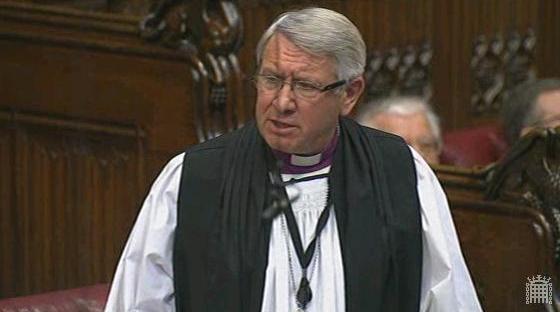
The Lord Bishop of Leicester: My Lords, can the Minister tell us how many 16 and 17 year-olds are awaiting reassessment? What action do the Government propose to take to meet the additional needs of that group, including providing support for them through the reassessment process?
Lord Freud: I will have to write to the right reverend Prelate on that matter. I do not have the data on 16 and 17 year-olds so I shall write to him.
(via Parliament.uk)
On 12th February 2015, the House of Lords debated the Lords Spiritual (Women) Bill at Second Reading. The Bill will bring forward the time at which the first female diocesan bishops can sit as Lords Spiritual in the House of Lords. Speaking just prior to the ‘winding up’ of the debate, the Bishop of Leicester responded to a small number of questions raised in the course of the debate:
 The Lord Bishop of Leicester: My Lords, I know I speak for all of us on this Bench in wanting to express our appreciation to your Lordships’ House for the serious, thoughtful and supportive way that your Lordships have considered this legislation, and to rehearse the most reverend Primate’s appreciation to the Government and Opposition Benches, and to the usual channels, for making it possible for the Bill to reach this stage so quickly. Continue reading “Bishop of Leicester: Lords Spritual (Women) Bill to serve “interests of the nation””
On 29th January 2015, The Earl of Courtown asked Her Majesty’s Government what they are doing to ensure that the benefits of lower oil prices are passed on to consumers, particularly in rural areas. The Bishop of Leicester, the Rt Revd Tim Stevens, asked a supplementary question:
On 28th January, Baroness Massey of Darwen asked Her Majesty’s Government what are the conditions which must be met before a new state-funded faith school or free school is allowed to be established; who sets and agrees the conditions; and how the conditions must guarantee a broad and balanced curriculum for pupils. The Bishop of Leicester, the Rt Revd Tim Stevens, asked a supplementary question:
The Lord Bishop of Leicester: My Lords, does the Minister agree that “faith school” covers a variety of different kinds of institution? Church of England schools are not faith schools in the narrow sense of providing an education for people of just one faith. In places such as Leicester they provide a rounded education for the whole community, including many of other faiths who value highly what they have to offer.
Lord Nash: I agree entirely with the right reverend Prelate. Many church schools are highly inclusive. A study by the University of York undertaken in 2009 praised the record of church schools on community cohesion.
(via Parliament.uk)
The Lord Bishop of Leicester: My Lords, will the Minister join me in expressing his appreciation of those moderate Muslims who have spoken out in this country against Boko Haram and in emphasising the continuing need to be proactive in drawing together those communities that would easily find themselves pitched against each other in our towns and cities?On 6th November 2014, the Bishop of Leicester, the Rt Revd Tim Stevens, took part in a debate in the House of Lords on women facing homelessness, domestic violence and social exclusion, led by Labour Peer Baroness King of Bow. The Bishop focused his remarks on tackling domestic violence, highlighting the need for closer co-ordination between faith groups and local and national government, increasing the availability and quality of training for key institutions such as the police, and asked the Minister to update the House on progress made on the Government’s violence against women strategy and its obligations under international treaties.
The Lord Bishop of Leicester: My Lords, as this debate progresses the seriousness and critical nature of this subject is dawning on all of us. I share with other noble Lords a gratitude to the noble Baroness, Lady King, for bringing it to our attention with such eloquence and passion. We all look forward to the maiden speeches of the noble Baroness, Lady Rebuck, and the noble Lord, Lord Farmer, this morning.
Although there are profound links between the three subjects before us, I intend to concentrate on the issue of women facing domestic violence. I do so with considerable caution, even trepidation, because of the horrific stories that have already been brought to our attention, but also as a man who represents a hierarchical position in a patriarchal ecclesiastical institution. Nevertheless, I dare to speak, for three reasons. First, because of the extremely disturbing statistics which others have referred to: an estimated 7% of all women experience domestic violence, according to the 2011-12 figures, equivalent to some 1.2 million victims. There were 88,000 domestic violence cases referred to the Crown Prosecution Service that year, of which more than 64% reached a decision to charge, leading to more than 52,000 convictions. Even more disturbing are the 2013 figures, which indicate that on average 155 women and 103 children were turned away from refuges every day, at the most dangerous and vulnerable moment for them. They were then, of course, faced with returning to an abusive partner. Continue reading “Bishop of Leicester calls for closer co-ordination between faith groups and Government to tackle domestic abuse”
In the House of Commons on 1 July 2014, the Second Church Estates Commissioner, the Rt Hon St Tony Baldry MP, took part in oral questions to the Secretary of State for Justice. He asked a supplementary question on the commemoration of King Richard III, which was answered by the Minister of State, the Rt Hon Simon Hughes MP.
King Richard III
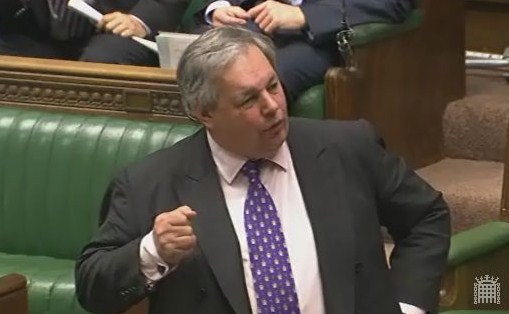 Sir Tony Baldry (Banbury) (Con): As the Minister said, Richard III was the King of all England, not just of York or Yorkshire. Is he aware that the Dean and Chapter of Leicester Cathedral see it as their responsibility to rebury the remains of King Richard and to commemorate his memory on behalf of the whole nation, and not just for Leicester or York?
Simon Hughes: I have every confidence that the Dean and Chapter of Leicester cathedral will do that job for the nation. I understand that they intend to apply for an extension so that it may be done in the spring of next year. I believe that it will be a great credit to Leicester and will bring great joy to the people of Leicestershire that a King of England is buried in their county.
(via Parliament.uk)
..without some risk, innovation and courage in this area, local government will continue to be starved not only of cash but of the civic talent it desperately needs – Bishop of Leicester, 5/6/14
On 5th June 2014 in the first of the responses from the Bishops’ Benches to the Queen’s Speech, Rt Rev Tim Stevens, Bishop of Leicester focused on the need for revitalisation of local government. Citing political disconnect and the pledge in the Queen’s Speech to deliver a fairer society, the Bishop called for a creative reinvigoration of the relationship between central and local government, not least in the areas of health and social care. He cited Leicester’s plans for the reinterment of Richard III as an example of good local partnerships that also help create a sense of shared local identity.
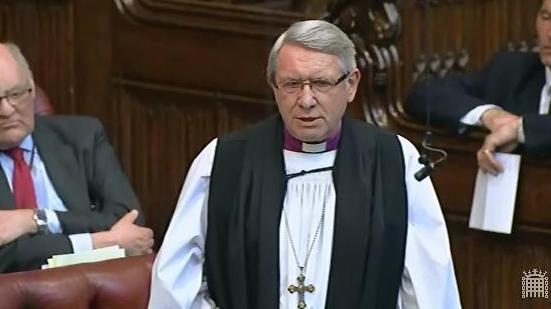
The Lord Bishop of Leicester: My Lords, I want to take the opportunity of this debate to raise some questions about the balance of power between London and the regions in our country today. The gracious Speech emphasised the new financial powers to be implemented for the Scottish Parliament and the National Assembly for Wales. While this is welcome, it highlights even more acutely the need for urgent action to address the very different environment for local government in England, in spite of what the Minister briefly said to us about resourcing local economic partnerships.
Continue reading “Queen’s Speech 2014: Bishop of Leicester on local government and civic identity”
On 3rd April 2014 the Bishop of Leicester, Rt Rev Tim Stevens, spoke during a short debate in the Lords on abortion, tabled by Baroness Knight of Collingtree. The debate title was: “To ask Her Majesty’s Government what steps they intend to take to investigate reported law breaking by those carrying out terminations of pregnancies.” The Bishop said:
The Lord Bishop of Leicester: My Lords, whatever our differing positions on the ethics of abortion, it must be a matter of widespread concern if there is the appearance of a long-standing gap between the spirit of the Abortion Act and the interpretation of the law. This is a matter of particular interest to many in the churches because of a theological commitment to the sanctity of human life, including potential human life.
Continue reading “Abortion on grounds of gender or disability: Bishop of Leicester raises concerns”
 The Church of England in Parliament
You must be logged in to post a comment.