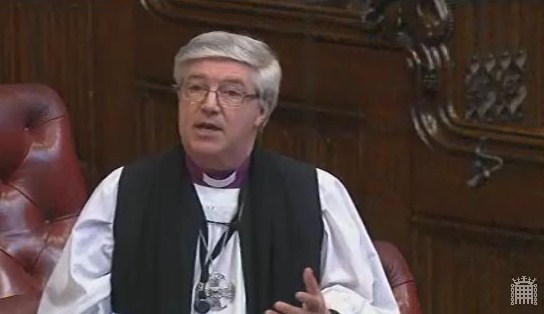
Bishop of Norwich asks question on Gangmasters Licensing Authority

On 17th November 2014, the Bishop of Norwich, the Rt Revd Graham James, received an answer to a written question from the Home Office on the subject of the Gangmasters Licensing Authority.

14.06.12 Bishop of NorwichThe Lord Bishop of Norwich: To ask Her Majesty’s Government whether they have any plans to extend the powers of the Gangmasters Licensing Authority under the Gangmasters (Licensing) Act 2004 in order to regulate gangmasters in sectors such as hand car washes. [HL2564]

The Parliamentary Under-Secretary of State, Home Office (Lord Bates): The Government has no plans to extend the licensing remit of the Gangmasters Licensing Authority to additional sectors such as hand car washes. Licensing can be an appropriate response to particular problems in particular sectors, but that does not mean it is appropriate in all cases. However the Government will keep the Gangmasters Licensing Authority’s remit under review.

(via Parliament.uk)

Bishop of Norwich calls for stronger response to tackle growth of food bank use

“When we stigmatise the poor, the unemployed and the vulnerable, we have succumbed to blaming them for their position. However, although some people stigmatise welfare claimants, many others show enormous human and social solidarity by volunteering to help them.”

On 6th November 2014, Labour Peer the Rt Hon. the Lord Whitty led a take-note debate in the House of Lords on the cumulative effects of Government economic, public spending and regulatory policies on low income and vulnerable consumers. The Bishop of Norwich, the Rt Revd Graham James, spoke in the debate. He focused his remarks on the rise in the use of food banks across his diocese, and the need for a sustained response to help reduce the use of food banks, including investment in nutrition programmes and reducing the number of delays to welfare payments. He praised those who volunteer and support food banks and other charitable responses, and cautioned some of the language used to describe those who use food banks and other forms of support.

14.06.12 Bishop of NorwichThe Lord Bishop of Norwich: My Lords, I am grateful to the noble Lord, Lord Whitty, for securing this debate, which I enter in no partisan spirit but hope to contribute some reflections from local experience in Norwich of those on low incomes in our city.

It was more than five years ago that I was first approached to become patron of the Norwich food bank, a relatively early one to be established. Its work informs a good deal of what I want to say. The necessity for it was identified before the previous general election as a result of the recession. Suddenly, people who thought themselves reasonably secure were worried. Those who were already insecure became highly vulnerable. That was all very noticeable within our church communities on the housing estates in Norwich, especially in the areas of greatest social deprivation. Continue reading “Bishop of Norwich calls for stronger response to tackle growth of food bank use”

Infrastructure Bill – Division

On 15th November 2014, three bishops voted on an amendment to the Infrastructure Bill, during its Report Stage. The amendment, tabled by Labour peer Lord Adonis, sought to create a National Infrastructure Commission, based on recommendations made by Sir John Armitt in his independent review into national infrastructure for the Labour Party.

House of Lords Division Lobby


The Bishop of Norwich, the Rt Revd Graham James, the Bishop of Portsmouth, the Rt Revd Christopher Foster, and the Bishop of St Albans, the Rt Revd Alan Smith, voted ‘content’ with the amendment. No bishop voted ‘not content’.

There were Contents: 195 | Not Contents: 235 | Result: Government Win.

(via Parliament.uk)

Bishop of Norwich calls for extension of PSVI initiative to Central African Republic

On 4th November 2014, Lord McConnell of Glenscorrodale asked Her Majesty’s Government what support they will provide to the United Nations mission in the Central African Republic. The Bishop of Norwich, the Rt Revd Graham James, asked a supplementary question:

14.06.12 Bishop of Norwich

The Lord Bishop of Norwich: My Lords, given the widespread violation of both women and children in this tragic conflict, will the Minister indicate whether there are ways in which the Government could extend the success of the Preventing Sexual Violence in Conflict Initiative to the Central African Republic?

Baroness Anelay of St Johns: The right reverend Prelate makes a very important point. The work done by my noble friends in the Foreign Office and DfID this summer is bearing good results but we need to be able to take those further forward. I listened to what he said and I will certainly take his views back to the FCO.

(via Parliament.uk)

Bishop of Norwich supports ban on pre-watershed payday loan advertising

“These loans are not being taken seriously by young people, serious though they are. We have allowed them to take over our televisions and radios, normalising them to the point where their use is seen as casual. Just this morning I was told the story of a young woman who took out a payday loan to pay for a Domino’s pizza. That could prove to be a very expensive pizza indeed.”- Bishop of Norwich, 3/11/14

On 3rd November 2014, the Bishop of Norwich, the Rt Revd Graham James, took part in the Committee Stage of the Government’s Consumer Rights Bill, speaking in favour of an amendment to regulate the advertising of payday loans to children. The Bishop highlighted the pervasiveness of pre-wateshed advertising of payday loans, and the fact that young parents were far more likely to take out a loan than older parents. He also called for greater investment in financial education.

The amendment, which was co-sponsored by the Bishop of Truro, was withdrawn at the end of the debate, with its supporters calling for the Government to take further action before the Bill returned for its Report Stage.
14.06.12 Bishop of NorwichThe Lord Bishop of Norwich: My Lords, I rise to support the noble Lord, Lord Alton, and to speak to Amendment 105B, in the name of my colleague the right reverend Prelate the Bishop of Truro, on the advertising of payday loans. He cannot be here today but has been working very closely with the Children’s Society on this issue. Amendment 105B seeks to make provisions to restrict the times at which payday loan advertisements are shown, most specifically in relation to the watershed.

It surprised me to discover that, according to Ofcom, no less than 80% of all payday loan advertisements are shown before the watershed. It is therefore no surprise—to pick up on some of the statistics that the noble Lord, Lord Alton, mentioned—that the Children’s Society found in its survey that over half of all children aged 10 to 17 reckon that they see payday loan advertisements either “often” or “all the time”. It is the sheer quantity of these advertisements that normalises payday loans for children and young people. The research shows that one-third of all teenagers think that the payday loan adverts themselves are tempting and exciting—they are very well designed. Those teenagers are much more likely than their counterparts to say that they would consider taking out a payday loan in the future. Continue reading “Bishop of Norwich supports ban on pre-watershed payday loan advertising”

Bishop of Norwich calls for focus on family well-being in handling of Chilcot Inquiry

On 3rd November 2014, Lord Dykes asked Her Majesty’s Government what steps they are taking to expedite the publication of the report by the Chilcot Inquiry. The Bishop of Norwich, the Rt Revd Graham James, asked a supplementary question:

14.06.12 Bishop of NorwichThe Lord Bishop of Norwich: My Lords, does the Minister accept that repeated press reports of rows between the Cabinet Office and the inquiry over the declassification of documents are deeply hurtful to the families most affected by the Iraq conflict? Does he agree that until the inquiry is completed, many bereaved and grieving families will not be able to move on?

Lord Wallace of Saltaire: My Lords, I appreciate that many have been affected by the issues studied by this inquiry. I am not aware of any rows between the Cabinet Office and the inquiry. I am aware of a long series of complex discussions within the British Government, between the British Government and our allies and with the inquiry about the exact nature of what should be published. I am conscious that what will be published includes notes from more than 200 Cabinet meetings, for example, including some extracts from Cabinet minutes.

(via Parliament.uk)

Votes on the Deregulation Bill

On 21st October 2014 three bishops took part in three votes on the Government’s Deregulation Bill during the House of Lords committee stage . Details on the Bill can be found here. Continue reading “Votes on the Deregulation Bill”

House of Lords debates ‘the importance of the English Parish Church’

“No other country in Europe has less financial support from the taxpayer for ecclesiastical heritage than England—which, ironically, has an established church” – Bishop of Norwich, 12/6/14

On 12th June Lord Cormack led a debate in the House of Lords on the subject ‘That this House takes note of the importance of the English parish church.’ The Bishop of Norwich spoke in the debate, about the community and financial value of parish churches, their heritage importance and current financial pressures. Lord Ahmad responded for the Government. Their speeches are reproduced in full below. The Bishop’s speech can also be viewed at ParliamentLive.TV and a useful summary of the debate can be found on the Law & Religion UK website, here.

14.06.12 Bishop of Norwich

The Lord Bishop of Norwich: My Lords, we are meant to declare our interests in this House, but I think that standing here dressed like this is probably a visual declaration. Noble Lords will not be surprised to learn that I believe that the Motion tabled by the noble Lord, Lord Cormack, to take note of the importance of our parish churches, is one that I am happy to endorse. It applies in Wales and Scotland as well, of course, although I need to be a bit careful of the Presbyterian conscience and not presume any authority north of the border. Continue reading “House of Lords debates ‘the importance of the English Parish Church’”

Bishop of Norwich presses Government on lack of affordable new homes in rural areas

On 12th June 2014 Lord Dubs asked Her Majesty’s Government ‘what action they are taking to increase the supply of affordable housing.’ The Bishop of Norwich, Rt Rev Graham James, asked a supplementary question:14.06.12 Bishop of Norwich

The Lord Bishop of Norwich: My Lords, eight years ago the Affordable Rural Housing Commission estimated that we needed at least 11,000 affordable new homes every year in rural areas. We have scarcely ever managed more than a third of that number, and the proportion is falling. That means that those who need such homes in rural areas move to urban areas, adding to the numbers of the urban homeless and further obscuring the rural problem. What remedy does the Minister have for this state of affairs? Continue reading “Bishop of Norwich presses Government on lack of affordable new homes in rural areas”

Bishop of Norwich on contribution of cathedrals and hopes for female bishops

I want to draw attention briefly to a remarkable cultural development—the renewal of our cathedrals where, I hope and pray, the first female diocesan bishops will be enthroned – Bishop of Norwich, 11/6/14

On 11th June 2014, in the eighth contribution to the debate on the Queen’s Speech from the Lords Spiritual, the Bishop of Norwich, Rt Rev Graham James, focused on constitutional and heritage issues. The Bishop spoke of his hope that female bishops would soon be able to join the Bench of Bishops in the House of Lords, and highlighted the cultural and economic impact of cathedrals in the life of the country.

The Lord Bishop of Norwich: My Lords, the Scottish referendum means that we face constitutional change, or the possibility of it, on a massive scale. I recall someone remarking that constitutional change in Britain is a bit like unpicking a ball of wool—once it unravels, it is hard to stop without creating a knotty mess. That is neither an argument against constitutional change nor against knitting but it does call for a good pattern to follow.