
On 28th January 2020 the House of Lords debated a question from Lord Collins of Highbury, asking Government”what consideration they have given to formulating their pledge at the Tokyo Nutrition for Growth 2020 summit, and what they are doing to build commitments from other countries.” The Bishop of Oxford, Rt Revd Steven Croft, spoke in the debate:
 The Lord Bishop of Oxford: My Lords, I, too, welcome this timely debate. I thank the noble Lord, Lord Collins, and welcome the opportunity offered by the Tokyo Nutrition for Growth Summit.
It is moving to note, as other noble Lords have mentioned, that the number of people suffering from hunger has been increasing since 2015, albeit slowly. We know that behind the statistics lie terrible and moving stories of human suffering, disease and death, especially across Asia and sub-Saharan Africa. It is sobering to ponder on the one hand the challenge of providing a sustainable diet and preventing the lifelong consequences of malnutrition and, on the other, the striking rise in obesity across the world and consequent health problems. Continue reading “Bishop of Oxford asks Government about links between food security, poor nutrition and climate change”
 On 26th June 2019 Lord Bird asked the Government, “by what means, if at all, they require public bodies to act, and to demonstrate how they act, in a manner which seeks to ensure that the needs of the present generation are met without compromising the ability of future generations to meet their own needs.” The Bishop of Oxford, Rt Revd Steven Croft, asked a follow-up question:
 The Lord Bishop of Oxford: My Lords, I too welcome this debate and thank the noble Lord, Lord Bird, very warmly for bringing it. I welcome his proposals. As the noble Lord, Lord Layard, said, the foundation is a moral and ethical case. That moral case has shifted in recent years because of the realisation of the effects of the Anthropocene era. Humanity’s effect on the environment means that the interests of not just the next generation but every generation beyond that need to be protected in our policy-making and debate.
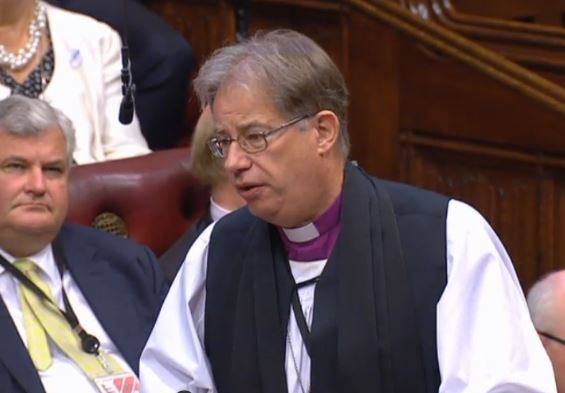 The Lord Bishop of Oxford: My Lords, those were extremely moving speeches. I thank the noble Lords, Lord Faulkner, Lord Collins and Lord Cashman, and the noble Baroness, Lady Brinton, for the contributions they have made in the Chamber today and the moving way in which they have spoken. I thank them for sharing their personal experiences so movingly, and for the important and necessary articulation of the views they have heard within the broader Church of England in favour of movement and inclusion. I deeply regret the language used in writing to the noble Lord, Lord Collins, and others; it has no place in the contemporary Church.
 On 19th November 2018, Lord Clement-Jones tabled a Motion ‘That this House takes note of the Report from the Select Committee on Artificial Intelligence AI in the UK: ready, willing and able? (HL Paper 100).’ The Bishop of Oxford, the Rt Revd Steven Croft, served on the committee that produced the report and he spoke in the debate:
 On 5th July 2018 Baroness Bakewell led a debate on the motion “That this House takes note of part-time and continuing education, and in particular the future of the Open University.” The Bishop of Oxford, Rt Revd Steven Croft, spoke in the debate:
 The Church of England in Parliament
You must be logged in to post a comment.