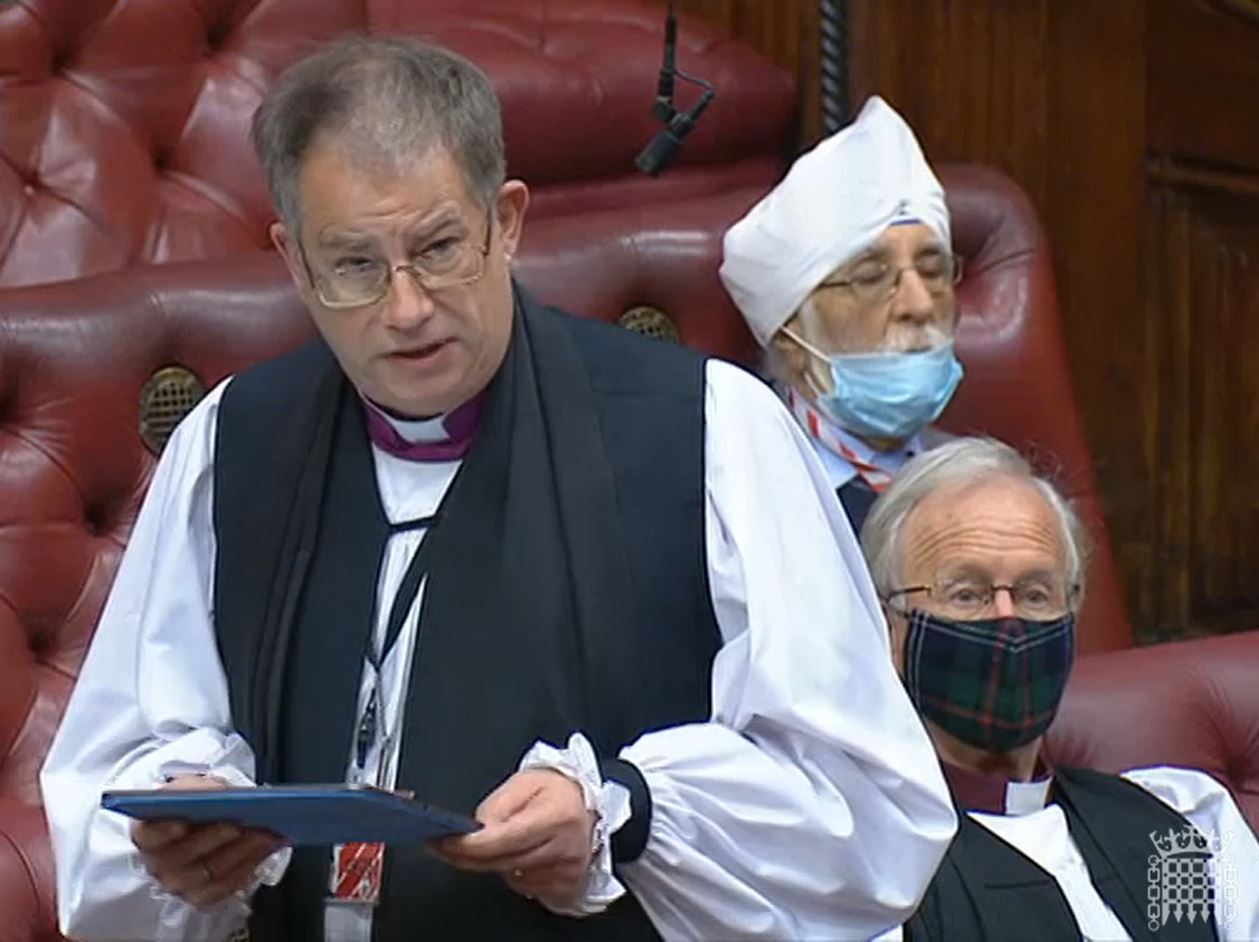
Bishop of Oxford asks about the cost of energy

On 6th September 2022, the Bishop of Oxford asked a question on energy bills for low income families:

The Lord Bishop of Oxford: My Lords, it is very good to hear that a plan is in place to address this catastrophe, which is concerning so many people, and to bring help to households. What steps will the Government take to address this fundamental failure of the market, such that huge, almost unimaginable profits are accruing to energy companies, while the poorest in the country face the dreadful choice between heating and eating?

Continue reading “Bishop of Oxford asks about the cost of energy”

Bishop of Oxford asks about autonomous weapons

The Bishop of Oxford received the following written answers on 5th September 2022:

The Lord Bishop of Oxford asked Her Majesty’s Government, further to their policy paper Ambitious, Safe, Responsible: Our approach to the delivery of AI enabled capability in Defence, published on 15 June, which says that “We do not rule out incorporating AI within weapon systems” and that real-time human supervision of such systems “may act as an unnecessary and inappropriate constraint on operational performance”, when this would be seen as a constraint; and whether they can provide assurance that the UK’s weapon systems will remain under human supervision at the point when any decision to take a human life is made.

Continue reading “Bishop of Oxford asks about autonomous weapons”

Bishop of Oxford speaks in a debate on artificial intelligence

The House of Lords debated the AI in the UK (Liaison Committee Report) in grand committee on 25th May 2022. The Bishop of Oxford spoke in the debate:

The Lord Bishop of Oxford: My Lords, it is a pleasure to follow the noble Lord, Lord Evans, and thank him in this context for his report, which I found extremely helpful when it was published and subsequently. It has been a privilege to engage with the questions around AI over the last five years through the original AI Select Committee so ably chaired by the noble Lord, Lord Clement-Jones, in the Liaison Committee and as a founding board member for three years of the Centre for Data Ethics and Innovation. I thank the noble Lord for his masterly introduction today and other noble Lords for their contributions.

There has been a great deal of investment, thought and reflection regarding the ethics of artificial intelligence over the last five years in government, the National Health Service, the CDEI and elsewhere—in universities, with several new centres emerging, including in the universities of Oxford and Oxford Brookes, and by the Church and faith communities. Special mention should be made of the Rome Call for AI Ethics, signed by Pope Francis, Microsoft, IBM and others at the Vatican in February 2020, and its six principles of transparency, inclusion, accountability, impartiality, reliability and security. The most reverend Primate the Archbishop of Canterbury has led the formation of a new Anglican Communion Science Commission, drawing together senior scientists and Church leaders across the globe to explore, among other things, the impact of new technologies.

Continue reading “Bishop of Oxford speaks in a debate on artificial intelligence”

Bishop of Oxford asks about the cost of living

The Bishop of Oxford asked the following question in a debate about the cost of living, on 25th May 2022:

The Lord Bishop of Oxford: My Lords, the Minister and other noble Lords will be aware of the paradox that it is often the very poorest people in society who pay a higher tariff for their electricity through pre-payment meters and the like. They may not have bank accounts or the ability to pay on any kind of credit. Are the Government proposing to do anything to help and support those who are locked into these higher energy prices when they can least afford then?

Continue reading “Bishop of Oxford asks about the cost of living”

Bishop of Oxford asks about zoonotic diseases

On 24th May 2022, the Bishop of Oxford asked a question during a debate on establishing a zoonosis research centre in the UK:

The Lord Bishop of Oxford: My Lords, I am sure the Minister is aware that the rapid increase in zoonotic diseases has its roots in the environmental crisis: deforestation, habitat destruction, intensive farming and unregulated trade in wild animals. Therefore, as well as the vital areas of medical research and response to disease, how are the Government focusing their intervention on prevention as well as diagnosis and cure?

Continue reading “Bishop of Oxford asks about zoonotic diseases”

Bishop of Oxford asks about targeted support for poorest community members

The Bishop of Oxford asked a question during a debate on inflation on 23rd May 2022:

The Lord Bishop of Oxford: My Lords, I have seen at first hand from touring every part of the three counties in the Diocese of Oxford the rise in the take-up of food banks in recent weeks. I pay tribute to all those who work and volunteer in them. I have heard heartbreaking stories of those who need to use them. The Government’s response to the Covid pandemic was remarkable in its creativity and urgency, helping the poorest. Will we see now a windfall tax? Will we see more targeted support for the poorest in the communities as an urgent matter?

Continue reading “Bishop of Oxford asks about targeted support for poorest community members”

Bishop of Oxford speaks in a debate on the Schools Bill

On 23rd May 2022, the House of Lords debated the Schools Bill (2022) in its second reading. The Bishop of Oxford spoke in the debate in regards to faith schools and rural schools. The Bill was read through and committed to a committee of the whole house:

The Lord Bishop of Oxford: My Lords, there is much to welcome in the new Bill, as my colleague the right reverend Prelate the Bishop of Durham and other noble Lords have indicated. In particular, it is good to know the Government’s direction of travel on academisation and the continued emphasis on raising standards. I support the comments made by other noble Lords on the need properly to resource our schools, particularly in the aftermath of the pandemic, to safeguard the morale of heads, governors and teachers and to pay much greater attention to mental health provision.

It is vital as well to continue to build on secure partnerships across the statutory, voluntary, church and faiths sector. The education of our children has never been the sole responsibility of central government—it is the responsibility of all. These vital partnerships have flourished for many decades to the mutual benefit of all and the common good. It is very good to note the Government’s intention to safeguard those partnerships into the future through the Bill and the process of academisation which will follow. One of the tests of the Bill will be the strengthening of social capital and intermediate institutions.

Continue reading “Bishop of Oxford speaks in a debate on the Schools Bill”

Queen’s Speech: Bishop of Oxford speaks about levelling up and the environment

On 11th May 2022, the House of Lords debated the Queen’s Speech. The Bishop of Oxford spoke in the debate:

The Lord Bishop of Oxford: My Lords, it is a privilege to share in this debate, and I thank the Minister for her careful and thoughtful introduction. I particularly look forward to the maiden speech of my colleague, the right reverend Prelate the Bishop of Guildford. I have heard him speak before, and it is always a profitable experience.

I congratulate the Government warmly on the priority given to the levelling-up agenda and the ambition of 11 of the 12 missions outlined in the White Paper. I know from my seven years as Bishop of Sheffield that the gap between different parts of the country has been widening for many years, and it is very good that this is being addressed.

Continue reading “Queen’s Speech: Bishop of Oxford speaks about levelling up and the environment”

Bishop of Oxford asks about use of surveillance technology in the workplace

The Bishop of Oxford asked a question on surveillance technology on 6th April 2022, during a debate on the introduction of a future Employment Bill:

The Lord Bishop of Oxford: My Lords, technology has intruded further into the world of work over the last five years. Many developments are helpful, but some are not. Almost 60% of workers now report some form of technological surveillance at work, often through so-called bossware, often introduced without consultation with unions and workers. How will the employment Bill eventually keep pace with this development, and will it introduce a statutory requirement on employers to consult and disclose the use of algorithmic and AI surveillance on employees, and protect workers from excessive surveillance by technology?

Continue reading “Bishop of Oxford asks about use of surveillance technology in the workplace”

Bishop of Oxford asks about facial recognition technology (FRT)

On 4th April 2022, the Bishop of Oxford asked a question during a debate on facial recognition technology and policing:

The Lord Bishop of Oxford: My Lords, I declare an interest as a former board member of the Centre for Data Ethics and Innovation. I wonder if the Minister would comment on the vital importance of establishing public trust and confidence in the deployment of FRT and indeed any new technology, especially in such a sensitive area as policing. A range of concerns have been raised about rapid deployment, governance and bias by the CDEI, the European Union and the makers of popular documentaries. Yet, in the face of this, the Met and South Wales Police have both announced a ramping up of the use of FRT. Does the Minister agree that it is time to slow this down and for urgent parliamentary scrutiny and better governance of the police’s use of facial recognition technology?

Continue reading “Bishop of Oxford asks about facial recognition technology (FRT)”