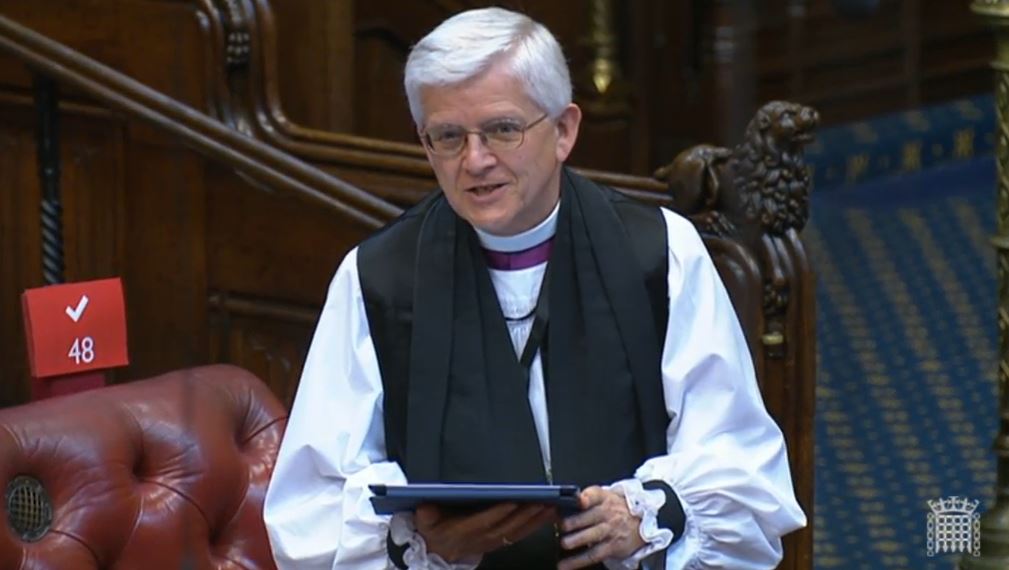
On 23rd June, the House of Lords debated the Social Security (Additional Payments) Bill in its first reading. The Bishop of Blackburn asked a question in the debate:
The Lord Bishop of Blackburn: I support the provisions in the Bill that strengthen the right to free speech and the freedom to believe, and the expression of that belief.
On 23rd June 2022 the House of Lords debated a motion from Lord Morse, “That this House takes note of the impact on the democratic process of any reduction in the standards of behaviour and honesty in political life.”
The Lord Bishop of Blackburn: My Lords, I am grateful to the noble Lord, Lord Morse, for this debate because it gives us the opportunity to speak here about what the country is talking about: a general concern about behaviour and honesty in political life, and I trust, therefore, about the institution of Parliament and democracy. It raises the key question: are there standards and values that govern and guide our way of life and our dealing with one another? If so, what are they are where do they come from? Or is there a vacuum in which everyone decides what is right in their own eyes? I would argue that, without a moral framework, we are bound and dictated to by those who shout the loudest and make their voices heard. That is a dangerous path to go down.
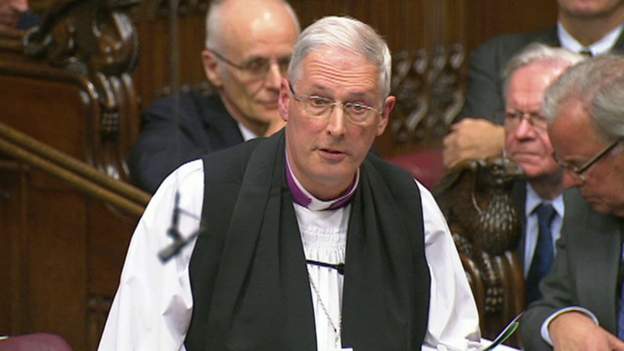
The Bishop of Leeds asked the following question on 16th June 2022:
The Lord Bishop of Leeds: My Lords, we know that the Prime Minister deems the Nolan principles vital. Why has he not really responded to Sue Gray’s report, where the question of leadership was raised?
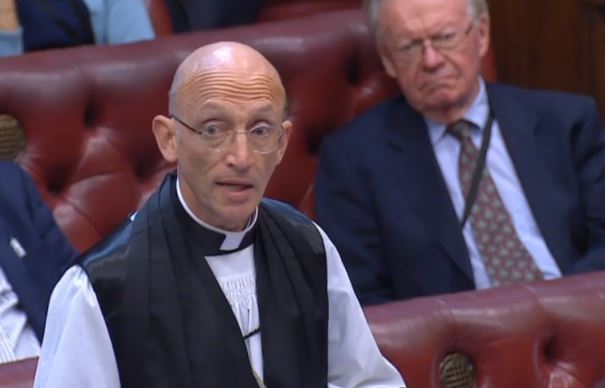
On 16th June 2022, the House of Lords debated the co-location of the Houses of Parliament. The Bishop of Southwark spoke in the debate:
My Lords, I am grateful to the noble Lord, Lord Norton of Louth, for securing this debate and bringing to it his distinguished record as a scholar of our constitution and of Parliament. My own contribution to the debate will, I think, chime with much of what we have heard already from noble Lords.
I wish to make a few simple points. First, we are two Houses but one Parliament, a point that has already been made. Secondly, although Covid has taught us much about the flexibility afforded by current technology, as did universal postage, the telegram, and the telephone in their day, it has also taught us a good deal about the importance of physical proximity. Finally, as has been eloquently pointed out, to separate out what was never meant to be put asunder will mean that the role of this House and its usefulness will diminish, and the capability of Parliament with it.
On 22nd February 2022, the House of Lords debated a motion ‘That the Report from the Select Committee Divisions: pass-readers; Sessional select committees; Participation of eligible members in oral statements and repeated urgent questions (6th Report, HL Paper 152) be agreed to.’ A vote was held on an amendment to the motion, in which a Bishop took part.
On 9th February 2022, the House of Lords debated the Dissolution and Calling of Parliaments Bill. Votes were held on amendments to the Bill, in which a bishop took part.
On 15th December 2021, the House of Lords debated a motion to approve continued COVID-19 Health Protection Restrictions. The Bishop of Leeds spoke in the debate, responding to issues of public health and personal freedom raised by other peers, and contrasting these issues with approaches to other legislation:
The Lord Bishop of Leeds: My Lords, in one sense I hesitate to contribute to this debate, which has been very interesting for lots of reasons. We sit in a Chamber where we contribute to the making of law, which is precisely about the infringement of people’s freedoms—that is what law is—so I struggle with the arguments about freedom. Yesterday or the day before we talked about infringing people’s freedoms regarding the right to protest, for example. I hope to hear the same arguments about the importance of freedom when we get to some of those very restrictive debates.
There are two issues here that we must not confuse. One is the public health issue and the demands of that; I hear everything that has been said about good scientists and bad scientists, and I totally agree that science is not God and scientists are not messiahs—noble Lords would expect me to say that anyway—but our job is to interpret the science with a view to then taking responsible decisions on behalf of other people. Like the noble Lord, Lord Thomas of Gresford, and his immuno- compromised situation, my wife up in Leeds is immuno- compromised because of radical chemotherapy for cancer at the moment. I had to think very carefully about whether I should come down here, and I question how it will be when I go back.
On 13th July 2021, the House of Lords debated a report from the Procedures and Privileges Committee regarding proposed changes to procedures in the House. Votes were held on a motion to approve the changes, and amendments to the main motion, in which Bishops took part:
On 13th July 2021, the House of Lords debated the motion:
“that the Report from the Select Committee Procedural adaptations arising from the hybrid House; Interim option of voting using PeerHub; Ongoing virtual participation by disabled members (1st Report, HL Paper 41) be agreed to.”
The Bishop of Chichester spoke in the debate, welcoming steps to retain some hybrid adaptations, but expressing concern over the proposed changes to some oral question procedures:
The Lord Bishop of Chichester: My Lords, my right reverend friend the Bishop of Birmingham, who is our convenor, regrets that he cannot attend today’s debate. As Bishop on duty, I offer some thoughts on behalf of these Benches. On behalf of my right reverend friends, I thank the Leader of the House and the leaders of the parties, and especially all the staff who have seen us through this extremely challenging time. All of us have a particular debt of gratitude to those in the digital and technical spheres, which many of us struggle with. I noted earlier that it has enabled some of my right reverend friends to share with the House the interior of their splendid cathedrals, so that has been great. I am grateful to the noble and learned Lord, Lord Mackay, for his recognition that being present in the House is also a very important contribution on our behalf.
I speak as a relative newcomer to your Lordships’ House, and as one of those Members, found on all sides of the House, who combines their service here with a significant full-time outside commitment. It is one of the strengths of this House that it gives space for this, so that membership is not just for what might be described as the full-time, professional politician. The assessment of any change to our procedure should not only test efficiency in our working practices and the capacity for inclusion in them but demonstrate how it will enable those who are not full-time to participate as fully as possible to bring into the debate and scrutiny this House exercises the wide range of experience that they bring.
It is an extraordinary responsibility to attend Parliament. As bishops, our faith compels us to raise questions with those in power about people on the margins, children, the voiceless, the many attacks on human rights abroad, and solutions to the climate emergency.
We are not there to simply defend the interests of the established church, or speak only for people of faith, but to play our own part in holding our elected powers to account on behalf of those who need us most, and help the process of making better law.
We have been at the forefront of recent campaigns in Parliament on justice for leaseholders facing fire safety costs, on prison reform, welfare of migrants and refugees, and on harms caused by gambling.


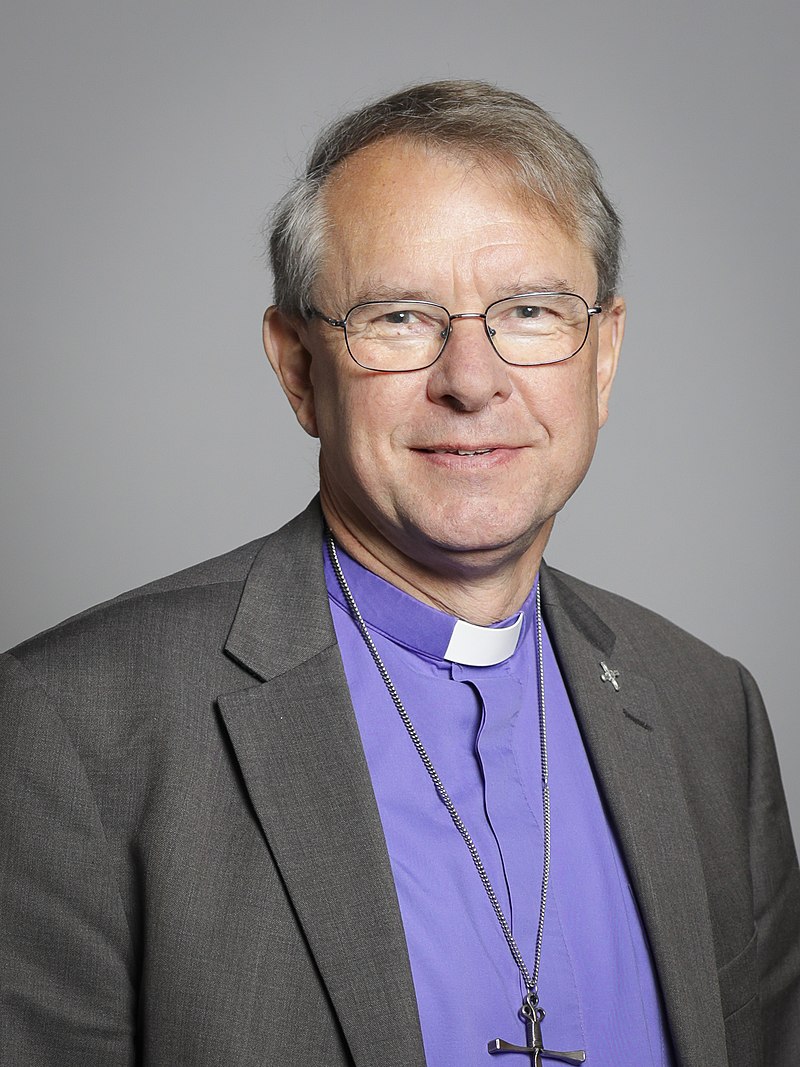
 The Church of England in Parliament
You must be logged in to post a comment.