
On 29th February 2016, the House of Lords considered changes made in the House of Commons to the Government’s Welfare and Work Reform Bill. Earlier, MPs had voted to reject an amendment to the Bill tabled by the Bishop of Durham and passed by the House of Lords, which made it a duty of the Secretary of State to report annually on income measures of child poverty. In its place Lord Freud, Minister for Welfare Reform, tabled an alternative Government amendment in the Lords, to require government to annually publish the child poverty income measures, without requiring a report to be laid before Parliament. The Bishop of Durham, the Rt Revd Paul Butler, and the Bishop of Portsmouth, the Rt Revd Christopher Foster, both welcomed this concession by Government. Lord Freud’s speech introducing that amendment can be seen here. The Bishop of Durham’s response can be seen here.The Bishop of Portsmouth’s response is below, in which he also pressed the Minister on points he had made at earlier stages about the two-child limit and impact on those who are bereaved or fleeing domestic violence.
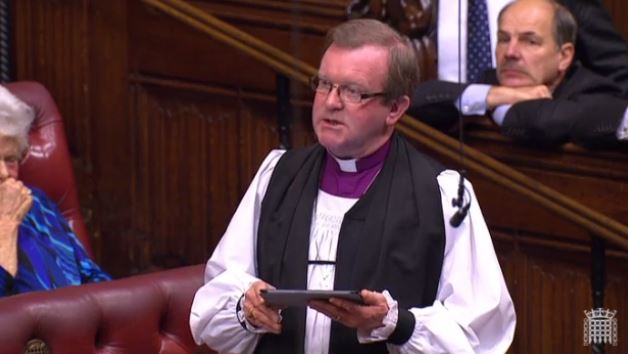 The Lord Bishop of Portsmouth: My Lords, I, too, am grateful for the Government’s decision to publish under obligation the three HBAI low-income measures, along with the further measure of children in persistent poverty. In welcoming this response to the clear wish of the House, I will not detain the House with my commentary on the tortuous routes to this wise and welcome decision, tempting though that is; we are in Lent and bidden not to succumb to temptation. As we have so powerfully and carefully considered in this House the plight particularly of children in poverty, I recall that the Minister said that he expected the Government to come under further pressure—I paraphrase—and I do not want to disappoint him. Continue reading “Welfare Reform Bill: Bishop of Portsmouth welcomes child poverty proposals and presses Government on two-child limit”
 The Lord Bishop of Durham: My Lords, throughout our debates on the Bill, we have all consistently expressed our desire to see child poverty in our nation reduced and, ultimately, eradicated. We have different views about how this might best be achieved, and about the impact the Bill will have. I continue to have deep concerns about its impact. I fear that it will lead to more children and families being poor.
  The Lord Bishop of Portsmouth: My Lords, by happy coincidence, this debate takes place almost exactly on the anniversary of the signing of the Armed Forces corporate covenant by the right reverend Primates the Archbishops of Canterbury and York. There has been excellent work with the Minister in developing the impact of that covenant, and it is a pleasure to mark that anniversary today and anticipate the maiden speeches this afternoon.
 On 27th January 2016 the Bishop of Portsmouth, the Rt Revd Christopher Foster opened the second day of Report Stage on the Government’s
 The Lord Bishop of Portsmouth: My Lords, I tabled Amendment 21 to highlight the impact of this measure on different faith communities who share our concerns with this part of the Bill in particular. Noble Lords who attended the special briefing we organised two weeks ago will have heard Chaya Spitz, chief executive of the Interlink Foundation, speak passionately about the implications for the Orthodox Jewish community that she represents and is a member of. For her community, larger families are the norm and the central pivot around which everything else revolves. There is a positive, faith-based imperative to have children, to create the next generation in service of God. There is also a commonly held conscientious objection to the use of artificial contraception, except in prescribed circumstances, and to abortion, except in rare circumstances. By limiting financial support to the first two children, this policy is making a judgment that touches on deeply personal and strongly held religious and cultural beliefs about the family, and that threatens the viability of whole faith communities.
 The Lord Bishop of Portsmouth: My Lords, I highlight two particularly vulnerable groups in my Amendments 5, 6, 13 and 14, groups that I believe should be exempted from this measure. These are bereaved parents and victims of domestic abuse. In focusing so heavily on promoting personal responsibility, there is always a danger with welfare reforms that we neglect our collective responsibility to look after those who fall on difficult times, people we will probably never meet but whom we support through our taxes in their time of need so that we, too, will be supported when we need help.
 The Church of England in Parliament
You must be logged in to post a comment.