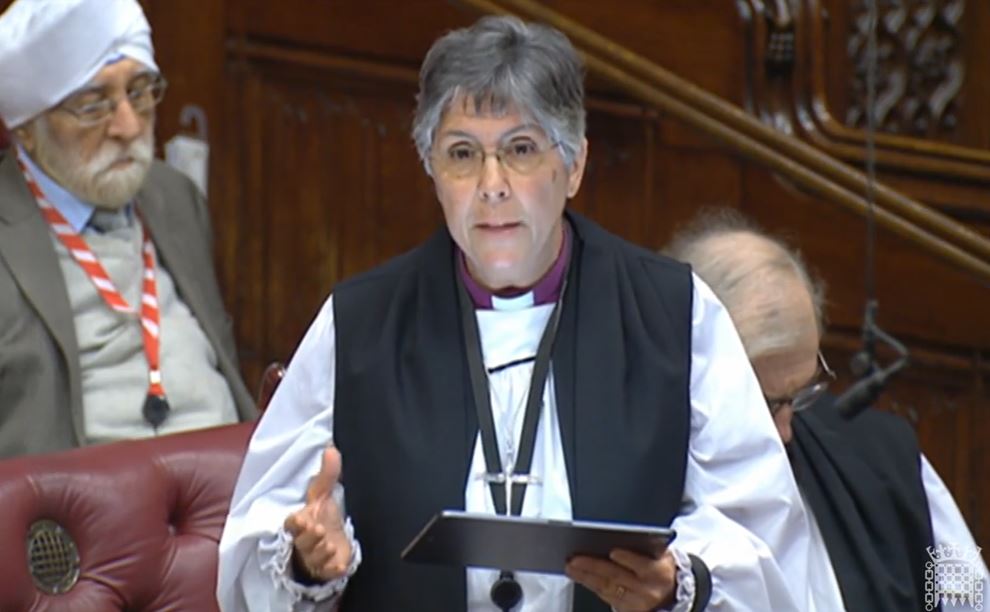
Bishop of Sheffield asks about educational attainment gap

The Bishop of Sheffield received the following written answer on 2nd December 2024:

The Lord Bishop of Sheffield asked His Majesty’s Government what assessment they have made of the finding in the Joseph Rowntree Foundation report UK Poverty 2024: The essential guide to understanding poverty in the UK, published on 23 January, that of all entrants into first class undergraduate degrees in 2021–22, “just one per cent had a parent who was long-term unemployed or had never worked”; and what steps they are taking to reduce this educational attainment gap.

Continue reading “Bishop of Sheffield asks about educational attainment gap”

Bishop of St Albans asks about poverty and debt

The Bishop of St Albans received the following written answers on 24th October 2024:

The Lord Bishop of St Albans asked His Majesty’s Government, with regard to the finding in the Christians Against Poverty report Under the rubble of debt and poverty, published in May, that 59 per cent of their new clients had incomes below the poverty line, what steps they will take to reduce the number of individuals living below this threshold.

Baroness Sherlock (Lab, DWP): This government is committed to tackling poverty.

Continue reading “Bishop of St Albans asks about poverty and debt”

Bishop of Newcastle asks about child poverty and benefits system

The Bishop of Newcastle received the following written answers on 24th October 2024:

The Lord Bishop of Newcastle asked His Majesty’s Government what assessment they have made of the financial impact that the five-week wait has on those awaiting their first Universal Credit payment.

Baroness Sherlock (Lab, DWP): No assessment has been made of the financial impact of the 5-week-wait. The Government is committed to reviewing Universal Credit so that it makes work pay and tackles poverty.

Continue reading “Bishop of Newcastle asks about child poverty and benefits system”

Bishop of Manchester asks about issue of holiday hunger for children

The Bishop of Manchester asked a question on the governments plans to tackle holiday hunger for children on 24th July 2024, raising the example of church projects offering support to children and families in school holidays:

The Lord Bishop of Manchester: Something like seven out of every eight local authorities now use this money to alleviate holiday hunger among our children. Can we have any hope that the Government will look at a more strategic way of helping children cope with hunger during the school holidays? Many of the churches in my diocese, and those of my right reverend friends here, are having to put on voluntary projects to support children during those periods. What can we hope for?

Continue reading “Bishop of Manchester asks about issue of holiday hunger for children”

King’s Speech Debate: Bishop of Lincoln speaks on impact of poverty in rural and coastal communities

The Bishop of Lincoln spoke in the King’s Speech debate on 19th July 2024, raising the issue of poverty in coastal and rural areas and the subsequent effects on children’s mental health and wellbeing:

The Lord Bishop of Lincoln: My Lords, I share your Lordships’ appreciation of the noble Baronesses, Lady Barran and Lady Jolly, and I welcome the appointment of our new Ministers. The noble Baroness, Lady Merron, will know as much as I do about Lincolnshire and that, particularly in its coastal towns and rural areas, Lincolnshire suffers from intergenerational poverty, which has a very direct impact on children. I think your Lordships’ House has received two reports in the last 15 years about the poverty in our coastal towns, but nothing much has changed. If I have heard the Government correctly, I am glad to hear them express their intention to pay more attention to rural and coastal poverty, which is often hidden away when it is not in our big cities.

Therefore, I also particularly look forward to the progress of the children’s well-being Bill and the work of the newly announced child poverty unit. In moving forward in this area, how do His Majesty’s Government plan to involve faith communities in addressing these needs, particularly considering the concentration of faith communities in areas of poverty and deprivation, as my right reverend friend the Bishop of London referred to earlier?

Continue reading “King’s Speech Debate: Bishop of Lincoln speaks on impact of poverty in rural and coastal communities”

Bishop of Leicester asks about assessing impact of the two-child limit

The Bishop of Leicester received the following written answer on 24th April 2024:

The Lord Bishop of Leicester asked His Majesty’s Government, further to the Written Answer by Viscount Younger of Leckie on 27 March (HL3520), why it is not possible to undertake a robust assessment of the impact of the two-child limit.

Continue reading “Bishop of Leicester asks about assessing impact of the two-child limit”

Bishop of Leicester asks about impact of the two-child limit for child benefit on poverty

The Bishop of Leicester received the following written answer on 27th March 2024:

The Lord Bishop of Leicester asked His Majesty’s Government, further to the answer by Lord Markham on 11 March (HL Deb col 1802), and taking account of the latest Households Below Average Income data, which shows a 300,000 increase in the number of children living in absolute poverty in the past year, what assessment they have made of the impact on health and well-being of the two-child limit for child benefit; and what assessment they have made of the strengths and weaknesses of using the measure of absolute poverty rather than relative poverty.

Continue reading “Bishop of Leicester asks about impact of the two-child limit for child benefit on poverty”

Bishop of Leicester asks about impact of the two-child benefit limit

The Bishop of Leicester asked a question on the impact of the two-child limit on families receiving child benefit payments on 11th March 2024:

The Lord Bishop of Leicester: My Lords, there is strong evidence that in the early 2000s increases in child benefits led to an increase in the amount parents spent on fruit and vegetables and books and toys for their children. What assessment have the Government made of the impact of the two-child limit on benefits and, in particular, on the health and well-being of the 1.5 million children affected?

Continue reading “Bishop of Leicester asks about impact of the two-child benefit limit”

Bishop of Southwark takes part in debate marking International Women’s’ day

The Bishop of Southwark gave a speech during a debate to mark international women’s day on 8th March 2024, paying tribute to the women of the Bishops Benches and raising the impact of poverty on women in the UK and overseas:

The Lord Bishop of Southwark: My Lords, I thank the noble Baroness, Lady Barran, for securing this important debate on International Women’s Day. I look forward to the maiden speech of the noble Baroness, Lady Casey of Blackstock.

It is my belief that the kingdom of God is a place of radical inclusion in which all are welcome and all shall flourish. I speak as the duty bishop today, but I am mindful of the determined advocates on this Bench, which include the right reverend Prelate the Bishop of Gloucester, who is attending the 68th session of the Commission on the Status of Women at the United Nations headquarters in New York.

Continue reading “Bishop of Southwark takes part in debate marking International Women’s’ day”

Bishop of Hereford makes maiden speech on poverty in rural communities

On 22nd February 2024, the Bishop of Hereford made his maiden speech during a debate on poverty reduction, focusing on tackling poverty in rural communities:

The Lord Bishop of Hereford: My Lords, I begin by recording my grateful thanks for the welcome and encouragement I have received since my introduction to your Lordships’ House. I am especially grateful for the forbearance of the staff as they have helped me navigate the labyrinthine corridors of this place, and to my colleagues for their patience in introducing me to the various procedures and protocols that govern our business.

I became the Bishop of Hereford in early 2020, just before the start of the first lockdown. The diocese of Hereford celebrates the 1,350th anniversary of its foundation in 2026—we are a diocese that predates the foundation of England. Indeed, the earliest timbers in the episcopal residence were acorns in the year 910. I have both worthy and ignoble predecessors in this role. I have already done better than four of them, who never actually came to the diocese at all. I hope not to emulate one of my Saxon predecessors, who, angered by the burning of the cathedral by the Welsh in 1055, took up arms with some of the canons and died in battle as a result. I also hope to avoid the fate of the cousin of the bishop who was murdered in the garden in 1256 on the coat-tails of his cousin’s unpopularity.

Hereford is the smallest and most rural diocese in England. We comprise the counties of Herefordshire and the southern half of Shropshire, one parish in Worcestershire and 14 in Wales. Sustaining a diocesan infrastructure with such a small base presents its challenges. For every 800 people who live here, we have one church building, and three-quarters of them are grade 1 listed.

Continue reading “Bishop of Hereford makes maiden speech on poverty in rural communities”