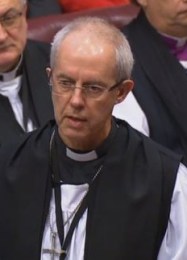
 On 25th July 2019 the Leader of the House of Lords (Baroness Evans of Bowes Park) repeated a statement made in the House of Commons by the new Prime Minister, Boris Johnson. The Archbishop of Canterbury, Most Revd and Rt Hon Justin Welby, asked a follow-up question:
The Lord Archbishop of Canterbury: My Lords, I welcome the repetition of the Statement. We on these Benches wish to express our thanks to the Chief Whip, the noble Lord, Lord Taylor, and to Mr Evans. We tend to turn over numbers rather more regularly than your Lordships and have always been very well welcomed. We are deeply grateful and will miss them both very much indeed. I say that on behalf of all Members of these Benches—including the ones in disguise [indicates Lord McFall, sitting beside].
To move away from Brexit for a moment, the Statement talks powerfully about ambitions for education, tackling crime, social care and health, and about increasing funding for them very significantly.
All that will of course be most welcome—if it comes. The issue, though, is that money does not do it all. In all those areas, the impact of households and families in their many diverse forms today is crucial. Social care is best handled—most effectively and affectionately—from within the home.
Continue reading “Archbishop of Canterbury responds to statement by new Prime Minister, stresses importance of support for families”

 The Lord Bishop of London: My Lords, I am sure the Minister knows that safety is about not just numbers but the continuing development and supervision of nurses and midwives. Can she comment on what the Government are doing to ensure that both nurses and midwives are funded properly for clinical supervision and professional development?
 On 22nd October 2019 Parliament continued to debate the Queen’s Speech, including scrutiny of measures relating to Health and Social Care. The Bishop of London, Rt Revd Sarah Mullally (and formerly Chief Nursing Officer for England), contributed to the debate:
 On 30th July 2019 the Bishop of Durham, Rt Revd Paul Butler, received a written answer from Government, in reply to three questions about children and vulnerable EU nationals and the EU Settlement Scheme:
 On 25th July 2019 Baroness Wheeler asked the Government “what assessment they have made of the Association of Directors of Adult Social Services Budget Survey 2019 on the state of adult social care”. The Bishop of Ely, Rt Revd Stephen Conway, asked a follow-up question:
 On 2nd July 2019 Baroness McIntosh of Pickering asked the Government “what measures they propose to take to ensure that there is adequate provision of GP services in rural areas”. The Bishop of London, Rt Revd Sarah Mullally, asked a follow-up question:
 On 1st July 2019 the Parliamentary Under-Secretary of State, Department of Health and Social Care repeated a statement made by the Secretary of State for Health and Social Care on the implementation of the NHS long-term plan. The Bishop of Carlisle, Rt Revd James Newcome, asked a follow-up question:
 On 24th June 2019 Baroness Campbell of Surbiton asked the Government “what crisis prevention measures are in place to address the difficulties of those working-age disabled adults who have lost the support needed to live independently in the community”. The Bishop of London, Rt Revd Sarah Mullally, asked a follow-up question:
 On 17th June 2019 Baroness Hussein-Ece asked the Government “what assessment they have made of the adequacy of the support received by people with a disability when they report any form of abuse to appropriate authorities”. The Bishop of Ely, Rt Revd Stephen Conway, asked a follow-up question:
 The Church of England in Parliament
You must be logged in to post a comment.