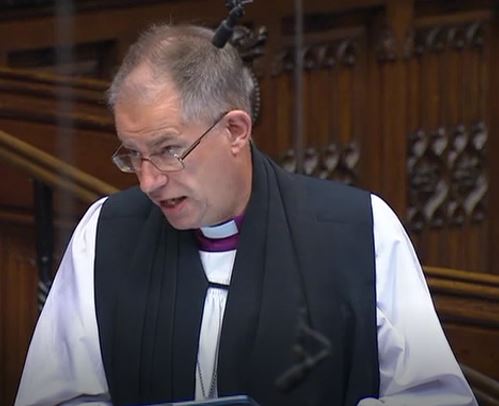
On 9th September 2020 the Bishop of Oxford, Rt Revd Steven Croft, asked a question of Government about the use of artificial intelligence in dealing with COVID-19:
Covid-19: Artificial Intelligence
The Lord Bishop of Oxford: To ask Her Majesty’s Government, further to the report by the Centre for Data Ethics and Innovation AI Barometer, published on 18 June, what assessment they have made of the benefits and risks of the use of artificial intelligence in addressing the impact of COVID-19.
The Parliamentary Under-Secretary of State, Department for Digital, Culture, Media and Sport (Baroness Barran) (Con): My Lords, artificial intelligence played a very important role in responding to Covid, from identifying potential drug candidates to AI-driven education technology. AI also has the potential to drive productivity gains across sectors, supporting exciting new careers and businesses as an essential part of economic recovery. It is important that we keep society engaged as we do, so the centre’s Covid-19 repositories and its public attitudes surveys inform our understanding of public sentiment. The independent AI Council advises the Government on how best to realise the benefits and mitigate the risks.
The Lord Bishop of Oxford [V]: I thank the Minister for her Answer, and I draw attention to my registered interest as a board member of the Centre for Data Ethics and Innovation. A year ago, the Prime Minister set out a vision, in his speech to the United Nations, for the UK to become a global leader in ethical and responsible technologies. We are discovering more deeply and painfully that ethics, good governance, human mediation and public trust are vital to realise the deeper benefits of these new technologies and prevent real harm. Will the noble Baroness affirm the importance of balancing innovation with a continued emphasis on ethics and good governance across the technology sector? In particular, will she confirm that the long-delayed government response to their own online harms consultation will be published this month, paving the way for much-needed legislation? Continue reading “Bishop of Oxford asks about ethics in technology, and use of AI in coronavirus response”


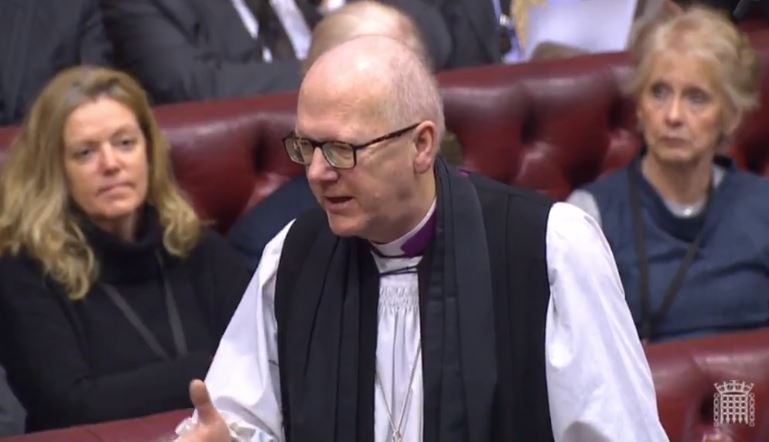

 The Lord Bishop of Oxford [V]: My Lords, I declare my interests, particularly my membership as a board member of the Centre for Data Ethics and Innovation.
 The Lord Bishop of Oxford: My Lords, I warmly welcome this debate. The country faces the triple challenge in the next decade of the threat of climate change, the deepest recession for generations and the health challenges of Covid, all of which will exacerbate existing inequalities. I support much of what other noble Lords have said and will focus my remarks on the vital theme of digital inclusion.
 On 13th February 2020 the Second Church Estates Commissioner, Andrew Selous MP, answered written questions from Jim Shannon MP, on carbon emissions, religious freedom, strategic development funding, church planting, green investments, the Democratic Republic of Congo and South Sudan, the Primates’ Meeting, new technologies, marriage and family life.

You must be logged in to post a comment.