

On 14th March 2018, Lord Kirkwood of Kirkhope asked Her Majesty’s Government “what assessment they have made of the effect on Universal Credit work incentives of the recently announced proposals for passporting family entitlement to free school meals.” The Lord Bishop of Newcastle, Rt Revd Christine Hardman, asked a follow-up question:
The Lord Bishop of Newcastle: My Lords, we have years of clear evidence that tackling child hunger improves outcomes at school and improves achievement and social mobility. What assessment have the Government made of the impact of these proposals on child hunger and on our investment in our children’s futures?
Continue reading “Bishop of Newcastle asks Government about proposals to tackle child hunger”
 On 6th March 2018 the Bishop of Durham, the Rt Rev Paul Butler, received an answer to three written questions on Child Tax Credits, following up written questions asked in
  The Lord Bishop of Portsmouth: My Lords, one of the duties in which I take particular pleasure is chairing the governors at Ripon College, Cuddesdon, just outside Oxford, a theological college at which men and women are prepared for ministry. It is known by those associated with it more colloquially as a vicar factory. Notices around the college remind the residents that, after night prayer or Compline, they are expected to abide by what is known as the great silence. It is not, I suspect, adhered to with the same severity as in years past. Indeed, one has a sense that the silence masks all kinds of feverish activity, all of it associated with theology, of course.
 The Lord Bishop of Coventry: My Lords, I share with the Minister and the House a bit of local information. We find ourselves in an interesting situation in Coventry, with rising employment and yet a 30% increase in usage among those in the city—mostly single males—among whom universal credit has been rolled out. Like others, I very much welcome the changes and I am sure they will help enormously but, at the same time, I still have reservations about whether they have gone far enough and address other issues that some of us on the ground have identified.
  “The Chancellor’s Budget has gone some way to deal with the immediate problems facing our economy, housing and NHS, but it could have gone much further to help the many at the sharp end struggling to get by.
 The Lord Bishop of Durham: My Lords, I, too, congratulate the noble Baroness, Lady Hollis, on securing this debate and on her introduction.
 The Lord Bishop of St Albans: My Lords, I am deeply concerned—as I know are many other Members of this Chamber—about rising levels of household debt in this country. Households in the UK are taking on far more debt than they used to and overall are taking on more debt than they bring home in income. While the ratio of household debt to income has not yet eclipsed the 160% peak hit in early 2008, it currently hovers around 140%, a dramatic shift from the ratio of 95% in 1997.
 The Lord Bishop of Durham: To ask Her Majesty’s Government, further to the remarks by the Secretary of State for Work and Pensions on 9 October (HC Deb, col 4), whether they will publish the evidence supporting his statement that the roll-out of Universal Credit will mean that 250,000 more people will be in work.
  On 19th October 2017 the Bishop of Durham, Rt Revd Paul Butler, received a written answer to a question about families with children on Universal Credit:
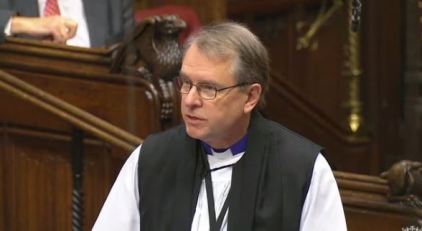 On 24th April 2017, the Bishop of Durham, the Rt Revd Paul Butler, received written answers to two questions on Child Tax Credit and Universal Credit:
  The Church of England in Parliament
You must be logged in to post a comment.