On 4th February 2020 the Parliamentary Under-Secretary of State for Work and Pensions, Baroness Stedman-Scott, repeated a Government statement made in the House of Commons on the extension to the universal credit implementation date. The Bishop of Durham, Rt Revd Paul Butler, asked a follow-up question:
 The Lord Bishop of Durham: My Lords, can we honour the DWP staff for allowing the BBC in? Many of us look forward to seeing what comes out. They have been very brave; many departments do not do that. I understand that the Minister does listen but some of these things have now been going on since the system’s very inception. Yes, many people at food banks and people who talk locally say that the work coaches are doing a wonderful job. That is great, but it is the most vulnerable who are suffering. Could we please listen to their voice and make some changes very rapidly? Continue reading “Bishop of Durham asks for rapid changes to universal credit to help most vulnerable”
 On 3rd October 2019 Lord McNicol of West Kilbride asked the Government “what steps they have taken to reduce inequality in the United Kingdom.” The Bishop of Newcastle, Rt Revd Christine Hardman, asked a further question about people in poverty as a result of early pilots of universal credit.
 On 23rd July 2019 the Government Minister Baroness Buscombe repeated a
 On 10th July 2019 the Parliamentary Under-Secretary of State, Department for Work and Pensions made a statement on universal credit fraud. The Bishop of Chelmsford, Rt Revd Stephen Cottrell, asked a question:
 The Lord Bishop of Durham: To ask Her Majesty’s Government what analysis they have made of the impact of the two-child limit on the per-child element of Universal Credit and Child Tax Credit payments on (1) child poverty, and (2) child development, for children under five years old affected by the policy.
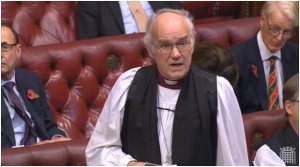 The Lord Bishop of Chester: My Lords, it is a privilege and a challenge to follow such a brilliant speech from someone who knows his way around the subject. If you want to find good things to tax, I always say that you should start with sin: find a new sin and tax it. I rather agree that HS2 is a sin, not for adding capacity, which I am all in favour of, but in doing so in such an unnecessarily expensive way. For me, trains go quite fast enough already and it could have been done far more cheaply without factoring in the speeds in a small country. As I follow the noble Lord’s speech, I think of St Paul, who once began by saying, “I speak as a fool”. I do so too, a little, after that wonderful description of the financial landscape.
 On the 25th February 2019 the Bishop of Durham, the Rt Revd Paul Butler, received a written answer to a question about Universal Credit, the two-child limit and the cost of childcare.
 The Lord Bishop of Durham: My Lords, the two-child limit means that welfare reforms weigh particularly heavily on families with three or more children. What assessment have the Government made of the consequence of changes to free school meals that are set to impact on children with more than one sibling? Does the Minister agree that this policy will effectively harm children from large families through no fault of their own?
 The Lord Bishop of Durham: My Lords, I thank the Minister for the time that she has given to a number of us. The session that we had at the DWP was very informative and helpful, and I thank her for it. However, I am still confused as to why, when we met the Minister, we were told that these regulations had to be dealt with before Christmas, yet we are still not clear exactly what regulations we will be asked to debate. Can she please clarify that?
 On 12th December 2018 the Bishop of Newcastle, Rt Revd Christine Hardman, received a written answer to a question on hardship and the impact on debt & health in Universal Credit pilot areas:


You must be logged in to post a comment.