Bishop of Wakefield asks question on Syria peace talks

On 28th November 2013, Lord Dykes asked Her Majesty’s Government what is their assessment of the outcome of the talks held earlier this month regarding the proposed Geneva II peace conference on the conflict in Syria.

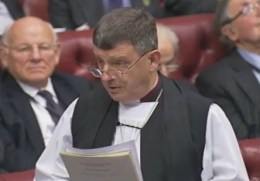
The Bishop of Wakefield asked a supplementary question:

Bishop Stephen Platten

The Lord Bishop of Wakefield: My Lords, much as I am encouraged by the recent UN announcement that the Geneva talks are to take place on 22 January, I would welcome the Minister’s reassurance that this was born not out of an understandable desperation and frustration, but that there is a real and clear diplomatic plan for progress. Am I right in assuming that the Free Syrian Army, which is one of the largest rebel groups taking part in the war in the moment, will be represented at those talks?

Lord Ahmad of Wimbledon: Our view is that it is important that the date for Geneva II was set, and I am the sure that the whole House welcomes that it has been determined. Her Majesty’s Government’s view is that the national coalition and the current Syrian national coalition, led by President Ahmad Assi Jarba, will be central to the delegation representing the opposition at the talks.

(via Parliament.uk)

Bishop of Wakefield seeks government response to DRC peace initiative (Written Question)

On 27th November 2013, the Bishop of Wakefield, the Rt Revd Stephen Platten, received an answer to a written question on the Democratic Republic of Congo.

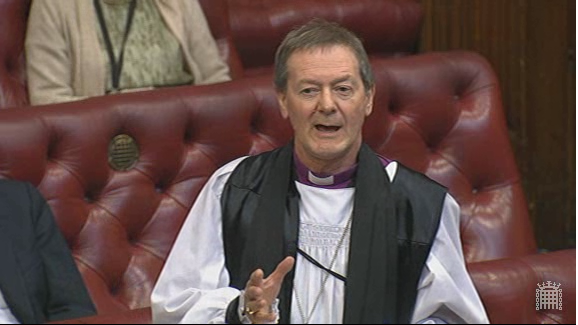
Bishop Stephen Platten

The Lord Bishop of Wakefield: To ask Her Majesty’s Government whether they intend to allocate additional resources to support the implementation of commitments outlined in the Peace, Security and Cooperation Framework for the Democratic Republic of the Congo; and, if so, what will be the main focus of those resources.

Baroness Northover: The UK is currently considering how best to support the Peace Security and Cooperation Framework (PSCF). DFID is engaging with the Democratic Republic of Congo’s National Oversight Mechanism for the PSCF to ensure those that represent local populations, such as civil society organisations, are consulted during implementation. This will include ensuring that there are on-going opportunities for these organisations to provide feedback from the Congolese people affected.

(via Parliament.uk)

Bishop of Wakefield raises concerns about human rights abuses in Tanzanian mine

On 26th of November 2013, the Bishop of Wakefield, the Rt Revd Stephen Platten, asked Her Majesty’s Government what representations they have made to the government of Tanzania regarding allegations of human rights violations at the North Mara Mine.

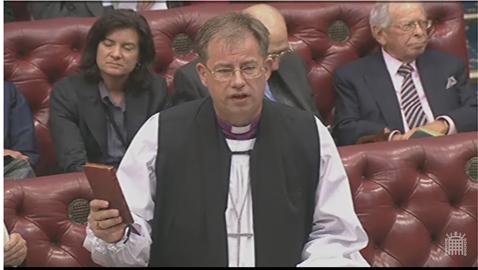
Bishop of Wakefield Platten

The Lord Bishop of Wakefield: My Lords, I beg leave to ask the Question standing in my name on the Order Paper. In doing so, I declare an interest as the joint leader of the Wakefield-Tanzania Diocesan Link.

Lord Ahmad of Wimbledon (Con): My Lords, the UK’s high commissioner to Tanzania visited the North Mara mine in March 2013 to raise concerns directly about the alleged human rights violations with African Barrick Gold, the mine owner, and also discussed a range of issues with the local authorities. We are, of course, working closely with the Tanzanian Government on improving respect for human rights and also encouraging them to sign up to the voluntary principles on security and human rights in the extractive sector. Continue reading “Bishop of Wakefield raises concerns about human rights abuses in Tanzanian mine”

Bishop of Wakefield calls for Government to implement UN conclusions on ending violence against women

On 25th November 2013, the Labour Peer Baroness Gould of Potternewton asked Her Majesty’s Government what steps they are taking to prevent rape and violence against women and girls. The Bishop of Wakefield, the Rt Revd Stephen Platten, asked a supplementary question.

Bishop of Wakefield PlattenThe Lord Bishop of Wakefield: My Lords, following a debate that I was able to secure on a related issue back in March, more than 60 bishops around the country are today supporting the campaign to end gender-based violence, and are visiting on this day a large number of projects up and down the country to support the cause. I apologise that, in the rush to get here, I have no white ribbon. Could the Minister inform the House what additional action the Government are taking to implement the agreed conclusion from this year’s UN Commission on the Status of Women, which focused on the ending of violence against women?

Lord Taylor of Holbeach: I congratulate my right honourable friend the Foreign Secretary on his role in ensuring that 135 countries have signed up to the agreement on the use of rape as a weapon of war. This is a significant development, and shows that these arguments are not just confined to this country. Discussions that we are having here have raised awareness throughout the world.

(via Parliament.uk)

Bishops of Derby and Wakefield take part in debate about Human Rights

On 21st November 2013, the Bishop of Derby, the Rt Revd Alastair Redfern, and the Bishop of Wakefield, the Rt Revd Stephen Platten, took part in a debate on human rights, led by Lord Alton of Liverpool. The Bishop of Derby spoke about the role of women within society and religious institutions. He particularly focused on the objectification of women in magazines and the treatment of women in India. The Bishop of Wakefield spoke of the need for a greater engagement on the subject of the right to the freedom of religion, calling on the Government to develop a more positive approach towards religious freedom.

DerbyThe Lord Bishop of Derby: My Lords, I, too, congratulate the noble Lord, Lord Alton, on securing this debate, and I also associate myself with the remarks of the noble Lord, Lord Selkirk.

Many of the pictures painted are dramatic and challenging, and I invite the House to think a little about the context that we are in and how we might approach some of these huge issues. The Government have identified six key priority areas, including women and freedom of religion, and those are the two things that I will look at in particular. We are in a world where we have ideals and fall short of them, and need to negotiate between the two. Continue reading “Bishops of Derby and Wakefield take part in debate about Human Rights”

Bishop of Wakefield urges proactive response to crisis in Central African Republic

“It is not surprising that the violence and insecurity that now plagues this country has hampered the delivery of humanitarian aid. As a result, local faith groups and a few national and international NGOs are the primary responders” – Bishop of Wakefield, 18.11.13

On 18th November 2013, Conservative Peer Baroness Berridge led a short debate to ask Her Majesty’s Government what assessment they have made of the security and humanitarian situation in the Central African Republic and the Great Lakes region of Africa. The Bishop of Wakefield, the Rt Revd Stephen Platten, took part in the debate, focusing his remarks on the need to sanction the perpetrators of violence in the Central African Republic and the urgent need to tackle sexual violence in conflict.

Bishop of Wakefield PlattenThe Lord Bishop of Wakefield: My Lords, I warmly congratulate the noble Baroness, Lady Berridge, for securing this debate and for introducing it with such clarity of purpose. Those of us of a certain age will remember graphically the tragedy of the Congo, going all the way back to independence itself. This was followed by the Katanga breakaway movement and the instability there, and the subsequent tragedies made the entire Great Lakes region a terrible, open wound on our common humanity. As we know, that conflict, which began all those years ago, continues in a number of countries. Continue reading “Bishop of Wakefield urges proactive response to crisis in Central African Republic”

Bishop of Wakefield leads debate on religious freedom in the Middle East and North Africa

“States need to feel comfortable and confident enough in their own skins, as one might put it, to uphold their core values for all citizens regardless of religious or non-religious background. Even in our own nation, it can sometimes appear to be a fragile commodity but we have the comfort of two centuries’ experience of relative tolerance. If freedom of religion is in many ways the fundamental right upon which all other rights turn, it is important for our and other Governments to remain actively engaged over the long term, pressing for the rights of all religious minority communities.”

On 29th October 2013, the Bishop of Wakefield, the Rt Revd Stephen Platten, led a debate in the House of Lords to ask Her Majesty’s Government what is their assessment of the situation of religious minorities in the Middle East and North Africa after the events of the Arab Spring. He noted that the Arab Spring and resulting events were about issues of identity, political organisation and rights, all of which impact on the place of religious minorities. He urged wisdom and patience from the international community and urged for governments based on consent to be established throughout the region. He noted in particular the persecution of Christians in the region, including many groups historically amongst the earliest Christian communities. He commended the work of the Government in prioritising the freedom of religion but called for there to be consideration around the appointment of an Ambassador-at-Large for Religious Freedom. 

Bishop of Wakefield PlattenThe Lord Bishop of Wakefield: My Lords, I am very grateful for this opportunity to speak about the situation of religious minorities in the Middle East and north Africa since the Arab spring. The debate will, I hope, provide the opportunity to take a more detached view on developments over the past few years and to look at the underlying dynamics affecting religious minorities in the region.

Events in the Middle East since the start of the Arab spring have been a challenge not only to those living in the region but to all of us. Many, myself included, have viewed the series of uprisings which started in Tunisia through the lense of our experience of the Cold War. We wrongly assumed then that the fall of the Berlin Wall would usher in an era of tolerance and political pluralism throughout Europe. The reality was very different. Released from the uniformity of authoritarian rule, the former states of the USSR struggled with weak Governments to meet the diverse and competing aspirations of all their people. Often, as in the case of Balkans, those struggles turned horribly violent, with religion politicised as a marker of identity. Of course, the lessons of our own European history are seminal when trying to understand the transformations shaping the Middle East today. Revolutions are never simple and straightforward affairs. The Reign of Terror and the Vendée in France at the end of the 18th century were perhaps the beginning in our own modern era. Continue reading “Bishop of Wakefield leads debate on religious freedom in the Middle East and North Africa”

The Bishop of Sheffield introduced as member of House of Lords

On 14th October 2013, Steven John Lindsey, Lord Bishop of Sheffield, was introduced and took the oath, supported by the Bishop of Leicester and the Bishop of Wakefield, and signed an undertaking to abide by the Code of Conduct.

Sheffield

The full video of the Bishop’s introduction can be viewed here.


Bishops of Derby and Wakefield seek clarification on UK’s position on EU Justice and Home Affairs measures

On 14th October 2013, the Bishop of Derby, the Rt Revd Alastair Redfern, and the Bishop of Wakefield, the Rt Revd Stephen Platten, both received answers to written questions on the European Union’s Justice and Home Affairs Measures.

Bishop of DerbyThe Lord Bishop of Derby: To ask Her Majesty’s Government, further to the Written Answer by Lord McNally on 29 August (WA 318), what guarantees they sought from other member states, prior to their decision of 9 July to opt out of 130 European Union Justice and Home Affairs measures, that the United Kingdom would be able to opt back in to various police and justice measures.

The Minister of State, Ministry of Justice (Lord McNally): Protocol 36 does not provide for guarantees to be obtained from Member States and no Member State would have been able to have given such a guarantee. We therefore did not seek any such guarantees from Member States. However, the issue has been discussed in meetings with our EU counterparts at both Ministerial and official level.

However, Protocol 36 to the Treaties places an obligation on the UK and the Union institutions to, “…seek to re-establish the widest possible measure of participation of the United Kingdom in the acquis of the Union in the area of freedom, security and justice without seriously affecting practical operability of the various parts thereof, while respecting their coherence”. Given this, we are confident that we will be able to reach agreement on a sensible final package of measures that the UK will formally apply to rejoin.

Final agreement is subject to approval by the Council in the case of Schengen measures and the Commission for all others. Continue reading “Bishops of Derby and Wakefield seek clarification on UK’s position on EU Justice and Home Affairs measures”

Bishop of Wakefield – EU Justice and Home Affairs measures (Written Answer)

On 5th August 2013, the Bishop of Wakefield, the Rt Revd Stephen Platten, received an answer to a written question on European Union Justice and Home Affairs measures.

Bishop of Wakefield PlattenThe Lord Bishop of Wakefield: To ask Her Majesty’s Government whether, prior to their decision on 9 July to opt out of 130 European Union Justice and Home Affairs measures as provided for by the Lisbon Treaty, guarantees were provided by the European Commission that the United Kingdom would be able to opt back in to various police and justice provisions.

The Minister of State, Ministry of Justice (Lord McNally): Protocol 36 to the Treaties places an obligation on the UK and the Union institutions to, “…seek to re-establish the widest possible measure of participation of the United Kingdom in the acquis of the Union in the area of freedom, security and justice without seriously affecting practical operability of the various parts thereof, while respecting their coherence”. We are confident that we will be able to reach agreement on a sensible final package of measures that the UK will formally apply to rejoin.

Of course it is not possible to predict the final outcome of the discussions with EU institutions, but following the Governments announcement on 9 July the Commission made clear in a press release that it “respects the UK Government’s choice to opt out, which is in line with the Treaty, and welcomes the UK intention to also opt back into certain measures”.

(via Parliament.uk)