Archbishop of York asks about access to green spaces

The Archbishop of York asked a question on what steps the government are taking to improve access to outdoor and green spaces, particularly for disadvantaged communities, on 7th March 2024:
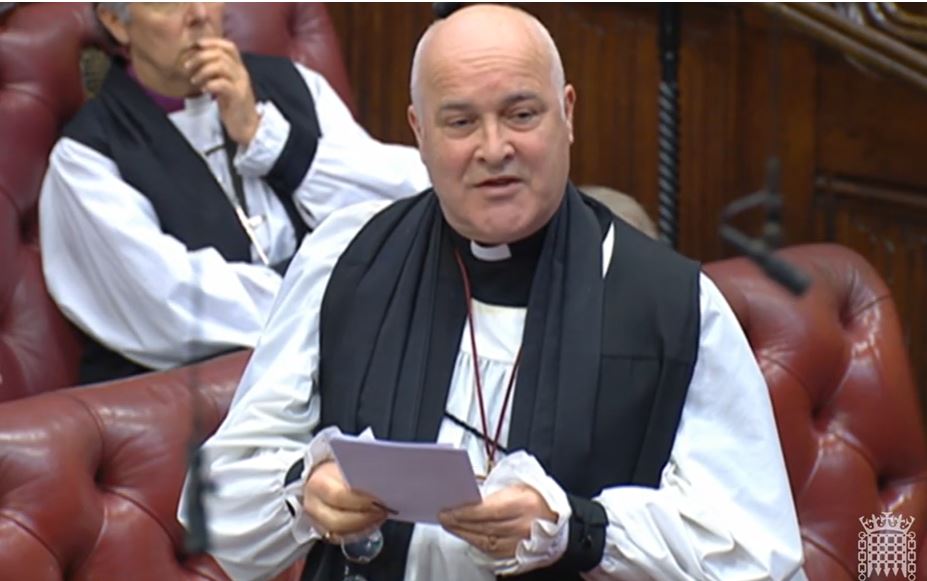
The Lord Archbishop of York: My Lords, during Covid, we all became aware of how important it is to have access to outside space. Yet we know that many people do not have access to outside space, let alone green space, and we know the health benefits of having that space, particularly for mental health. In my work, I often visit communities, particularly in Hull and Middlesbrough, where so many people simply do not have this kind of access, and I see the consequences. I am wondering what steps the Government are taking to try to improve the situation. It is estimated that 10 million people in this country may not have ready access to green space. What steps are being taken to address this?

Continue reading “Archbishop of York asks about access to green spaces”
Archbishop of York asks about introduction of an essentials guarantee for benefits claimants

On 28th February 2024, the Archbishop of York asked a question on whether the government had assessed a recent proposal by the Joseph Rowntree Foundation and the Trussell Trust for the introduction of an “essentials guarantee” to universal credit, during a discussion on the adequacy of the housing benefit subsidy for temporary accommodation:

The Lord Archbishop of York: My Lords, I thank the Minister for his commitment to trying to make headway on this issue. We are all aware of the terrible strains that local authorities are under because of temporary accommodation being necessary and, of course, we also know that the reason is that incomes are just not meeting housing needs. Have the Government assessed the recent proposal from the Joseph Rowntree Foundation and the Trussell Trust for what they call an essentials guarantee? This would guarantee that universal credit was enough to cover the essentials—rent—which would therefore reduce the number of households in temporary accommodation, creating a virtuous cycle that would reduce the budget strain on local councils.

Continue reading “Archbishop of York asks about introduction of an essentials guarantee for benefits claimants”

Archbishop of York asks about reasons for increased policing of face-masks at protests

The Archbishop of York asked a question on the issue of face masks being worn at protests on 13th February 2024, following a government statement on new measures being introduced to police these activities:

The Lord Archbishop of York: My Lords, like others, I entirely share the views about war memorials and their desecration, and fireworks and flares—there is a lot that is sensible in this. On face coverings, what concerns me is the law which we often do not often think about—the law of unintended consequences. To those dissidents, I would add religious minorities to the list of those who may be concerned about this. I wonder whether the effect of this will be that more people will wear face coverings, not fewer, because they are concerned about facial recognition. I find it hard to understand why this should be a matter for the law. If somebody commits a criminal offence while on a march, we already have the powers to deal with them. If somebody on a peaceful protest chooses to wear a face covering, I find it hard to understand why that, in and of itself, is a problem. The Minister has explained that this will be used only under certain circumstances, but if I have heard him correctly it is around the “risk” of criminal activity and violence. We do not arrest people because we think that they might be doing something. If the protest is peaceful, why should somebody not wear a face mask? I am struggling to understand why this has become such an issue, and I am concerned about minority groups who could be adversely affected by this.

Continue reading “Archbishop of York asks about reasons for increased policing of face-masks at protests”

Archbishop of York asks about non-consensual creation and sharing of intimate images

On 13th February 2024, during a discussion on the proliferation of AI being used to create intimate images without consent, the Archbishop of York raised a point of clarification on the difference between malicious and non-malicious sharing of these images:

The Lord Archbishop of York: My Lords, it would be very helpful if the Minister could explain. If I heard him correctly, he said that sharing has a six month ban but for malicious sharing it could be up to two years. Could he explain what non-malicious use would be?

Continue reading “Archbishop of York asks about non-consensual creation and sharing of intimate images”

Kings Speech Debate: Archbishop of York speaks on devolution in the North of England

The Archbishop of York spoke on devolution, with a particular focus on the North of England on 8th November 2023, in a debate following the Kings Speech:

The Lord Archbishop of York: My Lords, from these Benches I too express our sadness at the news of the death of Lord Judge and offer prayers and condolences to his family. I look forward with others to the speeches of the noble and learned Lord, Lord Burnett of Maldon, and the noble and learned Lords, Lord Houchen of High Leven and Lord Bailey of Paddington.

The focus of my speech is devolution, looking particularly at devolution in and within the regions of England, not least because devolution and devolved government allow us to seek consensus in our decision-making, and therefore to be better able to take a longer view, which in turn is the best way of tackling some of the huge issues facing us that were mentioned in the gracious Speech: the greening of the economy; poverty; and criminal justice. Yesterday, the order was laid by the Government for the establishment of the mayoral combined authority for York and North Yorkshire, the area where I live and serve. This is very good news for the north and is the first deal of its kind that includes a large rural area in combination with a small city, and therefore is an opportunity for a new model that does not require a big city for its success.

Continue reading “Kings Speech Debate: Archbishop of York speaks on devolution in the North of England”

Archbishop of York speech in Lords debate on Israel/Gaza

On 24th October 2023 the Archbishop of York spoke in a House of Lords debate on the situation in Israel/Gaza.

The Archbishop of York: My Lords, I too begin by expressing great thanks to the noble Lord, Lord Ahmad, for the grace, wisdom and fortitude with which he has led us in this debate. I welcome the consensus that I have heard across the Chamber from all sides. Like others, I have learned so much this evening. I also want to echo what the most reverend Primate the Archbishop of Canterbury said earlier: I too deeply mourn and cry out for all those who have been brutally murdered in this conflict and rightly note the duty of Israel to guard and defend her citizens, yet at the same time I cry out on behalf of the innocent in every community and appeal for a peace with justice.

Continue reading “Archbishop of York speech in Lords debate on Israel/Gaza”

Bishop of York asks about tackling online disinformation

During a debate on misinformation relating to the conflict in Israel and Gaza on 24th October 2023, the Archbishop of York asked a question on the proliferation of disinformation on X, (formerly Twitter):

The Lord Archbishop of York: My Lords, it is good to hear that the Government are engaging with the social media platforms on this incredibly serious issue. Twitter has most aptly been renamed X, but without irony: one goes into this area with great caution, as it is distressing and nasty. I am told that X is currently laying off people whose job it is to monitor and remove posts that contain disinformation. Given this, and given that we have made progress in looking at social media platforms, what are we doing to require them to do this other than simply engaging with them?

Continue reading “Bishop of York asks about tackling online disinformation”

Archbishop of York asks about role of civil societies in regulating artificial intelligence

On 26th June 2023, the Archbishop of York raised a question on the inclusion of civil society representatives in conversations and debates on AI, in order to aid in building ethical frameworks for regulation of artificial intelligence:

The Lord Archbishop of York: My Lords, I am very grateful to the noble and right reverend Lord, Lord Harries, for raising this issue. I too believe that the best way for us to find the potential of AI is by paying great attention to regulation and ethics, building on what has just been said. What is best in us is beyond rationality—

“Greater love hath no man than this, that a man lay down his life for his friends”

Continue reading “Archbishop of York asks about role of civil societies in regulating artificial intelligence”

Archbishop of York asks about access to arts education

The Lord Archbishop of York: My question is about the variability of access. I think we all recognise that the statistics quoted are going the wrong way. What we observe particularly is that it is far worse in some parts of the country than others. That is something I particularly observe in the north, where I serve. The DCMS Committee’s report last year spoke about how the creative industries themselves are saying that there is a shortage of the skills that we need. What is being done about this and, particularly, how do we know about the situation? In about 2014, Ofsted changed the way its inspections investigated the arts. For instance, dance was looked at as part of PE. Does the Minister think that this lack of joined-up thinking has had an impact on where we are now and, in particular, on the way that some parts of the country are suffering much more than others?

Continue reading “Archbishop of York asks about access to arts education”

Archbishop of York asks about social care reform

During a debate on the government’s social care strategy on 22nd March 2023, the Archbishop of York asked a question on reforming the social care workforce, emphasising the need to value care workers:

The Lord Archbishop of York: My Lords, the report by the Archbishops’ Commission on Reimagining Care was published in January. I am sure that the Minister is aware of this: in fact, I know that he is having a meeting later today with the right reverend Prelate the Bishop of Carlisle, who co-chaired that commission. We argue for a very bold approach to social care, which puts at its heart the concept of a care covenant, with clear expectations on each of us of what we should give and expect in return, recognising that each of us is a carer and that most of us will need care one day.

Continue reading “Archbishop of York asks about social care reform”