
 On 12th October 2020 the Bishop of St Albans received a written answer to a question on gambling advertising and young people:
The Lord Bishop of St Albans: To ask Her Majesty’s Government what assessment they have made of the long-term effects of gambling advertising on young people and their future participation in gambling activities. [HL8688] Continue reading “Bishop of St Albans asks about impact of gambling advertising on young people”
 The Lord Bishop of Carlisle: My Lords, I spoke last week with a young person whose father, sadly, died recently of Covid-19, and she told me about the impact that experience has had on her own mental health. I am therefore grateful for the reassurance from the Minister that Her Majesty’s Government will be strengthening access to mental health services in our schools and, I hope, in our colleges and universities. Are there any plans for bereavement support and counselling to form part of that provision?
 On the 6th Feb 2020 the Second Church Estates Commissioner, Mr Andrew Selous MP, answered a written question about youth work in the Church of England:
 On 9th July 2019 Lord Kennedy of Southwark asked the Government “what is their response to the report by The Children’s Society, Counting Lives: responding to children who are criminally exploited, published on 5 July”. The Bishop of Chelmsford, Rt Revd Stephen Cottrell, asked a follow-up question:
 The Lord Bishop of St Albans: My Lords, I too am grateful to the noble Lord, Lord Paddick, for obtaining this debate and for his excellent analysis of some of the causes and, indeed, the work that has been done on how we might address them, which is a holistic approach. I am also delighted that a number of experts in policing are speaking in this debate. I come to this with little knowledge of that, but I have knowledge through the 136 schools in my diocese—I have been to two this week—and in many of the urban areas across Bedfordshire and Hertfordshire, which seek to bring together groups of young people to reflect on how this can be addressed.
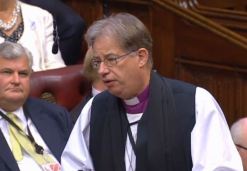 On 26th June 2019 Lord Bird asked the Government, “by what means, if at all, they require public bodies to act, and to demonstrate how they act, in a manner which seeks to ensure that the needs of the present generation are met without compromising the ability of future generations to meet their own needs.” The Bishop of Oxford, Rt Revd Steven Croft, asked a follow-up question:
 The Lord Bishop of Oxford: My Lords, I too welcome this debate and thank the noble Lord, Lord Bird, very warmly for bringing it. I welcome his proposals. As the noble Lord, Lord Layard, said, the foundation is a moral and ethical case. That moral case has shifted in recent years because of the realisation of the effects of the Anthropocene era. Humanity’s effect on the environment means that the interests of not just the next generation but every generation beyond that need to be protected in our policy-making and debate.
 The Lord Bishop of Leeds: My Lords, I, too, am grateful to the noble Lord, Lord Bird, for bringing this debate to us. Despite wanting to say one or two things,
  The Church of England in Parliament
You must be logged in to post a comment.