
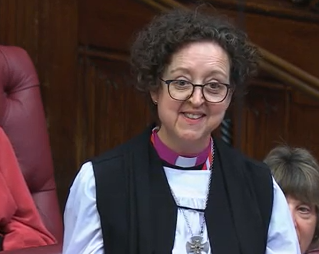
The Bishop of St Edmundsbury and Ipswich made her maiden speech in the King’s Speech debate on the topic of justice and accountability in the criminal justice system on 18th May 2026:
The Lord Bishop of St Edmundsbury & Ipswich: My Lords, I am grateful for the opportunity to make my maiden speech in this House. I begin by expressing my sincere gratitude for the warm welcome I have received from all sides. I thank the officers and staff of this House for their patience, professionalism and kindness in guiding new Members through these early days. As Bishop of St Edmundsbury and Ipswich, I serve the people of Suffolk, that great east of England county upon which the sun rises first each morning. I aim to join those who live out the particular Suffolk virtue of quiet service: people getting on with the task, often without applause, motivated by a genuine desire to make their communities better places for all.
My academic literary research before ordination took me deep into the works of the great Elizabethan poet, Edmund Spenser, whose Fairie Queene examines some of the private and public virtues needed to uphold the common good and the bonds of society. Whether biblically or classically rooted, virtue is much needed. Leadership in this current age needs to refocus on the common good, the social bonds and contracts that hold individuals together as communities. Of course, I include in that a matter at the heart of our debate today in response to His Majesty’s gracious Speech: justice, with a specific interest in the realities of and responses to miscarriages of justice. I thank my right reverend friend the Bishop of Gloucester, from whom we will hear later in this debate, for her energy, commitment and expertise over the years in urging us to reimagine a better criminal justice system for all. I welcome the Government’s desire to improve the courts and look forward to seeing their proposed legislation in these areas.
The United Kingdom has long been seen as a standard-bearer for the rule of law—yet even strong systems are not immune to error. When those errors lead to wrongful convictions, the impact is profound, not just for individuals but for confidence in the whole system. In this landscape, the role of the Criminal Cases Review Commission is indispensable. It exists as a safeguard—a recognition that the justice system must contain within it the means to correct its own errors. It is in relation to the CCRC that I draw this House’s attention to the case of Jason Moore, convicted in 2013 for the murder of Robert Darby. I mention this matter with the permission of Jason and his sister Kirsty. Both Jason Moore’s and Robert Darby’s families have spent the last 13 years campaigning to have that conviction reviewed. Amid fiascos of lost evidence and problems with the management of identity parades and vital witnesses, Jason is still waiting for the CCRC to come to a decision about sending his case to appeal. His case has been under consideration by it for six years now.
Miscarriages of justice are not abstract legal concepts but lived human experiences. They concern individuals who maintain their innocence while navigating a system that can be slow, complex and difficult to penetrate. Wrongful conviction is not simply the loss of liberty; it is the loss of years, sometimes decades. When convictions are ultimately overturned, the sense of relief is tempered by a stark reality: lost time cannot be restored. Noble Lords may be aware of previous criticism of the CCRC and the promise of a review of it by the Law Commission. Since justice delayed is justice denied, this review needs to be concluded, with any actions that follow from it considered with urgency. I therefore press the Minister for a timescale for the completion of that review.
As this House considers the legislative programme set out in His Majesty’s gracious Speech, I hope we will give due weight to those whose voices are hardest to hear: individuals maintaining their innocence over many years from within prison, and the families who stand alongside them. Any system worthy of public confidence must be able to correct and learn from its mistakes. In the words of Edmund Spenser,
“Where justice grows, there grows eke greater grace”.
If I can contribute in however a modest way to strengthening fairness, timeliness and accountability within such systems, I shall consider it a privilege to do so.
Extracts from the speeches that followed:
Baroness Hyde of Bemerton (Lab): I congratulate the right reverend Prelate the Bishop of St Edmundsbury and Ipswich for an important and moving maiden speech. The first person in her family to stay in education after 16, this tenacious Teessider has a lot to offer your Lordships’ House. When Bishop of Stepney, she was my amazing friend Reverend Alexandra’s boss, and it was following the untimely death of Reverend Alexandra’s husband, my wonderful friend Michael, that I learned that the right Reverend Prelate was at the vicarage with a bottle of gin for my newly widowed friend. When asked who was there, she simply said, “It’s Joanne”, showing her trademark humility, care and—frankly, with that bottle of gin—practicality.
She did not falter in the difficult and complex task of being the lead bishop for safeguarding. She continues as deputy leader for safeguarding and is an exemplary agent for culture change via stronger governance and processes. Having seen first hand the devastating impact of safeguarding failures, I wish her all the best in those important endeavours. I look forward to seeing the right reverend Prelate bring the rigour and compassion that have characterised her 26 years in ordained ministry to your Lordships’ House in years to come.
I very much welcome the measures outlined in the gracious Speech to improve the justice system, whether that is via changes to policing or the expedition of justice by the measures outlined in the courts modernisation Bill. It is clear that 14 years of austerity, neglect and, frankly, a lack of courage to pursue the evidence had left our justice system, from police to courts, prisons and probation, in a sorry mess. I am sorry that we have heard so much in this debate about the changes to jury systems and so little about what happens after people are incarcerated by the state.
We are all too aware, in these times, of the threat posed from outside the country and the arguments for increased defence spending to protect society, and this can be to the detriment and neglect of arguments for funding commensurate with ensuring safety for people currently inside our country, both those in our prisons and in wider society. If we cannot keep people in prison safe, how can we hope to achieve any of the other more lofty goals of recovery from addiction, education, rehabilitation, skills and training? This is about pragmatism. We do not just send people away to become non-people, never to be heard of again; we send people somewhere. We send them to prison.
Lord Marks of Henley-upon-Thames (LD): We also enjoyed two excellent maiden speeches: the philosophical approach of the noble Lord, Lord Case, to the working of our constitution, and the clear commitment to fairness and justice of the right reverend Prelate the Bishop of St Edmundsbury and Ipswich, who also reminded us that the sun rises first over Suffolk. Both demonstrated the qualities they will each bring to our future debates.
The Hillsborough law Bill has been a long time coming, but we fully support it. At last, public officials will have a specific duty to tell the truth about mistakes made, unchecked faults and tragedies suffered in consequence. The offences of misleading the public and misconduct in public office should reinforce accountability and reduce the culture of cover-up and self-exculpation that is its very opposite. The increase in legal aid for inquests should also help level the playing field between bereaved families and those allegedly responsible for their loss. We support the principles of the national security Bill and the tackling state threats Bill, though we will always take care to protect individual liberties.
Lord Hanson of Flint (Lab, Home Office): In the same way, I pay tribute to the right reverend Prelate the Bishop of St Edmundsbury and Ipswich. She spoke very fluently on the key issues that she faced and brought criminal justice issues to the fore, including the issue of wrongful convictions. I say in response to her question that the review that she mentioned from Dame Vera Baird is independent and will report accordingly.
We have had a very good debate today. As well as those maiden and valedictory speeches, we have had some 70-plus contributions, which I will try and respond to in due course. This is important because the issues that we are discussing on security, policing, criminal justice, immigration and the union are essential to the lives of everyone in this country.


You must be logged in to post a comment.