
On 28th January 2019 a vote took place on an Opposition Motion on the outcome of Government negotiations with the European Union. Two bishops took part. Baroness smith, who moved the amendment, explained its purpose here. Continue reading “Votes: European Union Withdrawal Agreement”
Author: parliamentaryunit
Bishop of London asks Government to encourage professional development for nurses
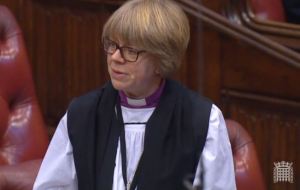 On 28th January 2019 Lord Crisp asked the Government ” what plans they have to commemorate the bicentenary of the birth of Florence Nightingale in 2020.” The Bishop of London, Rt Revd Sarah Mullally, asked a follow-up question:
The Lord Bishop of London: My Lords, as the noble Baroness rightly said, Florence Nightingale not only cared for the sick and wounded but was a statistician, thus providing the foundation of our infection control today. Does the Minister agree that the best tribute to Florence Nightingale is to ensure that nurses today have enough time and resources to continue their own professional development, which contributes not just to the National Health Service but to the health and economic status of this country?
Continue reading “Bishop of London asks Government to encourage professional development for nurses”
Week in Westminster 21st-25th January 2019
 This week in the House of Lords bishops spoke about poverty in the UK, cultural and heritage services facing council cuts, and on a customs union amendment to the Government’s Trade Bill. They asked questions on Religious Education in the English Baccalaureate, EU environmental regulations, rail services in the north east, and the welfare of Nazanin Zaghari-Ratcliffe in Iran. Continue reading “Week in Westminster 21st-25th January 2019”
Bishop of Worcester highlights cultural and heritage losses of local council cuts
 On 24th January 2019 the Bishop of Worcester, Rt Revd John Inge, spoke in a debate tabled by Lord Scriven, “That this House takes note of the ability of local authorities across the United Kingdom to deliver essential services to their communities.”
The Lord Bishop of Worcester: My Lords, I rise with a heavy heart to raise questions concerning the ability of local councils to deliver essential services to their communities. I welcome the prospect of increased short-term government funding but, without that being increased and continued or there being rises in council tax, whatever the rights and wrongs of that, I question whether it will be sufficient to enable councils to meet rising demand, especially in social care. That issue is of immense concern, but others have spoken eloquently about it.
Continue reading “Bishop of Worcester highlights cultural and heritage losses of local council cuts”
Bishop of Chester speaks during Trade Bill amendments on Customs Union
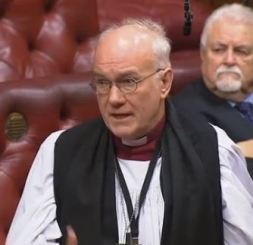 On 23rd January 2019 the House of Lords considered the Government’s Trade Bill during its Committee stage. The Bishop of Chester, Rt Revd Peter Forster, spoke during debate on Amendment 24, moved by Lord Stevenson of Balmacara, which sought to keep the UK in a customs union with the European Union.
After Clause 5, insert the following new Clause—“Customs union. It shall be the objective of Her Majesty’s Government to take all necessary steps to implement an international trade agreement which enables the United Kingdom to participate after exit day in a customs union with the European Union.”
The Lord Bishop of Chester: My Lords, it is always a pleasure to listen to the noble Lord, Lord Patten of Barnes, especially when religious imagery creeps into his speech with gospel truth and sacerdotal approaches. His opening remark reminded me of Trollope’s definition of hell: an eternity of listening to one’s own sermons. I do not know whether the noble Lord, Lord Patten of Barnes, has similar feelings about his speeches, but they are always wonderful to hear.
Bishop of Newcastle calls for improved rail services and infrastructure in the north east
On 23rd January 2019 Lord Teverson asked Her Majesty’s Government “what steps they are taking to improve rail service reliability in 2019.” The Bishop of Newcastle, Rt Revd Christine Hardman, asked a follow-up question:
 The Lord Bishop of Newcastle: My Lords, the latest quarterly statistics released from the Office of Rail and Road show that the London North Eastern Railway has suffered its worst punctuality levels in over a decade and came second—not an honour—on the list of the 10 worst train services for punctuality. As my noble friend Lord Cormack said, we had hopes for the new Azuma trains, but there is a lack of investment in infrastructure in the north—the signalling systems north of York are over 30 years old. Will the Minister tell us when the necessary infrastructure works will take place in order for these trains to run as they should to serve the people of the north-east and Scotland?
Bishop of Coventry asks Government about welfare of Nazanin Zaghari-Ratcliffe
 On 23rd January 2019 the Bishop of Coventry received written answers to two questions about the treatment of Nazanin Zaghari-Ratcliffe:
The Lord Bishop of Coventry: To ask Her Majesty’s Government what representations they have made to the government of Iran about Nazanin Zaghari-Ratcliffe, in particular that she be granted access to medical treatment for long standing mental and physical health complaints. Continue reading “Bishop of Coventry asks Government about welfare of Nazanin Zaghari-Ratcliffe”
Archbishop of York – EU environmental regulations have grown into a jungle
 On 22nd January 2019 the House of Lords considered a motion to approve the Floods and Water (Amendment etc.) (EU Exit) Regulations 2019. The Archbishop of York, Most Revd John Sentamu, asked a question of the Minister:
The Archbishop of York: The Minister has been very clear about the benefits of regulation, particularly for the environment, which, as he said, were brought about through sheer hard work, campaigning and persuading other people. Nevertheless, does he agree that EU regulations have grown into a jungle that has become very difficult to penetrate?
Continue reading “Archbishop of York – EU environmental regulations have grown into a jungle”
Bishop of Portsmouth – national crisis of poverty must be urgently tackled
 On 21st January 2019 the House of Lords debated a motion from Baroness Stroud “To ask Her Majesty’s Government what assessment they have made of metrics to measure United Kingdom poverty, in the light of the report from the Social Metrics Commission.” The Bishop of Portsmouth, Rt Revd Christopher Foster, spoke in the debate:
The Lord Bishop of Portsmouth: My Lords, Stalin, not often quoted on this Bench, is said to be the author of the maxim:
“A single death is a tragedy; a million deaths is a statistic”.
On that, and indeed on everything else, I disagree with the Marshal. A single person living in poverty is a tragedy; that millions do so is an affront to our values, our common decency and how we think of ourselves as a nation.
Continue reading “Bishop of Portsmouth – national crisis of poverty must be urgently tackled”
Bishop of Worcester argues for inclusion of RE in English Baccalaureate
On 21st January 2019 Lord Black of Brentwood asked the Government “what assessment they have made of the performance of pupils taking the subjects that make up the English Baccalaureate.” The Bishop of Worcester, Rt Revd John Inge, asked a follow-up question:
The Lord Bishop of Worcester: My Lords, one does not need to be an avid follower of the news to realise the huge impact that religion has for good and for ill geopolitically in our world. That is happening at the same time as we see a level of unprecedented and increasing religious illiteracy in our own society. Does the Minister regret the exclusion of RE from the baccalaureate, given the drop in numbers studying the subject at GCSE? Would its inclusion not assist in community cohesion as well as in an understanding of our world?
Continue reading “Bishop of Worcester argues for inclusion of RE in English Baccalaureate”


You must be logged in to post a comment.