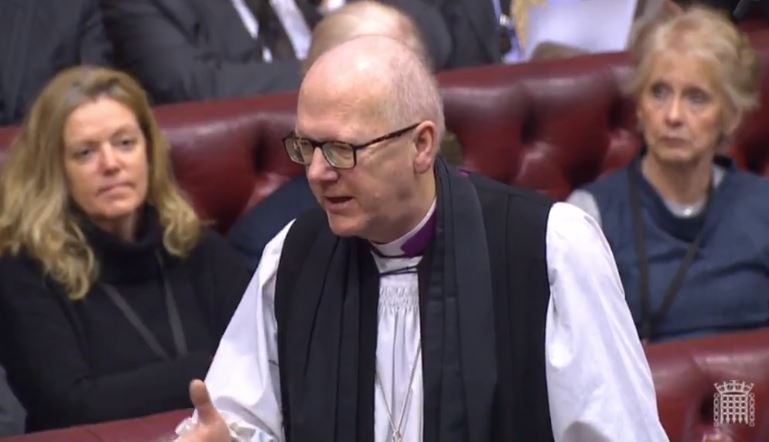
Levelling Up and Regeneration Bill: Bishop of Gloucester supports amendments targeting child poverty

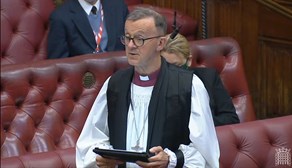
On 20th February 2023, the House of Lords debated the Levelling Up and Regeneration Bill on the first day of its committee stage. The Bishop of Gloucester spoke in support of an amendment tabled by Baroness Lister, emphasising that reducing child poverty should be considered a priority:

The Lord Bishop of Gloucester: My Lords, I too will speak in support of Amendment 4. I thank the noble Baroness, Lady Lister, for tabling this amendment. I am very aware that my right reverend friend the Bishop of Durham is a co-signatory and is unable to be here today to speak.

Levelling up, as the Government’s White Paper initially outlined, is about equally spreading opportunity across our country. It is about challenging unfairness and allowing people to live more fulfilling lives—I thank the noble Lord, Lord Bird, for his inspiring speech. These are aims that surely all of us welcome, but I cannot see how this will ever be achieved unless the Bill includes reducing child poverty.

This is about the present and the long-term future. As has already been said, the latest statistics are that there are 3.9 million children living in poverty in this country; that is more than one in four. With more and more families turning to food banks and the experience of persistent poverty tripling a child’s likelihood of having mental health problems, this cannot continue.

Continue reading “Levelling Up and Regeneration Bill: Bishop of Gloucester supports amendments targeting child poverty”

Votes: Public Order Bill

On 7th February 2023, the House of Lords debated amendments to the Public Order Bill (2022) in the second day of the report stage. Votes were held on amendments to the bill, in which Bishops took part:

Continue reading “Votes: Public Order Bill”

Public Order Bill: Bishop of Manchester speaks in support of amendments on stop and search regulations

On 7th February 2023, the House of Lords debated the Public Order Bill in the second day of the report stage. The Bishop of Manchester spoke in favour of amendments to remove clauses 10 and 11 of the Bill, which would have extended the police’s stop and search powers:

The Lord Bishop of Manchester: I too speak in support of the amendments to remove Clauses 10 and 11, to which I have added my name. I declare my registered interests as the co-chair of the national police ethics committee and the chair of the Greater Manchester Police ethics advisory committee.

Stop and search can be an extremely useful tool in the police kit box, but, like many tools, it works far less well if it is overused or used for the wrong task. Eventually, it loses its efficacy entirely. I have several broken screwdrivers at home that bear witness to my own excesses in that regard, as well as to my very limited DIY skills. That is the danger we run when we extend stop and search powers in what, at times, feels like a knee-jerk reaction. They are simply the most obvious tool at the top of the box, whether they are appropriate or not. As the noble Baroness, Lady Chakrabarti, indicated, stop and search becomes, as it has in the past, so discredited that it reaches a point where, like my screwdrivers, it is counterproductive to use it, even in circumstances where it would be right and appropriate to do so.

Continue reading “Public Order Bill: Bishop of Manchester speaks in support of amendments on stop and search regulations”

Education (Non-Religious Philosophical Convictions) Bill: Bishop of Southwark speaks on importance of religious education in schools

On Friday 3rd February, the House of Lords debated the Education (Non Religious Philosophical Convictions) Bill in its second reading. The bill would introduce provision for “religious worldviews” to replace religious education in some schools. The Bishop of Southwark spoke in the debate, arguing that religious education fills a key place in the curriculum:

The Lord Bishop of Southwark: My Lords, I speak in this debate feeling somewhat like an officer of the Salvation Army commending temperance to a conference of brewers. None the less, while I believe that the noble Baroness, Lady Burt of Solihull, has made some important points introducing this Bill and I am grateful for them, I want to make some general points to gently demonstrate why this proposed measure for RE in schools without a religious character is unnecessary. I am glad to follow the noble Lord, Lord Griffiths of Burry Port, although my view is somewhat different on this occasion from his wisdom and I have no immediate plans to join the British Humanist Association.

First, I stress the value of what remains of religious education within our schools. While the outcomes of education remain a contested area of debate in society, the purpose of education and what it does to us receives much less attention. Too much is assumed in that regard, and that partly informs this Bill. My belief is that human flourishing happens in body, mind and spirit and that education engages us in each of these aspects, which need to be held together holistically.

Continue reading “Education (Non-Religious Philosophical Convictions) Bill: Bishop of Southwark speaks on importance of religious education in schools”

Online Safety Bill: Bishop of Oxford speaks on risks to vulnerable adults

On 1st February 2023, the House of Lords debated the Online Safety Bill in its second reading. The Bishop of Oxford spoke in the debate , raising the importance of risk assessments of harm to adults, the independence of Ofcom, and the dangers of technology facilitated crime & domestic abuse:

The Lord Bishop of Oxford: My Lords, it is an honour and privilege to follow the noble Baroness, Lady Campbell, and all those who have spoken in this debate. As a member of your Lordships’ Committee on Artificial Intelligence and a founding member of the Centre for Data Ethics and Innovation, I have followed the slow progress of this Bill since the original White Paper. We have seen increasing evidence that many social media platforms are unwilling to acknowledge, let alone prevent, harms of the kind this vital Bill addresses. We know that there is an all too porous frontier between the virtual world and the physical world. The resulting harms damage real lives, real families, and real children, as we have heard.

There is a growing list of priority harms and now there is concern, as well as excitement, over new AIs such as ChatGPT; they demonstrate yet again that technology has no inherent precautionary principles. Without systemic checks and balances, AI in every field develops faster than society can respond. We are and for ever will be catching up with the technology.

The Bill is very welcome, marking as it does a belated but important step towards rebalancing a complex but vital aspect of public life. I pay tribute to the Government and to civil servants for their patient efforts to address a complex set of ethical and practical issues in a proportionate way. But the job is not yet fully done.

Continue reading “Online Safety Bill: Bishop of Oxford speaks on risks to vulnerable adults”

Online Safety Bill: Bishop of Manchester highlights need for regulatory cooperation and importance of child protection

On 1st February 2023, the Bishop of Manchester spoke in a debate on the Online Safety Bill in its second reading, encouraging the government to introduce a duty to cooperate for regulators, and highlighting issues of child protection:

The Lord Bishop of Manchester: My Lords, that is not an easy speech to follow, but I begin by declaring my interest as a Church Commissioner, as set out in the register. We have substantial holdings in many of the big tech companies. I am also vice-chair of the Church of England Ethical Investment Advisory Group. I commend the attention of noble Lords to our recent report on big tech that was published last September. There, we set out five core principles that we believe should guide our investment in and engagement with big tech companies: flourishing as persons, flourishing in relationships, standing with the marginalised, caring for creation and serving the common good. If we apply those principles to our scrutiny of this Bill, we will not only improve lives but save lives.

I will focus my remaining remarks on three areas. First, as the noble Baroness, Lady Merron, and the noble Lord, Lord McNally, have noted, the powers granted to the Secretary of State to direct Ofcom on its codes of practice and provide tactical and strategic guidance put Ofcom’s independence at risk. While I recognise that the Government have sought to address these concerns, more is required—Clauses 39 and 157 are not fit for purpose in their present form. We also need clear safeguards and parliamentary scrutiny for Secretary of State powers in the Bill that will allow them to direct Ofcom to direct companies in whatever we mean by “special circumstances”. Maintaining Ofcom’s autonomy in decision-making is critical to preserving freedom of expression more broadly. While the pace of technological innovation sometimes requires very timely response, the Bill places far too much power in the hands of the Secretary of State.

Continue reading “Online Safety Bill: Bishop of Manchester highlights need for regulatory cooperation and importance of child protection”

Public Order Bill: Bishop of Manchester expresses concerns on amendments relating to protests at abortion clinics

During a debate on amendments to the Public Order Bill on 30th January 2023, the Bishop of Manchester expressed concerns regarding amendments to clause 9 of the bill:

Clause 9: Offence of interference with access to or provision of abortion services.

The Lord Bishop of Manchester: My Lords, in Committee I shared my concerns about Clause 9 as it then stood. I am grateful for conversations that have taken place since. I particularly thank the noble Baronesses, Lady Sugg and Lady Barker. The latter has listened patiently and sympathetically to me and my friends on these Benches at some length.

My concerns regarding Clause 9 had nothing to do with the moral merits or otherwise of abortion; they lie in my passion to see upheld the rights of citizens of this land, both to receive healthcare and to protest. Women must be able to access lawful medical interventions without facing distressing confrontations, directed at them personally, when they are identifiable by their proximity to the clinic or hospital. At the same time, anyone who wishes to protest in general about abortion law must be able to do so lawfully, with the least restriction on where and when they may do so.

Continue reading “Public Order Bill: Bishop of Manchester expresses concerns on amendments relating to protests at abortion clinics”

Public Order Bill: Bishop of Manchester speaks in favour of amendments on police powers

On 30th January 2023, the House of Lords debated amendments to the Public Order Bill. The Bishop of Manchester spoke in the debate, supporting amendments by Baroness Chakrabarti concerning police powers to arrest protestors for “locking on” offences:

The Lord Bishop of Manchester: My Lords, I shall speak very briefly in support of the amendment to remove Clauses 1 and 2 that my right reverend friend the Bishop of Bristol signed. She regrets that she cannot be in her place today. As the noble Baroness, Lady Chakrabarti, said, establishing new offences of locking on and being equipped for locking on have very significant consequences for the right to protest. A few days ago I got an email from a retired vicar in my diocese. He wrote to tell me he is awaiting sentencing: he has just been convicted of obstruction by gluing himself to a road during a protest by an environmental group. The judge has warned him and his co-defendants that they may go to prison. I cite his case not to approve of his actions—which I fear may serve to reduce public support for his cause rather than increase it—but because it clearly indicates to me that the police already have sufficient powers to intervene against those who are taking an active part in such protests. Anything extra, as the noble Lord, Lord Paddick, has just so eloquently illustrated, is superfluous.

Continue reading “Public Order Bill: Bishop of Manchester speaks in favour of amendments on police powers”

Votes: Public Order Bill

On 30th January 2023, the House of Lords debated amendments to the Public Order Bill (2022) in the first day of the report stage. Votes were held on amendments to the bill, in which Bishops took part:

Division 1:

The Archbishop of Canterbury, the Bishop of Manchester and the Bishop of Southwell & Nottingham took part in a vote on an amendment to the bill tabled by Lord Coaker: “to insert a new clause: Meaning of ‘serious disruption.’

Continue reading “Votes: Public Order Bill”

Levelling Up Bill: Bishop of Bristol raises concerns about support for parish churches and housing development

On 17th January 2023, the House of Lords debated the Levelling Up Bill in its second reading. The Bishop of Bristol spoke in the debate, raising concerns about financial support for parish churches and the services they provide, and the importance of housing and development planning:

The Lord Bishop of Bristol: My Lords, it is good to be here considering this much-awaited piece of legislation. I declare my interest as a member of the Church Commissioners board, as set out in the register. I congratulate the noble Baroness, Lady Anderson, on her powerful maiden speech and on the stories of her female antecedents. I look forward to the maiden speech of the noble Lord, Lord Jackson.

I am also grateful to the noble and right reverend Lord, Lord Chartres, for his speech on the role of heritage in levelling up. As the current Church of England lead bishop for church buildings, I want to look at one detail in this Bill, which provides an opportunity for the clarification of the law on local council funding for parish church buildings. Across the country, parish churches are vital to the flourishing of their local communities. Initiatives have brought about much transformation in recent years. Exemplifying this is the current Warm Welcome campaign. Since its launch, thousands of churches and other places of worship across the country have welcomed 2.6 million people, providing space for relationship and community building and practical support as the days, like today, get colder. Add to this the ongoing work done in every region by church-run food banks, debt advice centres, domestic abuse support services and so much more. As your Lordships can imagine, I want to live in a world where such services are not needed, but it is important that action can be taken now to address systemic inequalities.

Continue reading “Levelling Up Bill: Bishop of Bristol raises concerns about support for parish churches and housing development”