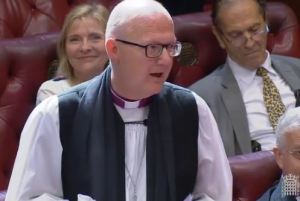
Bishop of St Albans asks Government about social housing supply in rural areas

On 27th March 2018 Lord Bassam of Brighton asked Her Majesty’s Government “what further measures, if any, they plan to take to increase the supply of council housing stock to replace homes for rent lost through right-to-buy sales”. The Bishop of St Albans, Rt Revd Alan Smith, asked a follow-up question:

The Lord Bishop of St Albans: May I push the Minister a little more on the whole question of rural housing? Only 12% of the rural housing stock is social housing, compared with 19% in urban areas. How exactly are Her Majesty’s Government going to increase the level of rural social housing over the coming years? Continue reading “Bishop of St Albans asks Government about social housing supply in rural areas”

Bishop of Durham asks about impact of two-child limit on family stability

Durham161117On 26th March 2018 the Bishop of Durham, the Rt Revd Paul Butler, asked a question he had tabled to Government on the two-child limit policy for tax credit and universal credit. His follow-up question and those of other members is reproduced below:

The Bishop of Durham: To ask Her Majesty’s Government what specific measures they are taking to monitor the impact of the two-child limit policy in the child element of Child Tax Credit and Universal Credit on the well-being of children.

The Minister for State, Department for International Development, Lord Bates: My Lords, the Government are committed to supporting child well-being, and keep all our child welfare policies under review. We provide a range of support for children, including child benefit, that continues to be paid for each child in a household. Since 2010 there are 1 million fewer people in absolute poverty, including 300,000 fewer children.

The Bishop of Durham: I thank the Minister for that reply. Given that the Government’s impact assessment argues that the two-child limit would have a positive impact on overall family stability, and that the policy would increase financial resilience and support improved life chances for children, what current evidence does the Minister have to support the claims that the policy will have a positive impact on overall family stability and improve life chances for children?

Continue reading “Bishop of Durham asks about impact of two-child limit on family stability”

Bishop of Coventry asks Government about religious freedom in Sri Lanka

Coventry171123 bOn 26th March, the Bishop of Coventry, Rt Revd  Christopher Cocksworth, received answers to two questions on freedom of religion and belief in Sri Lanka:

The Bishop of Coventry: To ask Her Majesty’s Government what steps they are taking to safeguard religious pluralism and to defend and promote freedom of religion or belief in Sri Lanka. Continue reading “Bishop of Coventry asks Government about religious freedom in Sri Lanka”

Bishop of Durham: With child poverty on the rise, we must rethink the two-child limit

This article was written by the Bishop of Durham for The House Magazine and was published on 26th March 2018. It can also be seen on the PoliticsHome website, here.

Bishop of Durham: With child poverty on the rise, we must rethink the two-child limit

Almost one year on from its introduction, the consequences of the government’s two-child limit policy are deeply concerning, writes the Bishop of Durham

The two-child limit came into effect on April 6th 2017, restricting the amount of support to families with three or more children through tax credits and Universal Credit. As the policy’s first anniversary approaches, is it timely to review its impact and purpose.

When this measure was considered in the House of Lords, as part of the Welfare Reform & Work Act, I worked closely with other peers and faith groups to outline concerns. A core foundation of a just and compassionate benefits system is that the level of support is linked to need; a foundation which risked being seriously undermined by these changes. Continue reading “Bishop of Durham: With child poverty on the rise, we must rethink the two-child limit”

Bishop of St Albans calls on Government to reduce stakes on ‘modern scourge’ of fixed-odds betting machines

On 22nd March 2018 the Bishop of St Albans, Rt Revd Alan Smith, asked a qurstion he had tabled about the social costs of fixed-odds betting terminals (FOBTs). A transcript of his question and those of other members in response, is below: 

Gambling: Fixed-odds Betting Terminals
The Lord Bishop of St Albans, To ask Her Majesty’s Government what assessment they have made of the social costs of fixed-odds betting terminals.

Baroness Chisholm of Owlpen (Con): My Lords, the consultation on gaming machines and social responsibility measures closed on 23 January, and all responses are currently being considered. An impact assessment was published alongside the consultation in October and any additional evidence submitted, including on social costs related to FOBTs, will be taken into consideration. It was made clear at consultation that the stakes on FOBTs would be reduced, and the final position will be published in due course.

The Lord Bishop of St Albans: My Lords, these particular machines are a modern-day scourge which create misery and deepen poverty. Unemployed people are more likely to play these games than any other ​group. Citizens Advice has shown that, for every addict, six to 10 other adults are directly and adversely affected. The children and families of addicts are simply bewildered at the Gambling Commission’s suggestion that a stake of up to £30 might be acceptable. Will the noble Baroness assure the House that the needs of the vulnerable will be placed above concerns about either tax revenue or the gambling lobby, and that a £2 stake is the only answer? Continue reading “Bishop of St Albans calls on Government to reduce stakes on ‘modern scourge’ of fixed-odds betting machines”

Bishop of Winchester asks about religious persecution as category for refugee status

On 20th March 2018 Lord Roberts of Llandudno asked Her Majesty’s Government “what assessment they have made of the changing situation in Syria.” The Bishop of Winchester, Rt Revd Tim Dakin, asked a follow up question:

The Lord Bishop of Winchester: My Lords, will the Minister give an assurance that in the provision of humanitarian aid to those displaced in this conflict the Department for International Development’s understanding of vulnerability includes religious persecution? Will he also give an assurance that the Government will continue to ensure that the UNHCR’s procedures and criteria for determining refugee status recognise religious persecution as a distinct category? Continue reading “Bishop of Winchester asks about religious persecution as category for refugee status”

Bishop of Derby asks Government about modern slavery and child trafficking

Bishop of DerbyOn 19th March 2018, Baroness Kennedy of Cradley asked Her Majesty’s Government ‘over the last 10 years, how many children trafficked into the United Kingdom who have subsequently applied for asylum have had their applications approved.’ The Bishop of Derby, the Rt Revd Dr Alastair Redfern, asked a follow up question:

Continue reading “Bishop of Derby asks Government about modern slavery and child trafficking”

Caroline Spelman answers written question about WiSpire

spelman-190117bOn 19th March 2018, Dame Caroline Spelman, the Second Church Estates Commissioner, answered a written question from Sir Mark Hendrick, the Labour/Co-op Member for Preston, about churches involved in the WiSpire scheme:

Sir Mark Hendrick: To ask the right hon. Member for Meriden, representing the Church Commissioners, pursuant to the answer of 13 March 2018 to Question 131116 on Churches: Blackburn, what assessment has been made of the potential merits of drafting contracts for church spires and towers to host broadband and mobile facilities which take into account circumstances in which Church authorities subsequently wish to demolish such buildings to make alternative use of Church land.

Continue reading “Caroline Spelman answers written question about WiSpire”

Bishop of Portsmouth welcomes Government integration strategy, raises concern about Near Neighbours funding

On 15th March 2018 the Minister for Faith, Lord Bourne, repeated a statement made by the Secretary of State for Housing, Communities and Local Government on the new Integrated Communities Green Paper. The Bishop of Portsmouth, Rt Revd Christopher Foster, asked a follow up question:

The Lord Bishop of Portsmouth: My Lords, there is a great deal in this Statement and in the strategy that I welcome. It promises a big and positive difference in what the Government are doing to improve integration. It is good to see in the Green Paper initiatives such as the Near Neighbours Catalyst leadership programme, to which the Minister has recently referred. It is good to see that singled out for praise. However, there is some anxiety that Catalyst and other valuable Near Neighbours activity might have to come to an end as a result of a reduction in overall funding for Near Neighbours and the for the small grants fund. I am sure that that is far from the Government’s intention, and I wonder whether the Minister can give an assurance that he will look at the impact of any funding changes as part of the assessment of this new strategy. Continue reading “Bishop of Portsmouth welcomes Government integration strategy, raises concern about Near Neighbours funding”

Bishop of Gloucester asks Government what they are doing to combat hate speech online

On 15th March 2018 the Bishop of Gloucester asked a question she had tabled to Government on online hate speech. The exchanges are below, including the follow-up questions asked by other Members.

The Lord Bishop of Gloucester: To ask Her Majesty’s Government what action they are taking to combat hate speech online.

The Minister of State, Home Office (Baroness Williams of Trafford) (Con): My Lords, this Government abhor all forms of hate speech. It is clear that what is illegal offline is also illegal online. That is why we are taking a cross-government approach through the hate crime action plan, which will be refreshed this year. We are funding an online hate crime hub, building digital resilience and have successfully worked with industry and partners internationally to agree the removal of illegal content within 24 hours.

The Lord Bishop of Gloucester: My Lords, we know that websites and apps have brought many benefits, but at a cost. From my own visits to schools, I am particularly concerned about the hate speech that young people are exposed to online, including through anonymous apps like Sarahah. What are the Government doing to ensure that the age verification checks on apps are effective? How are the Government working with smaller developers to ensure that their platforms are not used to propagate threats and hate speech? Continue reading “Bishop of Gloucester asks Government what they are doing to combat hate speech online”