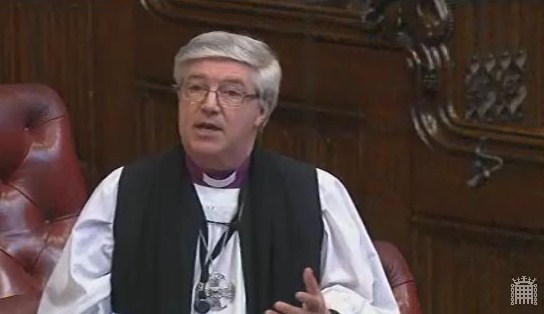
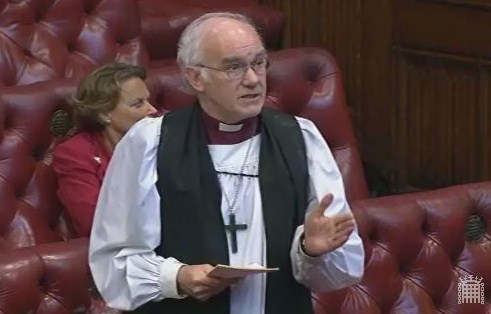
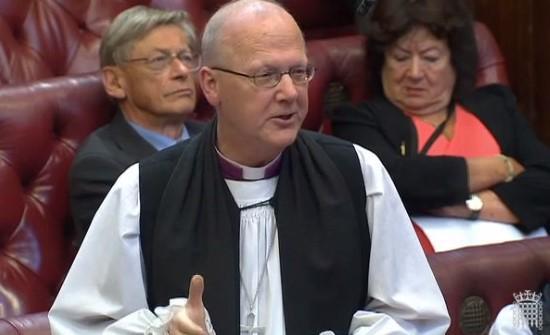
‘We cannot shirk our responsibility to be a force for good in the world’, Bishop of Worcester tells Peers

“We cannot shirk our responsibility to be a force for good in the world. The type of challenges highlighted by this debate can be managed only in partnership with others—working to win hearts and minds, as well as being involved in any defence initiatives.” – Bishop of Worcester, 2/7/15

On Thursday 2nd July 2015 the Lords debated a motion moved by Lord Ashdown of Norton–sub-Hamdon ‘that this House takes note of the United Kingdom’s role in addressing global challenges posed by terrorism, conflict, climate change and mass migration’. The Bishop of Worcester, Rt Revd John Inge, spoke in the debate.

The Lord Bishop of Worcester: My Lords, I begin by expressingmy profound sadness in the wake of the recent horrific terrorist attacks. A student from the University of Worcester was killed in Tunisia, which brought home to people locally that these problems are not “out there”. It demonstrated very clearly the connectivity, of which the noble Lord, Lord WorcesterAshdown, spoke so eloquently.

What should our response be to the unprecedented times described so well by the noble Lord? While recognising that we have faced more difficult times, as the First World War commemorations remind us, we need to hold on to the strategic objectives that have underpinned British foreign policy since 1945 but adapt them for these new circumstances. We need to recognise that, although we live in an unprecedentedly connected world, it remains fractured and broken, and we need to work ever harder in partnership with others for the global common good. Continue reading “‘We cannot shirk our responsibility to be a force for good in the world’, Bishop of Worcester tells Peers”

Bishop of St Albans asks Government about provision of mental health care services for children and young people

On 30th June 2015 the House of Lords debated a motion from Baroness Tyler of Enfield “to ask Her Majesty’s Government what plans they have to respond to the recommendations of the Children and Young People’s Mental Health Task Force Report Future in Mind.” The Bishop of St Albans, Rt Revd Alan Smith, spoke in the debate.

Bishop St Albans June 2015The Lord Bishop of St Albans: My Lords, I, too, am grateful to the noble Baroness, Lady Tyler, for introducing this debate, for the excellent work of the task group and for the commitment that Her Majesty’s Government have already made to this area.

I also pay tribute to the many excellent charities that are working in this area. Just round the corner from where I live in St Albans is a small charity. I do not suppose that any of your Lordships will have heard of it. It is called Youth Talk and it was set up some years ago, in 1997, by a local GP after she realised that there was a need for a safe place where young people could come for counselling and support. Continue reading “Bishop of St Albans asks Government about provision of mental health care services for children and young people”

Bishop of Derby: Opinion polls ‘more in the realm of entertainment than science’

“My opinion is that we should let the polling industry do its best. I would categorise it more in the realm of entertainment than science. It is helpful, people enjoy it and it is useful but we need a sense of proportion.” – Bishop of Derby, 18/6/15

On Thursday 18th June 2015 the Bishop of Derby, Rt Revd Alastair Redfern took part in a Lords debate tabled by Lord Lipsey, to ask the Government “whether they plan to regulate the opinion-polling industry.” He said:

Bishop of DerbyThe Lord Bishop of Derby: My Lords, I want to look at opinion poll industry regulation in a general way, rather than focusing on a particular case, as the noble Lords, Lord Lipsey and Lord McColl, have done.

In the spirit of the Motion I am going to offer an opinion. My first point is about opinion itself. Opinion is, by definition, fragile and changeable. It is lite—that is L-I-T-E, for Hansard—and that is very different from attitudes and prejudices, which are firm and more long-standing. We live in a time of opinion, when people just tweet things without much thought—bang, out goes the view. Continue reading “Bishop of Derby: Opinion polls ‘more in the realm of entertainment than science’”

Bishop of Southwark calls on Government to invest in peacekeeping and post-conflict role of armed forces

On Wednesday 17th June 2015 the House of Lords debated a motion in the name of Lord Sterling of Plaistow “to ask Her Majesty’s Government whether they consider that the current defence budget is sufficient to enable the Armed Forces to meet the needs of the United Kingdom’s long-term foreign policy.” The Bishop of Southwark, Rt Revd Christopher Chessun, spoke in the debate, highlighting the need to resource conflict resolution and post-conflict stabilisation in Syria and other parts of the region.

Bp Southwark May 2015The Lord Bishop of Southwark: My Lords, I too welcome this debate and thank the noble Lord, Lord Sterling, for securing it. With the strategic defence and security review we have an opportunity for a wider debate on the politics of defence that might help to reshape our understanding of the purpose and task of our Armed Forces. The fundamentals that have underpinned UK foreign policy and defence spending in the past will need to be adapted to the changed circumstances we face, especially in the Middle East and our European neighbourhood. Continue reading “Bishop of Southwark calls on Government to invest in peacekeeping and post-conflict role of armed forces”

Bishop of Derby asks Government about transport infrastructure and investment in the East Midlands

On Wednesday 17th June 2015 the House of Lords debated a Government motion in the name of Lord Ahmad of Wimbledonthat this House takes note of transport connectivity and infrastructure in the north of England.” The Bishop of Derby, Rt Revd Alastair Redfern, spoke in the debate, highlighting transport, infrastructure and investment questions for the east Midlands and Derby diocesan area.

Bishop of DerbyThe Lord Bishop of Derby: My Lords, I, too, thank the Minister for his clear, optimistic and encouraging introduction, and associate myself with the noble Lord, Lord Prescott, and his desire for this to proceed quickly and effectively. I declare an interest in that I come from Derby in the east Midlands, so I feel a bit like an interloper in this debate about the north—although part of our diocese is the Peak District, which may just qualify as the north. Continue reading “Bishop of Derby asks Government about transport infrastructure and investment in the East Midlands”

Sustainable Development Goals – Bishop of St Albans calls for a new moral vision

“I believe that the time is ripe for a new moral vision of the one world in which we all live, not just because it is morally right that we should do that but because, frankly, it is in our interests.” – Bishop of St Albans, 16/6/15

On Tuesday 16th June 2015 the Lords debated a motion by Lord McConnell of Glenscorrodale “to ask Her Majesty’s Government what are their priorities for the Sustainable Development Goals to be agreed by the United Nations in September.” The Bishop of St Albams, Rt Revd Alan Smith, spoke in the debate.

Bishop St Albans June 2015The Lord Bishop of St Albans: I am grateful to the noble Lord, Lord McConnell, for securing for us this opportunity to debate this important area.

As we mark the 800th anniversary of the sealing of Magna Carta this week, we are reminded that some ideas, initiatives or visions take a long time to come to fruition. Sometimes, all that one generation can do is to plant the acorn and it is for subsequent generations to appreciate the fully grown oak tree. Continue reading “Sustainable Development Goals – Bishop of St Albans calls for a new moral vision”

Empowering women in the developing world – speech by Bishop of Derby

On 11th June 2015 Lord Loomba led a debate in the House of Lords entitled “That this House takes note of the case for empowering women, including widows, in the developing world in order to aid conflict resolution and the long-term sustainability of more stable societies.”  The Bishop of Derby, Rt Revd Alastair Redfern, spoke in the debate.

Bishop of DerbyThe Lord Bishop of Derby: My Lords, I, too, want to thank Lord Loomba for securing this debate and giving us this chance to discuss with the Minister and the Government our priorities and contribution to these issues across the world.

We all know that there is a strong link between the well-being of women and girls and peace, security and development. It is in our UK national plan and is a very big part of my own experience. I am privileged to be a trustee of Christian Aid, and we deliberately prioritise investment in women and girls to secure the transformation and development of needy societies. Within my own Anglican tradition, the Mothers’ Union Worldwide does amazing work in places such as Rwanda, empowering women to transform communities. In my diocese, we have an annual harvest appeal and, for the last several years, have invested in helping women in Delhi set up recycling businesses and, this year, helped educate girls and women in Angola. It is right on the forefront of making a difference. My work on the Modern Slavery Bill opened my eyes to the appalling international abuse and oppression of women through sexual violence and exploitation. Continue reading “Empowering women in the developing world – speech by Bishop of Derby”

Bishop of Rochester on the role of churches, voluntary and community groups in building the common good

On 11th June 2015 the Bishop of Rochester, Rt Revd James Langstaff, spoke during the House of Lords debate on the Bishops’ Pastoral Letter for the 2015 General Election. The text is below and the speeches of others in the debate can be read here

Bishop of RochesterThe Lord Bishop of Rochester: My Lords, I, too, am grateful to my friend the right reverend Prelate the Bishop of St Albans for initiating this debate, and the opportunity to reflect on the House of Bishops’ pastoral letter, which, although issued in the context of an election, was written in the hope that it would provide an ongoing stimulus to thinking and reflecting on the shape of our society and the kind of society that we wish to be. Not least, it will provide something of a challenge to the churches, to which it is primarily addressed, but to others also, to discover afresh something that is a treasure and very much part of our story. Reference has been made to Magna Carta, and as Bishop of Rochester I would be remiss not to remind noble Lords of the existence of the Textus Roffensis, which predates the Magna Carta, although it is not quite so long, and which also merits celebration. Continue reading “Bishop of Rochester on the role of churches, voluntary and community groups in building the common good”

Bishop of St Albans leads debate on civil society, the common good and the Bishops’ General Election pastoral letter

“I am convinced that there is urgent work to be done to establish a new politics that seeks the common good. Indeed, I am keen that we will be able to explore the forms that such an approach to politics might take and the role that churches, charities and voluntary organisations, and indeed all intermediate institutions, can play in moving us in that direction.” – Bishop of St Albans, 11/6/15

On the 11th June 2015 the Bishop of St Albans, Rt Revd Alan Smith, led a House of Lords debate on the pastoral letter of the House of Bishops for the General Election of 2015. The debate was titled:

‘That this House takes note of the role played by civil society, in the light of the pastoral letter from the Church of England’s House of Bishops, Who is my neighbour?’

The Bishop’s speech is below in full, along with his closing remarks and links to the speeches of the other 16 participants.The speech and subsequent debate can also be watched here.

Bishop St Albans June 2015The Lord Bishop of St Albans: My Lords, there is much in our nation for which we can be profoundly grateful. Next week, as we mark 800 years since the sealing of Magna Carta, we give thanks for the long, yet sometimes tortuous, path that has led us to becoming a modern democracy. That moment was if not the birth then perhaps at least the conception of civil society at the beginning of a long gestation.

Last month, we celebrated 70 years of peace since the end of the Second World War, by which time civil society as we know it today was coming of age. As a nation, we have experienced extraordinary levels of economic growth over recent decades. Life expectancy has increased significantly and, importantly for this debate, in many communities in our nations, civil society is still strong and thriving. I for one am immensely grateful to be living in modern Britain and do not want to give any time to sentimental talk about a bygone era that probably never existed. Continue reading “Bishop of St Albans leads debate on civil society, the common good and the Bishops’ General Election pastoral letter”

Bishop of Rochester call for improvements to housing

On 3rd June 2015, during the debate on the Queen’s Speech, the Bishop of Norwich, the Rt Revd James Langstaff, spoke on improvements needed to the housing market and the far-reaching impacts that these would have. The text of his speech is below and can be watched online here:

Bishop of Rochester

The Lord Bishop of Rochester: My Lords, I welcome the opportunity to speak in this debate on the gracious Speech. I am delighted to follow the noble Earl because he has paved the way for me in reminding us of some of the contributions which were made in yesterday’s debate on matters to do with housing and the proposed housing Bill. He has illustrated the points rather more graphically and personally than I might be able to do. I make that connection between yesterday and today because I think it is very clear that issues to do with housing have a real relevance to the matters which are our main focus in today’s debate in your Lordships’ House. For example, research over decades has underlined the point which has just been so graphically made—that there is a clear connection between the quality and conditions of housing on the one hand, and people’s mental and physical health and well-being on the other. There can be very little debate about that; I do not need to labour the point. Continue reading “Bishop of Rochester call for improvements to housing”