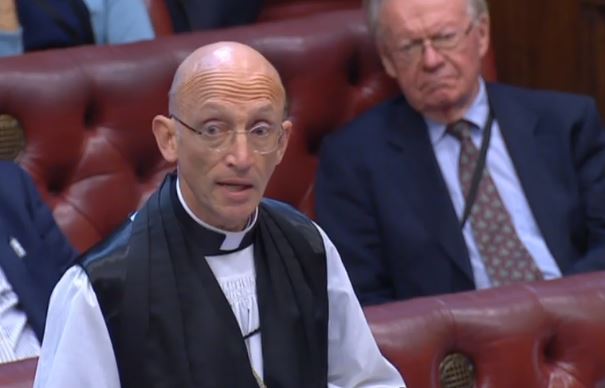
On 15th July 2021, the Bishop of Durham spoke in a debate on the Skills & Post-16 Education Bill, expressing his support for amendments focused on supporting students’ mental health:
The Lord Bishop of Durham: My Lords, I particularly want to support Amendment 63, but also the others in the group. Just last month, in June 2021, the DfE itself published a report, Student Mental Health and Wellbeing, based on research done before the pandemic. It points out that 96% of institutions ask their students about their mental health but only 41% ask them about their general well-being. It also notes that only 52% of universities would say that they have a “dedicated strategy” for the mental health and well-being of their students. So the DfE’s own report, from last month, highlights that there is plenty of work to be done on universities having proper, dedicated strategies around mental health and well-being—particularly on the well-being side.
On 15th July 2021, the House of Lords debated amendments to the Skills and Post-16 Education Bill in the second day of the committee stage. The Bishop of Durham spoke in favour of amendments 41 & 43, which would clarify language around provision for special educational needs & disabilities and require that further education settings regularly review their SEND offer:
The Lord Bishop of Durham: My Lords, I first need to declare my interest as chair of the National Society. I should also apologise that I was unable to take part in Second Reading because of other engagements; my noble friend the Bishop of Leeds spoke in my stead. I also need to apologise for a complete error on my part in not being available to speak to Amendment 11, to which my name was added, during day one of Committee; that was entirely an administrative error at my end.
However, I now enter into the debate on a very small matter, on Amendment 41, on which I simply want to endorse the comments made by the noble Lord, Lord Addington, about the phrase “from time to time”. The language seems too loose. The word “regularly” implies something more frequent without expressing exactly what that regularity is. Put simply, regular review that connects with potential changing local needs makes good sense. The amendment simply tightens this up.
On 15th July 2021, the Bishop of Durham asked a question on government plans to improve rail services in the north-east of England, following a discussion on frequency of services on the east coast mainline network:
The Lord Bishop of Durham: My Lords, I declare an interest as a regular LNER user. I have a lot of sympathy with the noble Lord, Lord Beith. I recognise that connections from Darlington, Durham and Newcastle are northwards as well as southwards. Will the Minister comment on how local services such as those from Bishop Auckland to Middlesbrough and the possible reopening of Durham to Sunderland need to be invested in for the economic growth of the north-east as a whole?
Question for Church Commissioners, UIN 31286, tabled on 12 July 2021
Michael Fabricant, (Conservative, Lichfield): To ask the Member for South West Bedfordshire, representing the Church Commissioners, with reference to the article by the Revd Marcus Walker, Rector of the Priory Church of St Bartholomew the Great, London, entitled, Is this the last chance to save the Church of England, published in the Spectator on 10 July 2021, what assessment the Church has made of the implications for its policies of the (a) findings of Revd Walker and (b) potential merits of proposals to create 10,000 new lay-led churches in the next 10 years in private homes and public halls.
The Bishop of London received the following written answer on 15th July 2021:
The Lord Bishop of London asked Her Majesty’s Government what plans they have (1) to collect, and (2) to report, data on the number of people affected by long-COVID alongside the data on hospitalisations and death.
On 14th July 2021, the House of Lords voted on the Business and Planning Act 2020 (Pavement Licences) (Coronavirus) (Amendment) Regulations 2021. A Bishop took part in the vote:
The Bishop of Worcester asked a question on cuts to the UK’s overseas development aid, with particular regard to the impact on recipients of aid and on our leadership in international development, on 14th July 2021:
The Lord Bishop of Worcester: My Lords, the Chancellor’s Statement published on Monday finally outlined the meaning of the much-repeated but undefined government line that 0.7% aid spending would be restored when the fiscal situation allows. Will the Minister accept that to many working in the field of international development, these criteria point to a permanent rather than a temporary cut in overseas development, which in any case was due to change and has changed because it is a percentage of gross national income? Does the Minister recognise that this decision represents a terrible sentence, probably of death, for thousands of children and risks doing untold reputational damage to Britain’s leadership in international development?
On 14th July 2021, the Bishop of Chichester asked a question on the abolition of the National Lottery Heritage grant for church buildings:
The Lord Bishop of Chichester: My Lords, will the Minister undertake to review the abolition of the HLF grant for places of worship, which has resulted in congregations without financial resources finding it much harder to compete for maintenance and development funding? The effect of abolition has been profoundly demoralising for small rural communities and areas of deprivation in coastal towns, such as Hastings, where the church building can be a source of local pride and community cohesion but is in danger of falling into disrepair and representing a sense of abandonment by local and national government.
On 13th July 2021, the House of Lords debated a report from the Procedures and Privileges Committee regarding proposed changes to procedures in the House. Votes were held on a motion to approve the changes, and amendments to the main motion, in which Bishops took part:
On 13th July 2021, the House of Lords debated the motion:
“that the Report from the Select Committee Procedural adaptations arising from the hybrid House; Interim option of voting using PeerHub; Ongoing virtual participation by disabled members (1st Report, HL Paper 41) be agreed to.”
The Bishop of Chichester spoke in the debate, welcoming steps to retain some hybrid adaptations, but expressing concern over the proposed changes to some oral question procedures:
The Lord Bishop of Chichester: My Lords, my right reverend friend the Bishop of Birmingham, who is our convenor, regrets that he cannot attend today’s debate. As Bishop on duty, I offer some thoughts on behalf of these Benches. On behalf of my right reverend friends, I thank the Leader of the House and the leaders of the parties, and especially all the staff who have seen us through this extremely challenging time. All of us have a particular debt of gratitude to those in the digital and technical spheres, which many of us struggle with. I noted earlier that it has enabled some of my right reverend friends to share with the House the interior of their splendid cathedrals, so that has been great. I am grateful to the noble and learned Lord, Lord Mackay, for his recognition that being present in the House is also a very important contribution on our behalf.
I speak as a relative newcomer to your Lordships’ House, and as one of those Members, found on all sides of the House, who combines their service here with a significant full-time outside commitment. It is one of the strengths of this House that it gives space for this, so that membership is not just for what might be described as the full-time, professional politician. The assessment of any change to our procedure should not only test efficiency in our working practices and the capacity for inclusion in them but demonstrate how it will enable those who are not full-time to participate as fully as possible to bring into the debate and scrutiny this House exercises the wide range of experience that they bring.








You must be logged in to post a comment.