Archbishop of York asks Government about consultation process for new pension regulations

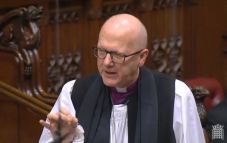
On 15th January 2019 the House of Lords debated a Motion to Approve the Occupational and Personal Pension Schemes (Amendment etc.) (EU Exit) Regulations 2018.  The Archbishop of York, Most Revd John Sentamu, spoke during the debate:

The Archbishop of York: My Lords, I just wanted to ask the Minister: how much consultation was undertaken with industry before the first regulations were produced? Did industry suggest, rightly, that this would cause trouble for the Pensions Regulator and others because it was bigger than just the United Kingdom? Continue reading “Archbishop of York asks Government about consultation process for new pension regulations”

Archbishop of York probes Government about new rules on visitors to detainees who are terminally ill

On 15th January 2019 the Government’s Counter-Terrorism and Border Security Bill was debated at its Third Reading in the House of Lords. The Archbishop of York, Most Revd John Sentamu, spoke during debate on a Government amendment to Clause 4 of the Bill, concerning whether a person might enter a ‘designated area’ to visit a detained relative who is  terminally ill.

The Archbishop of York: My Lords, will the Minister contemplate another example? Megrahi was sent from a Scottish jail back to Libya and expected to die within a short period, but he lived for longer than six months. What if someone was here and the same thing applied? President Pinochet was allowed to go back. Everybody expected him to die but he walked off the plane and lived for quite some time. So the six-month period could become a problem. One needs to find a way of describing it in another way. People have died within six months but some have lived longer. Can the noble Earl help us with that quandary? Continue reading “Archbishop of York probes Government about new rules on visitors to detainees who are terminally ill”

Archbishop of York thanks Minister for listening to concerns on Tenant Fees Bill

On 15th January 2019 the Government’s Tenant Fees Bill passed at Third Reading in the House of Lords. The Archbishop of York, Most Revd John Sentamu, spoke briefly:

The Archbishop of York: My Lords, I too thank the Minister for listening. He has been very attentive in listening to the suggestions, comments and evidence from tenants and all those people involved with this part of the Bill. I have been in correspondence with the Minister, starting in the Moses Room. Continue reading “Archbishop of York thanks Minister for listening to concerns on Tenant Fees Bill”

Bishop of St Albans asks Government how it will regulate gambling advertising online focused on young people

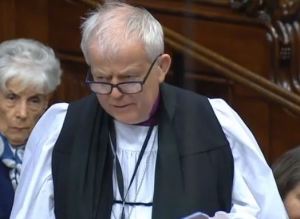
On 15th January 2019 the Bishop of St Albans, Rt Revd Alan Smith, asked a question he had tabled to Government in the House of Lords. The answer, his subsequent question and those of other Members are below:

Gambling: Children

The Lord Bishop of St Albans: To ask Her Majesty’s Government what assessment they have made of the prevalence of gambling among children and young people.

The Parliamentary Under-Secretary of State, Department for Digital, Culture, Media and Sport (Lord Ashton of Hyde) (Con): My Lords, protecting children is a priority for the Government. There are strict controls to prevent underage gambling. In 2011, 23% of 11 to 15 year-olds had gambled in the last week, including with friends. Last year, it was 12%. On the other hand, the Gambling Commission’s Young People & Gambling 2018 report shows an increase to 14%, though not to earlier levels. Sample sizes are small, and we do not know if this is a trend. We are of course monitoring the situation very carefully.

The Lord Bishop of St Albans: I thank the Minister for his reply. At a time when the gambling industry is spending about £1.5 billion a year on encouraging gambling, when children are seeing three gambling adverts every day on average and when 55,000 teenagers in this country are now classified as problem gamblers, we need to look at what is happening particularly online, where young people most often see the adverts, which is outside all the previous criteria for regulation. What are Her Majesty’s Government doing to regulate online advertising, which is particularly focused on our young people? Continue reading “Bishop of St Albans asks Government how it will regulate gambling advertising online focused on young people”

Votes: EU Withdrawal Agreement and Political Declaration

On 14th January 2019 the House of Lords voted to pass a ‘Motion to Regret’ the Government’s EU Withdrawal Agreement, tabled by the Leader of the Opposition Baroness Smith of Basildon. Five bishops voted, and whilst the Archbishop of Canterbury attended and spoke in the debate, he abstained in the vote. 

House of Lords Division Lobby

Baroness Smith of Basildon moved ‘That this House, while noting that it is for the House of Commons to determine the matter, considers that a no deal outcome to negotiations under Article 50(2) of the Treaty on European Union must be emphatically rejected, and regrets that withdrawal from the European Union on the terms set out in the Withdrawal Agreement and Political Declaration laid before Parliament would damage the future economic prosperity, internal security and global influence of the United Kingdom.

Continue reading “Votes: EU Withdrawal Agreement and Political Declaration”

Bishop of Lincoln urges tolerance and respect for diversity in Brexit debate

On 14th January 2019 the House of Lords debated the Government’s EU Withdrawal Agreement and Political Declaration. The Bishop of Lincoln, Rt Revd Christopher Lowson, spoke in the debate. His full speech is below:

The Lord Bishop of Lincoln: My Lords, I am honoured to speak after the noble Baroness—honoured and a little daunted. This is the first time I have spoken on this issue. I therefore want to say something about my context of Lincoln and then consider what a Bishop might usefully add to this debate.

As your Lordships know, Lincolnshire is one of the parts of the United Kingdom that voted most emphatically in favour of the UK’s withdrawal from the EU, with 66% voting to leave. I have thought hard about why that should be the case. There are the obvious reasons—the tip of the iceberg, if you like. Nationally, these would be described in terms of sovereignty and immigration.

Continue reading “Bishop of Lincoln urges tolerance and respect for diversity in Brexit debate”

Archbishop of York urges Government to learn from Lawrence inquiry when defining Islamophobia

On 14th January 2019 Baroness Finn tabled an Oral Question ‘To ask Her Majesty’s Government what assessment they have made of the potential consequences of adopting an official definition of Islamophobia.’ The Archbishop of York, the Most Revd and Rt Hon Dr John Sentamu, asked a follow up question:

The Archbishop of York: My Lords, on the overall question of definitions, sometimes it is much easier to do things when we handle them as concepts. In the Stephen Lawrence inquiry, we struggled with the question of racism, particularly when it is found in institutions, so we ended up saying: “The concept that we apply to this case of institutional racism is this”. That is much easier than a definition because a definition can restrict what you want to say. Is it not better to learn from what the Stephen Lawrence inquiry did?

Continue reading “Archbishop of York urges Government to learn from Lawrence inquiry when defining Islamophobia”

Bishop of St Albans asks what is being done to address cholera epidemic in Yemen

On 14th January 2019, Lord Ahmed tabled an Oral Question ‘To ask Her Majesty’s Government what assessment they have made of the humanitarian situation in Yemen.’ The Bishop of St Albans, the Rt Revd Dr Alan Smith, asked a follow-up question:

The Lord Bishop of St Albans: My Lords, as well as the huge famine—I congratulate Her Majesty’s Government on what they are doing to respond to it—we are also seeing unfold before our eyes a huge medical crisis, with possibly the largest cholera epidemic in recorded history. Will the Minister update us on what plans and action are being taken with our partners to bring in medical help urgently to try to address this unparalleled, Dickensian level of preventable disease?

Continue reading “Bishop of St Albans asks what is being done to address cholera epidemic in Yemen”

Week in Westminster 7th-11th January 2019

This week in the House of Lords bishops spoke in debates on the Government’s EU Withdrawal Agreement, and the welfare of girls in conflict-afflicted countries. 

They asked questions on benefit reforms and the impact on children, Iranians seeking asylum in the UK, child refugees, and Universal Credit. The Bishop of Durham welcomed the Government’s announcement on the two-child limit on welfare benefits.

In the House of Commons the Second Church Estates Commissioner answered questions on cathedral choirs and disability discrimination legislation. Continue reading “Week in Westminster 7th-11th January 2019”

Bishop of Durham Welcomes Universal Credit Announcement

From the Church of England website:

Following comments by the Work and Pensions Secretary Amber Rudd on changes to Universal Credit, the Bishop of Durham, Paul Butler, who speaks for the Church of England on issues relating to children and young people, said:

“As a just and compassionate society, we believe that every child is a blessing and deserves to be treated equally.

“So I very much welcome today’s announcement that the two-child limit policy will not be extended to children born before the policy came into effect in April 2017. I also welcome the Government’s more considered approach to moving people on to Universal Credit from the old benefits system.

Continue reading “Bishop of Durham Welcomes Universal Credit Announcement”