
 On 21st March the House of Lords considered the Government’s Immigration Bill at Report Stage. Labour Peer Lord Dubs tabled an amendment to require the Secretary of State to make arrangements for relocating 3,000 unaccompanied refugee children to the UK, from other countries in Europe. The Bishop of Chelmsford, the Rt Revd Stephen Cottrell, co-sponsored the amendment, speaking and voting in support. In the subsequent Division the amendment was agreed by 306 votes to 204.
Continue reading “Immigration Bill: Bishop of Chelmsford supports amendment to provide for unaccompanied refugee children”
Bishop of St Albans asks Government about case of Asia Bibi
On 21st March 2016 the Bishop of St Albans, Rt Revd Alan Smith, received a written answer to a question on the case of Asia Bibi.
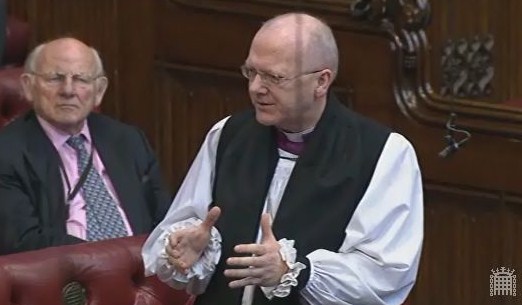 The Lord Bishop of St Albans: To ask Her Majesty’s Government what assessment they have made of the case of Asia Bibi, currently sentenced to death in Pakistan for blasphemy. [HL6793]
Baroness Anelay of St Johns: The Foreign and Commonwealth Office remains concerned about the case of Ms Bibi and continues to follow her appeal process closely. The Supreme Court suspended the death sentence to allow for appeal in July 2015, but she does not yet have a hearing date.
Continue reading “Bishop of St Albans asks Government about case of Asia Bibi”
Church of England Week in Westminster 14th-18th March 2016
Welcome to the Church of England’s weekly round-up of activity in Parliament.

This week bishops in the House of Lords sponsored, spoke to and voted on amendments to the Government’s Housing and Planning Bill, Immigration Bill and Trade Union Bill. Bishops also spoke in debates on renewable energy, maternal care and Israel/Palestine. They asked questions on fixed odds betting terminals, reception of unaccompanied migrant children, the effects of UK withdrawal from the EU, credit unions and preventing child abuse. In the House of Commons the Second Church Estates Commissioner answered questions on mission in deprived areas, helping ex-offenders into work, sustainable energy, women’s leadership in the church and the contribution of cathedrals to cultural and economic life. Continue reading “Church of England Week in Westminster 14th-18th March 2016”
Bishop of Worcester calls for end to demolition of Palestinian homes and land confiscation in West Bank and east Jerusalem
On 17th March 2016 Lord Hylton led a question for short debate, to ask Her Majesty’s Government “to what extent they will implement the recommendations of the House of Commons International Development Committee in their report of July 2014, The UK’s Development Work in the Occupied Palestinian Territories.” The Bishop of Worcester, Rt Revd John Inge spoke in the debate:
 The Lord Bishop of Worcester: My Lords, I, too, am grateful to the noble Lord, Lord Hylton, for securing this debate. As someone who wants to see the flourishing of both Israel and Palestine, I welcome this report, although I am saddened by the situation that has developed since its publication. In their response to the report, the Government affirm their support of a two-state solution. If that is to remain a possibility, we surely need to do all we can to persuade Israel to end the demolition of Palestinian homes and the confiscation of Palestinian land throughout the West Bank, including east Jerusalem. Continue reading “Bishop of Worcester calls for end to demolition of Palestinian homes and land confiscation in West Bank and east Jerusalem”
Bishop of Worcester speaks on importance of maternal care and calls for extension of married couples’ tax allowance
On 17th March 2016 the Earl of Dundee led a short debate “To ask Her Majesty’s Government what steps they are taking to promote ongoing maternal care for children.” The Bishop of Worcester, Rt Revd John Inge, spoke in the debate:
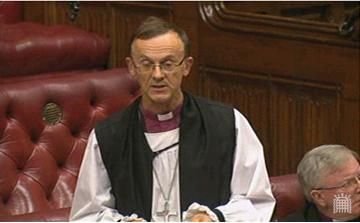 The Lord Bishop of Worcester: My Lords, I am also grateful to the noble Earl for securing this debate because I am utterly convinced about the importance of ongoing maternal care for children. I speak as the father of two adopted children. I have learned through experience and study how crucial is the relationship that children have with their mother. It is an essential and defining part of the process of perinatal life that a bond is formed between child and mother, regardless of the latter’s conscious attitude towards her baby. Continue reading “Bishop of Worcester speaks on importance of maternal care and calls for extension of married couples’ tax allowance”
Housing Bill: Bishop of St Albans puts amendment to require assessment of needs of Gypsies and Travellers
On 17th March 2016 the House of Lords considered the Government’s Housing and Planning Bill in committee. The Bishop of St Albans, Rt Revd Alan Smith, spoke to an amendment he had tabled, which was co-sponsored by the former Archbishop of Canterbury, Lord Williams of Oystermouth. The amendment, to clause 115 of the Bill, concerned the requirement on local authorities to assess the needs of Gypsies and Travellers. It was withdrawn after debate, as is usual at committee.The Bishops’ speech and the Minister’s response are below:
THE LORD BISHOP OF ST ALBANS
BARONESS BAKEWELL OF HARDINGTON MANDEVILLE
BARONESS WHITAKER
LORD WILLIAMS OF OYSTERMOUTH82H Page 53, line 1, leave out subsection (2)
 The Lord Bishop of St Albans: My Lords, I shall speak to Amendment 82H, which has broad support across this House. This is a simple probing amendment that would seek to retain Sections 225 and 226 of the Housing Act 2004 in legislation, requiring local authorities to undertake a direct assessment of Gypsy and Traveller needs. I shall also speak to Amendment 82GD, tabled by the noble Lord, Lord Beecham, which may point towards an alternative way forward. Continue reading “Housing Bill: Bishop of St Albans puts amendment to require assessment of needs of Gypsies and Travellers”
Bishop of St Albans praises work of credit unions in schools
On 17th March 2016 Lord Young of Cookham asked Her Majesty’s Government, “following their announcement concerning the Help to Save scheme, how many people in work and receiving either Working Tax Credit or Universal Credit are expected to benefit from that scheme.” The Bishop of St Albans, Rt Revd Alan Smith, asked a follow up question:
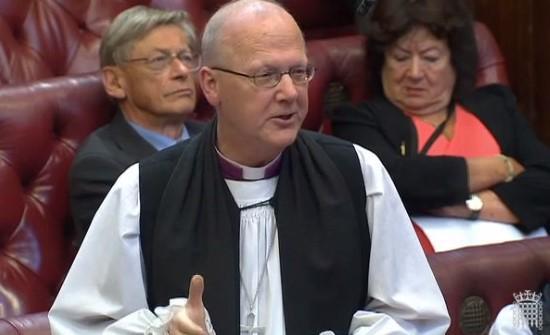 The Lord Bishop of St Albans: My Lords, will the Minister affirm the importance, in addition to the Help to Save scheme, of the increasing number of credit unions which routinely go into schools to try and create a culture of saving from the very earliest age, to address the endemic problem of a presupposition of debt? Continue reading “Bishop of St Albans praises work of credit unions in schools”
Church Commissioners’ Questions: mission, help for work, sustainable energy, women’s leadership, cathedrals
On 17th March 2016 MPs put questions to Rt Hon Caroline Spelman MP, representing the Church Commissioners. Questions were asked on mission in deprived areas, helping ex-offenders into work, sustainable energy, women’s leadership in the church and the contribution of cathedrals to cultural and economic life. A transcript is below.

Division: Trade Union Bill- Electronic voting

On the 16th March 2016 Lord Kerslake moved an amendment to the Government’s Trade Union Bill regarding the introduction of electronic voting for the purpose of ballots held before any trade union action.The Bishop of Chester took part.
Lord Kerslake moved amendment 3, after clause 3, to insert the new clause Electronic balloting Provision for electronic balloting: review and piloting scheme. The House divided: Continue reading “Division: Trade Union Bill- Electronic voting”
Division: Renewables Obligation Closure Etc. (Amendment) Order 2016
On the 16th March 2016 Baroness Featherstone moved a motion to regret the Renewables Obligation Closure Etc. (Amendment) Order 2016. A vote was called and the Bishop of Salisbury took part.
Division Result:
Contents: 153 | Not Contents: 144 | Result: Government Defeat
The Bishop of Salisbury voted Content.
(Via Parliament.UK)


You must be logged in to post a comment.