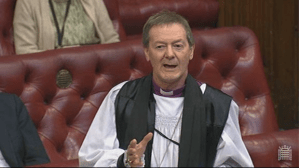
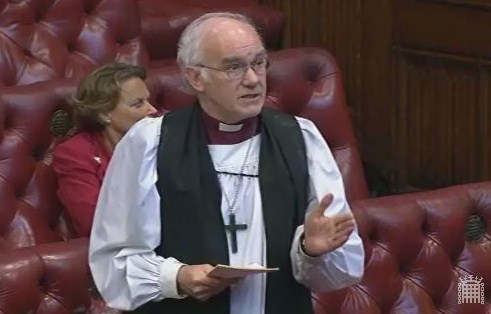
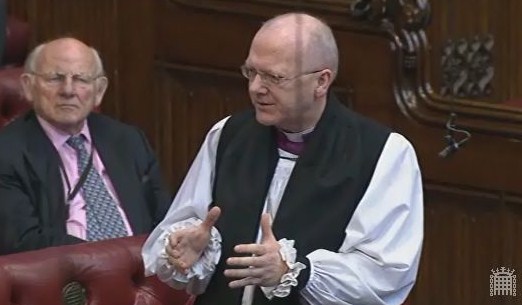
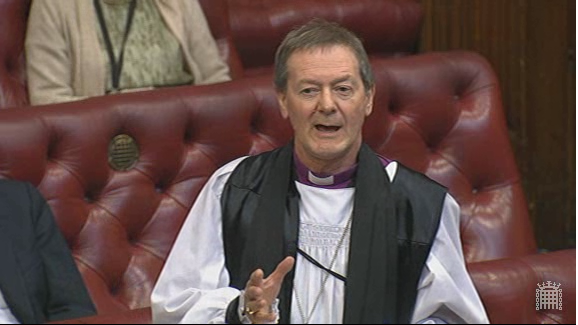
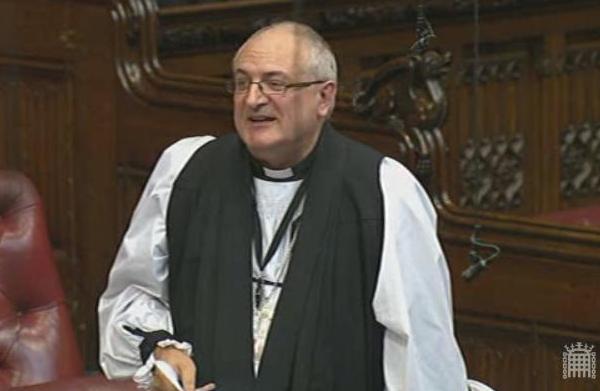
On 20th October 2014 the House of Lords debated the Government’s Criminal Justice and Courts Bill during its Report Stage. Peers debated an amendment from Crossbench Peer Lord Lloyd of Berwick to Clause 10, relating to treatment of prisoners serving indeterminate sentences. The Bishop of Rochester, Rt Rev James Langstaff, joined several Peers in expressing support for the amendment and he voted for its inclusion during the subsequent Division of the House. Continue reading “Criminal Justice and Courts Bill – vote on indeterminate sentences”
Church of England Week in Westminster, 13th-17th October 2014
Welcome to the Church of England’s weekly round-up of activity in Parliament.
In the past week, bishops in the House of Lords have led the debate on the Church of England Measure for Women Bishops, which was passed by Peers. They have also spoken in debates on the Government’s strategy for social justice, on wind farms and put questions on rented homes, ISIL in Iraq/Syria and the situation in Ukraine. Continue reading “Church of England Week in Westminster, 13th-17th October 2014”
ISIL, Iraq and Syria – Bishop of Truro asks about freedom of religion
On 16th October 2014 a statement by the Foreign Secretary on ISIL, Iraq and Syria was repeated in the House of Lords by the Minister of State at the Foreign and Commonwealth Office, Baroness Anelay of St Johns. The Bishop of Truro, Rt Rev Tim Thornton, asked a question in response:
The Lord Bishop of Truro: My Lords, I, too, thank the noble Baroness for her Statement and associate the Lords spiritual with her thanks and tributes to those she mentioned in it. The conflicts in Syria and Iraq are, sadly, part of a wider cycle of sickening violence in which individuals and groups are increasingly targeted for their religious affiliation. Continue reading “ISIL, Iraq and Syria – Bishop of Truro asks about freedom of religion”
Maiden speech by the Bishop of Ely – Government strategy on social justice
“The legitimacy of any legislature is judged by the sure access to justice for all citizens, regardless of age or estate. For that justice to be social it requires the active participation of all communities. I believe that this justice is rooted in the invitation of God to be generous and visible with and for others” – Bishop of Ely, 16/10/14
On 16th October 2014, the House of Lords debated a motion in the name of Baroness Tyler of Enfield, “that this House takes note of Her Majesty’s Government’s Social Justice strategy.” The Bishop of Ely, Rt Rev Stephen Conway, gave his maiden speech in the debate:
The Lord Bishop of Ely (Maiden Speech):My Lords, I begin by expressing my gratitude for the welcome I have received since I was introduced into your Lordships’ House. My theological sense of direction is rather more developed than my physical sense, and I have been touched by the noble Lords who have accompanied me around bewildering corridors. Your Lordships may yet see me, like Theseus, unwinding a ball of twine to get me back to the Bishops’ Robing Room. Continue reading “Maiden speech by the Bishop of Ely – Government strategy on social justice”
Lords debates social justice – speech by Bishop of Truro
“I worry enormously that in our society we fall too easily into a tendency to demonise and victimise and fall between us and them… I suggest that there is clear evidence that our society is struggling to understand itself as a society today, and not enough evidence on the value of justice for all members of our society” – Bishop of Truro, 16/10/14
On 16th October 2014, the House of Lords debated a motion in the name of Baroness Tyler of Enfield, “that this House takes note of Her Majesty’s Government’s Social Justice strategy.” The Bishop of Truro gave the following speech:
The Lord Bishop of Truro: My Lords, I am very grateful to the noble Baroness, Lady Tyler, for initiating this debate and congratulate her on her very clear and comprehensive introduction to this very important topic. I am also very grateful to be speaking in a debate when my friend the right reverend Prelate the Bishop of Ely is going to make his maiden speech. If it were not presumably against the protocols of this House, I would like to congratulate him on doing so before he has done it. However, knowing him as I do, I think that that is probably very dangerous. Continue reading “Lords debates social justice – speech by Bishop of Truro”
Bishop of Newcastle speaks in debate on wind farming in Northumberland
On 15th October 2014 Baroness Quin led a short debate in the House of Lords on the Government’s assessment of the extent of onshore wind farming in the county of Northumberland. The Lord Bishop of Newcastle, the Rt Revd Martin Wharton, contributed to the debate, making the case for an increased focus on the development of alternative forms of renewable energy outside the county of Northumberland.
The Lord Bishop of Newcastle: My Lords, last Friday I took a relatively short train journey from Waterloo to Winchester, in the heart of the Hampshire countryside. The journey took little more than an hour, about the same time as it takes me to travel through my diocese from Newcastle to the Scottish border. There was a striking difference between those two train journeys. Obviously, there was no beautiful coast or even the odd castle on my trip to Hampshire, and yet to me the most striking difference was that there was not a wind turbine—let alone a wind farm—in sight at all. This is hardly surprising when you consider that Northumberland now has more wind power capacity installed than 16 counties in the south of England put together. It is then hardly surprising that a recent survey claimed that 70% of the British public support onshore wind. The truth is that 70% of the British public live in places where they will never have to put up with the sight or the sound of a wind turbine, unlike the people who happen to live in the beautiful county of Northumberland. During my time as bishop, wind farms have proliferated across the countryside to an alarming degree.
The level of Northumberland’s contribution to the Government’s onshore wind targets has been disproportionately high, as we have heard. We contribute more than 10% of all England’s wind energy but consume just over 0.5% of England’s electricity. Nobody should accuse us of nimbyism. It is hardly surprising then that the message from this short debate is simply: enough is enough. The good people of Northumberland have had enough of onshore wind farms. That point has finally, if belatedly, been recognised by DCLG in recent guidance, which states that it does not mean that,
“the need for renewable energy … overrides environmental protection and the planning concerns of local communities”. Continue reading “Bishop of Newcastle speaks in debate on wind farming in Northumberland”
Lords Approves the Bishops and Priests (Consecration and Ordination of Women) Measure
Bishops and Priests (Consecration and Ordination of Women) Measure
14th October 2014
Motion to Direct
5.35 pm
Moved by
That this House do direct that, in accordance with the Church of England Assembly (Powers) Act 1919, the Bishops and Priests (Consecration and Ordination of Women) Measure be presented to Her Majesty for the Royal Assent.
My Lords, it is now 95 years since Parliament conferred on the Church of England the power to initiate legislation, which, following parliamentary approval and Royal Assent, becomes part of the law of England.
Most of the Measures passed by the Church Assembly and, since 1970, by the General Synod have been necessary but modest revisions of the church’s rule book and the law of England. Texts such as the Church of England (Miscellaneous Provisions) Measure 2014 or the Ecclesiastical Fees (Amendment) Measure 2011 were not framed with excitement in mind, but even they sound positively racy compared with that early piece of Church Assembly legislation considered by this House in the days of Archbishop Davidson—the Ecclesiastical Dilapidations Measure 1923. Just occasionally, though, the church brings to Parliament legislation which is of more significance and effect. The Church of England (Worship and Doctrine) Measure 1974 was one such, and so was the legislation passed by Synod in 1992 to enable women to be ordained priests in the Church of England. Continue reading “Lords Approves the Bishops and Priests (Consecration and Ordination of Women) Measure”
Archbishop of Canterbury calls for global, holistic and long-term response to threat presented by ISIL
On 14th October 2014 Lord Avebury asked Her Majesty’s Government what additional measures they are suggesting to allied states to prevent ISIL occupying further territory in Syria and Iraq. The Archbishop of Canterbury, the Most Revd and Rt Hon Justin Welby, asked a supplementary question:
The Archbishop of Canterbury: My Lords, I thank the noble Baroness for her last answer, which was very reassuring. However, given that the terrible events in Iraq and Syria are the result of a global phenomenon of ideology, what steps are the Government taking to support other areas such as Nigeria, Kenya, Somalia, Pakistan and Sudan where similar problems need to be either prevented, mitigated or contained?
Baroness Anelay of St Johns: My Lords, this is a matter that I discussed this very morning with a group set up by my noble friend Lady Warsi at the Foreign Office. She did most important work; the group is considering freedom of religion or belief. I can say firmly not only that this is one of the six priorities for this Government, but, as when my noble friend Lady Warsi led on this, it is a personal priority for me to ensure that throughout government and throughout our discussions, we consider exactly those points. It is not just a matter of looking at one area but of considering how a breaking down of religion or belief around the world can undermine the very societies in which people need to have security.
(via Parliament.uk)
Bishop of Rochester calls for greater security in tenancies for pensioners
On 14th October 2014, Lord McKenzie of Luton asked Her Majesty’s Government what steps they will take to improve housing stability for those renting in the private sector, particularly families. The Bishop of Rochester, the Rt Revd James Langstaff, asked a supplementary question:
The Lord Bishop of Rochester: My Lords, I am grateful to the Minister for his assurance that the Government are aware of the needs of families in relation to the length of tenure for tenancies. Is the Minister also cognisant of the needs of retired persons, where length and stability of tenancy are important not only for their well-being in old age but also for their contribution to the communities where they are living in a sustainable way?
Lord Ahmad of Wimbledon: The right reverend Prelate again raises an important point at the other end of the age spectrum, and the Government are very much cognisant of ensuring stability for residents and that their needs are met. One thing on which we are clear is our approach to the private rented sector, through landlords, through providing greater protection and a greater sense of professionalism for both landlords and agents. We are also helping provide an increased level of guidance to tackle any perceived rogue landlords and making more help available to tenants in this particular sector.
(via Parliament.uk)
Ukrainians in Russia: Bishop of St Albans raises concern
On 13th October 2014, Lord Spicer asked Her Majesty’s Government what steps they took to encourage negotiations between the two sides at the start of the conflict in Ukraine. The Bishop of St Albans, the Rt Revd Alan Smith, asked a supplementary question:
The Lord Bishop of St Albans: My Lords, as well as seeking a peaceful resolution to the ongoing conflict in Donetsk and Luhansk, it is vital that we do not forget those Ukrainians who remained in Crimea and now find themselves under the Russian state. Can the Minister tell us what representations have been made on their behalf, and what progress, if any, has been made by the OSCE monitors in gaining access to Crimea? Continue reading “Ukrainians in Russia: Bishop of St Albans raises concern”
You must be logged in to post a comment.