
My Lords, I am grateful to the noble Lord, Lord Mawson, for securing this debate and I pay tribute to the wonderful work that he has done in this area over many years, as I do to the noble Baroness, Lady Kidron, who has similarly done wonderful work. I claim no particular expertise, although I am passionate about the arts—perhaps that is something to do with the fact that it is sometimes said that many clergy are failed actors. Continue reading “The Bishop of Worcester speaks on arts and culture in the ‘current financial climate’”
The Bishop of St Albans asks Government about support for healthy living in schools
Baroness Morgan of Ely asked Her Majesty’s Government what representations they have made to the food and drink industry about reducing levels of sugar in processed products in the United Kingdom.
The Bishop of St Albans asked a supplementary question:
The Lord Bishop of St Albans: My Lords, while I support the need to reduce the level of sugar in processed food wherever possible, I am concerned that this alone will do little to improve the nation’s health or deal with the problem of obesity. What progress are the Department for Education and the Department of Health making on reducing the number of calories in meals served in schools, and what progress is being made on increasing the level of physical activities for the pupils in our schools?
Earl Howe: My Lords, tackling obesity calls for action by the widest possible range of partners, including the food industry but also including schools. That is what we are trying to do through the responsibility deal. Our National Child Measurement Programme, the School Food Plan, the School Games and the money that we are putting into school sports funding—£150 million a year—all contribute to the joint effort across government to influence the way in which calories are consumed by children. I have encouraging news on that front, which is that the level of child obesity is now the lowest that it has been since 1998, so we are moving in the right direction.
(via parliament.uk)
Bishop of Worcester commends the living wage as tool to tackle inequality
Lord Giddens asks Her Majesty’s Government what policies they have to address economic inequalities in British society.
The Bishop of Worcester asked a supplementary question:
The Lord Bishop of Worcester: My Lords, is the Minister aware of the first report published today by the Living Wage Commission, chaired by my friend the most reverend Primate the Archbishop of York, which found that emerging economic recovery will have no effect on more than 5 million workers unless employers pay a living wage. It found furthermore that 6.7 million of the 13 million people in poverty in the UK are in a family where someone works—which, for the first time, is more than half the total. Will the Minister tell the House what steps the Government are taking to address this real concern?
Lord Newby: My Lords, the Government are encouraging employers to pay the living wage where they can. One of the key things about people in work on very low incomes is that a large proportion of them are working a small number of hours or a smaller number of hours than they would like. Economic growth will mean that more of those people are able to work longer hours, which will help deal with their household circumstances.
(via parliament.uk)
The Bishop of Leicester raises concerns about Immigration Bill during Second Reading deabte
My Lords, I am happy to declare an interest in this debate as the Bishop of Leicester, a city whose character, economy, culture and vibrancy have all been immensely enhanced by waves of immigration over the last 40 years. At last year’s 40th anniversary of the arrival of the Ugandan Asians expelled from east Africa by Idi Amin, we were reminded of an advertisement placed by Leicester City Council in 1973. It read:
“In your own interests and those of your family you should accept the advice of the Uganda Resettlement Board and not come to Leicester”.
It led to a headline in the Leicester Mercury: “No room here”. It is a reminder that general anxiety about immigration and the fears of politicians about public opinion on this matter are not new. Continue reading “The Bishop of Leicester raises concerns about Immigration Bill during Second Reading deabte”
The Bishop of St Albans raises concerns about growing regional economic inequality
Baroness Wilcox asked Her Majesty’s Government what recent assessment they have made of the levels of manufacturing activity in the United Kingdom.
The Bishop of St Albans asked a supplementary question:
The Lord Bishop of St Albans: My Lords, I am sure we all want to encourage a much more robust manufacturing base in this country. An article in the Economist last week pointed out that, unlike the rest of the country, the north-east and south-west regions still saw an increase in unemployment up to the year ending November 2013. There are huge problems at the moment in the south-west, which was already facing a downturn in its tourist industry and now has floods and difficulties with trains. Is there anything the Government can do to encourage a more long-term, stronger economic and, indeed, manufacturing base in the south-west of England?
Viscount Younger of Leckie: Our industrial strategy focuses on the whole country. I note the right reverend Prelate’s point about the south-west where they are suffering so terribly from the floods. The industrial strategy has five main strands which are bearing fruit, particularly in places such as Liverpool and Tyneside, and the south-west is just as important.
(via parliament.uk)
Bishop of Worcester responds to Government statement on flooding
The Lord Bishop of Worcester: My Lords, I am grateful for the Minister’s Statement. As we all know, attention has rightly focused on the Somerset Levels and the terrible plight that people are enduring there, but when I left Worcester this morning the city was gridlocked as a result of the closure of the main bridge across the river and the situation remains acute. I do not want to apportion blame; I want to pay tribute to those who are working very hard and to the understanding and graciousness of the inhabitants of Worcester. However, it is true that the implications of this will be enormous, economically and from a human point of view. Can the Minister confirm that a coherent policy will be forthcoming for all the affected areas, not just those most terribly affected?
Lord De Mauley: The right reverend Prelate is absolutely right—I can confirm that. We have finite resources and must apportion them in a proper way, in accordance with priorities, and the priorities must be human life and property. While I am at the Dispatch Box, can I say that, although I have not given them credit, I know that the churches in Somerset in particular are playing a major part in helping people affected by this dreadful tragedy?
(via parliament.uk)
Bishop of Wakefield speaks on Citizenship (Armed Forces) Bill
The Lord Bishop of Wakefield: My Lords, I hope that not too much of what is about to follow will be seen as motherhood and apple pie. Being at the stage of trying to lose some weight, too much apple pie is no good thing, and I have not yet tried motherhood. Those of us who are survivors of the post-Second World War baby boomer generation probably had parents who served in the forces during that war. My own father was a Royal Marine. He rarely spoke of the war in detail, but often commended the courage and generosity of others with whom he had served. A frequent theme was the remarkable generosity of foreign and Commonwealth nationals who came to serve with the British Armed Forces: Australians, Canadians, New Zealanders and so on, as well as Polish soldiers and airmen, and of course, then as now, the Gurkhas. This is a remarkable story, and one that we will remember again next year when we commemorate the 100th anniversary of Gallipoli in the First World War. Continue reading “Bishop of Wakefield speaks on Citizenship (Armed Forces) Bill”
Watch: Bishop of Portsmouth introduced as Lord Spiritual
On Thursday 6 February 2014, Christopher Richard James, Lord Bishop of Portsmouth, was introduced and took the oath, supported by the Bishop of Chester and the Bishop of Wakefield, and signed an undertaking to abide by the Code of Conduct.
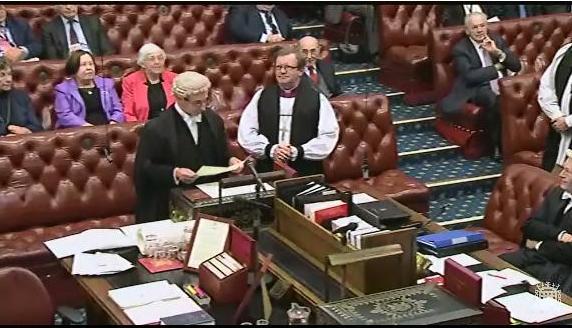
Watch the introduction here:
Bishop of St Albans raises plight of Roma communities in Parliament (Written Question)
The Lord Bishop of St Albans asked Her Majesty’s Government what analysis they have made of reports of the forced evictions of Roma communities in Cluj-Napoca, Romania; and whether they will discuss the matter with the government of Romania and ask that government to enforce the decision of the Cluj-Napoca County Court that evictions targeting the Roma community are illegal.
The Senior Minister of State, Department for Communities and Local Government & Foreign and Commonwealth Office (Baroness Warsi) (Con): Our Embassy in Bucharest has been monitoring this issue closely (along with other forced evictions of Roma e.g. in Eforie Sud and Baia Mare). We understand that the Cluj-Napoca Court recently ruled the forced eviction in December 2010 illegal. However this decision is not final and is subject to appeal. We have raised wider concerns about social inclusion of the Roma with the Romanian government on 28 January. With regard to this specific case, the British Embassy will visit Cluj on 11 February and will raise the issue of forced evictions with the local government. They will also launch a partnership with a local NGO to develop projects aimed at preventing disadvantaged Roma children leaving school before the minimum age. The UK government does not condone unjustified evictions of any community.
(via parliament.uk)
Bishop of Derby’s speech on inequality and social mobility
The Lord Bishop of Derby: My Lords, I, too, thank the noble Lord, Lord McFall, for his analysis, not least his observation that growth is not the answer and the unintended consequences of marketisation, as he called it. I probably want to explore what he might have meant by “the social, stupid”—there is an important clue in that.
I am engaged in this issue. In the City of Derby, where I work, I chair the inner city renewal project. That is the local authority and all kinds of voluntary and faith groups looking at how we can tackle this at grass-roots level, where there are a lot of people who are disadvantaged, with no social mobility and no equality in terms of finance, environment or opportunity. There are two ways of doing this. One is a needs-based approach—what are the needs and what resources can you put in to try to improve things?—and there is what they call an asset-based approach, which means asking what these people have in their own potential, as the noble Baroness, Lady Eaton, said—what do they have that can be grown so that they can contribute? Continue reading “Bishop of Derby’s speech on inequality and social mobility”
 The Church of England in Parliament
You must be logged in to post a comment.