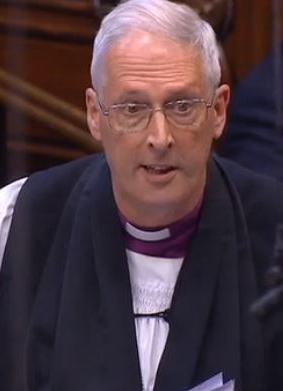
Bishop of Leicester asks about impact of reforms to disability benefits

The Bishop of Leicester received the following written answer on 28th April 2025:

The Lord Bishop of Leicester asked His Majesty’s Government what assessment they have made of the potential impact of reforms to incapacity and disability benefits on the employment rate of people with disabilities; and what plans they have to evaluate and monitor the impact of these reforms once they have been introduced.

Continue reading “Bishop of Leicester asks about impact of reforms to disability benefits”

Bishop of Leicester asks about impact of disability benefit reform

The Bishop of Leicester received the following written answers on 22nd April 2025:

The Lord Bishop of Leicester asked His Majesty’s Government what steps they will take to evaluate the impact of disability benefits reform on the employment rate of people with disabilities.

Continue reading “Bishop of Leicester asks about impact of disability benefit reform”

Bishop of Leicester asks about impacts of welfare reform

The Bishop of Leicester asked a question on the government’s planned welfare reforms and the DWP’s report on a resultant increase in relevant poverty on 27th March 2025:

The Lord Bishop of Leicester: My Lords, I appreciate the work that the Government are doing to stimulate the economy and to get people back into work. I understand the dilemma that the Government face with the spiralling costs of welfare. But I am left to wonder: how is it that the DWP’s own impact assessment, which I understand includes the £1 billion investment that the Minister referred to, does also state that 250,000 people will be pushed into relative poverty, including 50,000 children? How can the Government of one of the richest countries in the world justify policies that push people into poverty?

Continue reading “Bishop of Leicester asks about impacts of welfare reform”

Bishop of Newcastle asks about child poverty and benefits system

The Bishop of Newcastle received the following written answers on 24th October 2024:

The Lord Bishop of Newcastle asked His Majesty’s Government what assessment they have made of the financial impact that the five-week wait has on those awaiting their first Universal Credit payment.

Baroness Sherlock (Lab, DWP): No assessment has been made of the financial impact of the 5-week-wait. The Government is committed to reviewing Universal Credit so that it makes work pay and tackles poverty.

Continue reading “Bishop of Newcastle asks about child poverty and benefits system”

Bishop of Norwich asks about support for low income households

The Bishop of Norwich received the following written answers on 16th October 2024:

The Lord Bishop of Norwich asked  His Majesty’s Government what assessment they have made of introducing a minimum floor for Universal Credit so that benefit deductions and the benefit cap do not push people into financial hardship.

Continue reading “Bishop of Norwich asks about support for low income households”

Bishop of Sheffield supports motion to regret on changes to winter fuel payments

The Bishop of Sheffield spoke in a debate on changes to Winter Fuel Payments on 11th September 2024, supporting a regret motion and asking the government to reconsider the eligibility bar for payments:

The Lord Bishop of Sheffield: My Lords, I speak in broad support of the regret Motion in the name of the noble Lord, Lord Palmer. I appreciate the very tight fiscal constraints under which the Government are having to operate, and the need for tough choices to be made. I also accept the recent Statement by the Prime Minister that tough choices are almost by definition unpopular choices. Tough choices must also be wise choices, however, and I confess that I harbour misgivings about the wisdom of this proposal for two reasons.

Continue reading “Bishop of Sheffield supports motion to regret on changes to winter fuel payments”

Bishop of Gloucester asks about proposed review of personal independence payments

The Bishop of Gloucester asked a question on how the government’s proposed review of personal independence payments (PIP) would affect those with severe lifelong disabilities on 23rd April 2024:

The Lord Bishop of Gloucester: My Lords, yesterday I visited National Star, an FE college that serves young people with severe lifelong disabilities. Many of them are being subjected again and again to reassessment throughout their lives. That is not only traumatising but a complete waste of time and resources. What will the Government do to take this into consideration so that people with severe lifelong disabilities are not subjected to reassessment again and again, unless, of course, that disability is generative?

Continue reading “Bishop of Gloucester asks about proposed review of personal independence payments”

Church Commissioners Written Questions: Clergy – Universal Credit

On 26th March 2024, Andrew Selous MP, representing the Church Commissioners, gave the following written answer to a question from an MP:

Rachael Maskell MP (Lab, York Central): To ask the Member for South West Bedfordshire, representing the Church Commissioners, whether the Commissioners have had discussions with the Department of Work and Pensions on the potential impact of the migration of claimants of Child Tax Credit to Universal Credit on the financial position of members of the clergy.

Continue reading “Church Commissioners Written Questions: Clergy – Universal Credit”

Archbishop of York asks about introduction of an essentials guarantee for benefits claimants

On 28th February 2024, the Archbishop of York asked a question on whether the government had assessed a recent proposal by the Joseph Rowntree Foundation and the Trussell Trust for the introduction of an “essentials guarantee” to universal credit, during a discussion on the adequacy of the housing benefit subsidy for temporary accommodation:

The Lord Archbishop of York: My Lords, I thank the Minister for his commitment to trying to make headway on this issue. We are all aware of the terrible strains that local authorities are under because of temporary accommodation being necessary and, of course, we also know that the reason is that incomes are just not meeting housing needs. Have the Government assessed the recent proposal from the Joseph Rowntree Foundation and the Trussell Trust for what they call an essentials guarantee? This would guarantee that universal credit was enough to cover the essentials—rent—which would therefore reduce the number of households in temporary accommodation, creating a virtuous cycle that would reduce the budget strain on local councils.

Continue reading “Archbishop of York asks about introduction of an essentials guarantee for benefits claimants”

Bishop of London leads debate on impact of the removal of free prescriptions for benefits claimants

The Bishop of London tabled a question for short debate on the impact of the proposed removal of free prescriptions for benefit claimants who fail to look for work on 30th November 2023:

The Lord Bishop of London: To ask His Majesty’s Government what impact the removal of free prescriptions for benefit claimants who fail to look for work will have on their health, and the health of the workforce.

My Lords, I start by thanking your Lordships’ House for giving time for this important debate. I also thank the House of Lords Library for its very helpful briefing and the Minister for his engagement with me and for our helpful meeting earlier this week about this debate.

The measures we are discussing today relate to the announcement that the Government made in the Back to Work Plan and the Autumn Statement that people on universal credit who do not engage in activities designed to increase their skills and improve their employability after 18 months of support will have their claim terminated. With that termination, their accompanying passported benefits, including free prescriptions, will also be stopped.

Benefit claimants may disengage from Jobcentre Plus for many reasons, some of which I suspect we do not completely understand, and not solely because they have failed to look for work. I have brought this debate forward from a health perspective, and the central frame of my remarks today is around health inequalities, because the Back to Work Plan as it stands could serve to exacerbate these inequalities. There are many complexities within universal credit, and many exemptions and allowances that are made for vulnerabilities and medical conditions that are to be commended. I was grateful to hear about some of them at the meeting I had earlier in the week with the Minister and officials from DWP and DHSC. I understand that the number of people who will be affected by this is small: they are those without a vulnerability that would exempt them from having their claim ended, and who do not have an additional factor attached to their claim.

Continue reading “Bishop of London leads debate on impact of the removal of free prescriptions for benefits claimants”