
03/03/2021
Following the Budget speech, the Bishop of Birmingham, David Urquhart, Convenor of the Bishops in the House of Lords, said:
“This is a time of great uncertainty, and while the Chancellor has rightly focussed on steps to get the economy moving, I’m concerned he has missed the chance to give certainty to those people and families who rely on Universal Credit, by not making the £20 uplift permanent.
“I’ll look at the details of the Budget closely for measures that will help the poorest and most vulnerable, especially access to sustainable jobs. The £19m for Domestic Abuse programmes is welcome as is support for schools to help get children back on the road of educational discovery. The lack of detail on social care is, however, a worry.
“The £300m additional funding for the Culture Recovery Fund is very welcome and will support the many small businesses and independent contractors our churches employ and support. I also note that the Levelling Up Fund prospectus specifically mentions cultural and heritage assets, including churches, and we look forward to churches and cathedrals particularly in areas of high deprivation taking part in this programme.”
 The Lord Bishop of Rochester: My Lords, as many have already observed, this Budget comes in extraordinarily unusual circumstances, and in relation to the issues around Covid-19, subsequent to the Budget announcement, the Chancellor has brought forward a number of measures which have been largely well received, and no doubt others will need to follow. While voluntary action in our communities will form much of the day-to-day response to those who are the most vulnerable and potentially isolated across our nation, the sustaining of public services and of businesses is vital for both our social and economic well-being; other speakers have already begun to address some of those issues.
 On 25th September 2019 the House of Lords took note of the Government’s Spending Round 2019. The Bishop of Durham, Rt Revd Paul Butler, contributed to the debate:
 The Lord Bishop of Chester: My Lords, it is a privilege and a challenge to follow such a brilliant speech from someone who knows his way around the subject. If you want to find good things to tax, I always say that you should start with sin: find a new sin and tax it. I rather agree that HS2 is a sin, not for adding capacity, which I am all in favour of, but in doing so in such an unnecessarily expensive way. For me, trains go quite fast enough already and it could have been done far more cheaply without factoring in the speeds in a small country. As I follow the noble Lord’s speech, I think of St Paul, who once began by saying, “I speak as a fool”. I do so too, a little, after that wonderful description of the financial landscape.
 The Lord Bishop of Chelmsford: My Lords, for many on these Benches there are measures to welcome in this Budget: for instance, the decision to increase the work allowances within universal credit for families with children and people with disabilities, as other noble Lords have mentioned. This goes a substantial way towards reversing the cuts announced in 2015. Likewise, the announcement of measures to aid the transition to universal credit, worth £1 billion over five years, is also welcome, as is the additional and non-repayable run-on support for new claimants to help people manage during the five-week waiting period before their first payment. However, I am disappointed that the run-on support does not cover the child elements of universal credit.
  The Lord Bishop of Portsmouth: My Lords, one of the duties in which I take particular pleasure is chairing the governors at Ripon College, Cuddesdon, just outside Oxford, a theological college at which men and women are prepared for ministry. It is known by those associated with it more colloquially as a vicar factory. Notices around the college remind the residents that, after night prayer or Compline, they are expected to abide by what is known as the great silence. It is not, I suspect, adhered to with the same severity as in years past. Indeed, one has a sense that the silence masks all kinds of feverish activity, all of it associated with theology, of course.
 “The Chancellor’s Budget has gone some way to deal with the immediate problems facing our economy, housing and NHS, but it could have gone much further to help the many at the sharp end struggling to get by.
 On 15th March 2017, a statement by the Chancellor of the Exchequer on national insurance contributions was repeated in the House of Lords. The Bishop of Chester, the Rt Revd Peter Forster, responded to the statement.
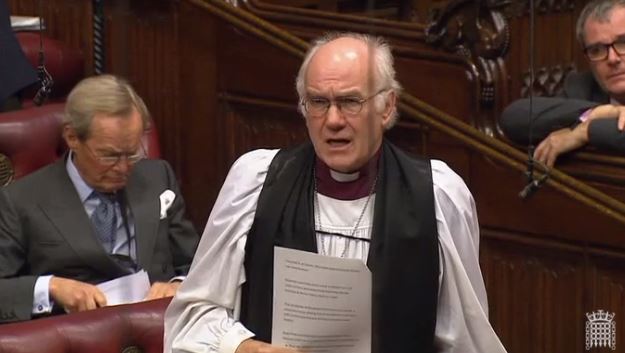 On 14th March 2017, the Commercial Secretary to the Treasury, Baroness Neville-Rolfe, moved that this House takes note of the economy in the light of the Budget Statement. The Bishop of Chester, the Rt Revd Peter Forster, spoke in the debate, focusing on national debt and expenditure pressures.
 The Church of England in Parliament
You must be logged in to post a comment.