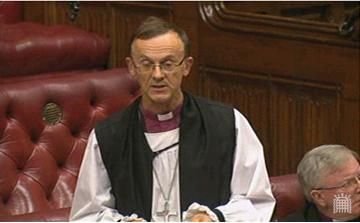
Bishop of St Albans questions government about executive pay

St Albans 2On 8th September 2016, the Bishop of St Albans, the Rt Revd Dr Alan Smith, asked Her Majesty’s Government “how they intend to address the gap between the remuneration of senior executives and their employees”. Baroness Neville-Rolfe responded for the Government. Her comments can be seen below, along with the follow up questions from other Members.

The Lord Bishop of St Albans: To ask Her Majesty’s Government how they intend to address the gap between the remuneration of senior executives and their employees.

Continue reading “Bishop of St Albans questions government about executive pay”

Bishop of St Albans on the importance of affordable housing, broadband and innovation to the rural economy

Bishop St Albans June 2015On the 27th April 2016, Baroness McItosh of Pickering led a Lords debate “to ask Her Majesty’s Government what is their assessment of the state of the rural economy.” The Bishop of St Albans, Rt Revd Alan Smith,  highlighted the need for more affordable housing, business innovation and greater access to broadband and mobile coverage

The Lord Bishop of St Albans: My Lords, my thanks go to the noble Baroness, Lady McIntosh, for securing the debate. I will focus on three areas that I believe are crucial to creating a strong, dynamic rural economy.

First, I underline the importance of affordable housing in creating sustainable rural communities at a time when rural house prices continue to be pushed well beyond the reach of many local residents. A failure to provide for local people and local families to live and work in rural areas leaves the rural economy seriously inhibited. An affordable housing supply, available to local workers on low and middle incomes, is an essential feature of the rural economy, providing homes, and, in many cases, workplaces for those who would work in rural areas. Continue reading “Bishop of St Albans on the importance of affordable housing, broadband and innovation to the rural economy”

Bishop of Derby questions the drive for efficiency in the use of technology instead of assisting meaningful face-to-face pastoral engagement

Derby 191115c

On the 14th April 2014 the Bishop of Derby, the Rt Revd Alastair Redfern spoke during a debate on the Deloitte report ‘Technology and people: The great job-creating machine published in August.’ Bishop Alastair spoke about the competing pressures of company supply chains and corporate responsibility, the values of society and the impact technology is having as efficiency cuts across the face-to-face pastoral engagement of professions such as healthcare. The Minister Baroness Neville-Rolfe responded for the Government and addressed a number of the questions highlighted by the Bishop.

Continue reading “Bishop of Derby questions the drive for efficiency in the use of technology instead of assisting meaningful face-to-face pastoral engagement”

Bishop of St Albans asks Government about impact of National Living Wage on small businesses

Bishop St Albans June 2015On 19th October 2015 Lord Haskel asked Her Majesty’s Government “what assessment they have made of the financial impact on British business of the new minimum wage when it comes into effect in 2016.” The Bishop of St Albans, Rt Revd Alan Smith, asked a supplementary question.

The Lord Bishop of St Albans: My Lords, while welcoming the Government’s moves to look at the level of wages as the Minister has mentioned in terms of the minimum living wage, I am aware that the Resolution Foundation is concerned about very small businesses—those that employ fewer than 10 people. Continue reading “Bishop of St Albans asks Government about impact of National Living Wage on small businesses”

Bishop of St Albans questions Government on impact of Sunday trading changes on small shops

On 17th September 2015 Lord Naseby asked the Government “what new proposals they have to support independent high street retailers, particularly in the light of the increasing cost of business rates”. The Bishop of St Albans, Rt Revd Alan Smith, asked a supplementary question:

Bishop St Albans June 2015The Lord Bishop of St Albans: My Lords, while I am grateful for the support Her Majesty’s Government are giving to independent retailers, it seems extraordinary that they are doing so at a time when they are talking about deregulating further Sunday trading hours, which many insiders in the industry believe will give huge commercial advantage both to the large supermarkets and to out-of-town shopping centres. Continue reading “Bishop of St Albans questions Government on impact of Sunday trading changes on small shops”

Bishop of St Albans- Company Pay and Homelessness (Written Answers)

On Monday 9th March 2015, the Lord Bishop of St Albans, Rt Revd Alan Smith, received  answers to two written questions on (i) company pay differentials, and (ii) the impact of relationship breakdown on homelessness.

Bishop of St AlbansThe Lord Bishop of St Albans: To ask Her Majesty’s Government what consideration they have given to requiring all listed companies to report annually on the ratio between the pay of chief executives and the median pay of workers in that company.

Continue reading “Bishop of St Albans- Company Pay and Homelessness (Written Answers)”

Bishop of Derby speaks about the Importance of Women’s Economic Empowerment

DerbyOn 5th March 2015 the Bishop of Derby, the Rt Revd Alastair Redfern, spoke in a debate to mark International Women’s Day, entitled ‘this House takes note of women’s economic empowerment and the progress in achieving it that has been made in the United Kingdom and internationally.’

The Bishop spoke about the importance of increasing workplace diversity in the UK, as well as the work of Christian Aid in empowering women overseas, alongside the need to challenge the myth that women taking jobs will displace men.

Baroness Garden responded for the Government and addressed a number of the points raised by the Bishop. Her comments can also be found below.


The Lord Bishop of Derby: My Lords, I rise with some trepidation to be the first man to speak in this debate, particularly having been gently chided by the noble Baroness, Lady Bottomley, about wearing a dress. Still, perhaps that is suitable bridging attire at this moment in the debate. I am also very conscious that the church could be seen to be behind the curve on this issue, as has been mentioned, and I hope that noble Lords can see that we are trying very hard to catch up and make proper progress. I want to do three things in this short address. I want to take up the theme that the noble Baronesses have talked about, the international perspective; look at some issues in the UK; and say what we might learn in terms of policy priorities.

Continue reading “Bishop of Derby speaks about the Importance of Women’s Economic Empowerment”

Bishop of Worcester Calls for Greater Third Sector Involvement in Local Enterprise Partnerships

On 11th February 2015, Baroness Bakewell of Hardington Mandeville asked Her Majesty’s Government what assessment they have made of the effect of local enterprise partnerships on the economy and key skills in their local areas. The Bishop of Worcester, the Rt Revd John Inge, asked a supplementary question:

WorcesterThe Lord Bishop of Worcester: My Lords, does the Minister agree that the involvement of the third sector in local enterprise partnerships is very enriching? As that involvement is very varied across the nation, would she be prepared to monitor the involvement of, and the partnership with, the third sector, as part of an assessment of the progress of LEPs?

Baroness Neville-Rolfe (Parliamentary Under-Secretary of State, Department for Business, Innovation and Skills): As I have said, the composition of a local enterprise partnership is very much a matter for the LEP, provided that it is business led and brings in local democracy with the local authorities. Otherwise, we draw on people who can help with growth and skills, and certainly there are those in the third sector who bring great strength to these areas.

(Via Parliament.uk)

Bishop of St Albans – Energy Prices and Supermarket Competition (Written Answers)

On 8th September 2014, the Bishop of St Albans, the Rt Revd Alan Smith, received answers to two written questions on energy prices and supermarket competition.

Energy: Prices

Bishop of St AlbansThe Lord Bishop of St Albans: To ask Her Majesty’s Government what consideration they have given to encouraging energy companies to use income-differentiated tariffs as a means of addressing fuel poverty.

The Parliamentary Under-Secretary of State, Department of Energy and Climate Change (Baroness Verma): Energy suppliers provide direct bill support for low income households through the Government’s Warm Home Discount scheme. As the original impact assessment for the scheme made clear, the scheme grew in part out of a concern about affordability of energy bills and accessibility of appropriate tariffs for those on low incomes. The scheme is now hugely successful. This year the Warm Home Discount will give eligible low-income bill payers £140 money off their energy bills, helping over 2 million people including 1.4 million of Britain’s most vulnerable pensioners. Continue reading “Bishop of St Albans – Energy Prices and Supermarket Competition (Written Answers)”

The Bishop of St Albans calls for greater support for businesses taking on apprentices

Baroness Stedman-Scott asked Her Majesty’s Government what steps they are taking to equip young people with the skills necessary to enter the job market.

The Bishop of St Albans asked a supplementary question:

The Lord Bishop of St Albans: My Lords, there are four times as many 18 to 24 year-olds looking for work at the moment as there are in the 16 to 17 age group. Yet the Government’s policy on apprenticeships for 19 to 24 year-olds is to ask employers to pay half the costs of the learning framework. Many businesses, especially SMEs, will pause before taking on an apprentice because of this. Does the Minister agree that if this requirement were to be removed, it would hugely encourage many more young people to get into apprenticeships as well as giving them much more of a chance to succeed?

Lord Ahmad of Wimbledon: The right reverend Prelate makes an important point, but I am sure many noble Lords are aware that the Government do support local businesses. Indeed, they have made additional funding available to small businesses that are looking to take on both trainees and apprentices.

On the age group that the right reverend Prelate mentioned, particularly 19 to 24 year-olds, in October 2013 the Government announced funding of an additional £20 million to support the expansion of traineeships, which are helping even more young people to get the skills and experience they need to get into full-time work.

(via parliament.uk)