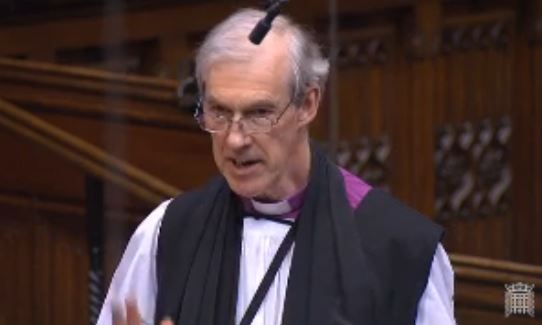
Bishop of Carlisle asks about new coal mine in Cumbria

The Bishop of Carlisle asked a question concerning the proposed opening of a new coal mine in Whitehaven, Cumbria, on 8th December 2022:

The Lord Bishop of Carlisle: My Lords, I declare a slight interest in this topic, since Whitehaven is in my diocese, and like the noble Baroness, Lady Hayman, I live in west Cumbria—in a particularly beautiful part of it, I have to say. This debate has now been running for more than two years, and in Cumbria, as in the whole country, it has been highly contentious, with a great deal of passion expressed on both sides. We have already heard some of that passion in the debate this evening. So I am acutely aware of the many arguments about both the potential environmental impact, which has been deplored, and the employment opportunities, which would—as has already been mentioned—be very welcome in this very deprived part of the country.

Continue reading “Bishop of Carlisle asks about new coal mine in Cumbria”

Bishop of Carlisle asks about alternatives to prison sentences

The Lord Bishop of Carlilse asked a question on what the government is doing to promote alternatives to prison sentences, during a debate on prison capacity on 6th December 2022:

The Lord Bishop of Carlisle: My Lords, my friend the right reverend Prelate the Bishop of Gloucester much regrets that she is not able to be present today. I know she shares my concern over this Statement since we, like others who have spoken, believe that the emergency use of police cells for prisoners is deeply worrying. We greatly welcome the increase in the number of police officers but feel that it is connected to the larger number of people going to prison, and that that should not be the case. Initially I wanted to ask about rehabilitation, but that question has already been addressed. I accept that the question of sentences is for the courts, but can the Minister help us by saying what the Government are doing to promote community and non-custodial sentences, rather than people simply going to prison?

Continue reading “Bishop of Carlisle asks about alternatives to prison sentences”

Bishop of Carlisle asks about medical approval for age assessments of refugees

The Bishop of Carlisle asked a question on whether the government would seek approval from relevant medical bodies for methods of age-assessment used on refugees on 6th December 2022, during a debate on the ethical considerations of such assessments:

The Lord Bishop of Carlisle: My Lords, further to that answer, in determining what constitutes an appropriate scientific method of age assessment, can the Minister assure us that any future methods will be formally approved by the relevant medical body before they come into use?

Lord Murray of Blidworth (Con): Plainly they will be formally approved by the advisory committee to the Home Secretary, and one suggests that the views of relevant professional bodies will be of great weight in making such a decision.

Hansard

Energy Bill: Bishop of Carlisle calls for more community-led energy generation

On 19th July 2022 the House of Lords debated the Government’s Energy Bill at its Second Reading:

The Lord Bishop of Carlisle: My Lords, I take many of the cogent and very well-informed points that have already been made in this debate, not least the one made by the noble Lord, Lord Howell, on the need for international co-operation. Even so, I welcome all three pillars of this Bill. Its stated direction could offer at least a step forward towards the goal of net-zero carbon.

I suggest in particular two rather domestic but, I hope, practical areas that could, in my view, do with further development in the Bill; namely, local renewable energy generation, as raised by the noble Baroness, Lady Hayman, and carbon capture, which has been addressed by the noble Lord, Lord Whitty, and the noble Baroness, Lady Sheehan.

In both cases, I hope noble Lords will forgive special reference to Cumbria, where I live. It is currently engulfed in a very contentious debate about the Woodhouse Colliery near Whitehaven that is not nearly as straightforward as it might first appear. Cumbria also has the “energy coast”—originally coal, then nuclear and now, increasingly, renewables. It has the Walney Extension offshore wind farm, which has more than 20% of the UK’s wind farm generating capacity. What is more, as a county, we have more than 50% of all the potential small-scale hydropower generation in the north-west.

Continue reading “Energy Bill: Bishop of Carlisle calls for more community-led energy generation”

Bishop of Carlisle asks about flexible working for carers

The Bishop of Carlisle asked the following question on 19th July 2022:

The Lord Bishop of Carlisle: My Lords, we are all aware of the huge contribution to the nation’s health and economy made by unpaid carers, including those who combine caring responsibilities with other paid employment.

This issue is currently being explored by both the Select Committee of your Lordships’ House and an Archbishops’ Commission. Does the Minister agree that, whenever possible, as well as paid or unpaid leave, flexible working arrangements for those with caring responsibilities are in everybody’s best interests?

Continue reading “Bishop of Carlisle asks about flexible working for carers”

Schools Bill: Bishop of Carlisle supports amendments on regulation of home schooling

The Bishop of Carlisle spoke in a debate on the Schools Bill in its second day of Report Stage, on 18th July 2022, in support of amendments on home schooling and the home school register. His speech is below, followed by those of other peers:

The Lord Bishop of Carlisle: My Lords, I speak on behalf of my right reverend friend the Bishop of St. Albans, who has two amendments in his name, 

Amendments 66 and 94. His name is also listed on Amendments 65 and 66A, in the name of the noble Lord, Lord Lucas.

Amendments 65, 66 and 66A continue to take issue with the proposals for details of the means by which a child is being educated to be included on the register. Amendment 66 would replace this with a determination of suitability, and provide for visits by the local authority for determining that suitability to be recorded. However, further to communication with the Department for Education and the Minister, we understand that their interpretation of the word “means” does not relate to the educational content or methods of home educating but simply to the providers of the education, since separate rules for registration will pertain to out-of-school education. We have been informed that this framework will be set out in the future statutory guidance. This is a much more positive interpretation than had previously been supposed, but if this is the interpretation I am not sure why it could not have been contained within the primary legislation rather than prescribed at a later date. Amendment 66A, from the noble Lord, Lord Lucas, would naturally resolve that problem.

Continue reading “Schools Bill: Bishop of Carlisle supports amendments on regulation of home schooling”

Bishop of Carlisle on Her Majesty the Queen’s faithfulness

The Bishop of Carlisle received asked the following question on 18th July 2022, in response to a question from Lord Farmer about whether Her Majesty the Queen might be given the additional title ‘the Faithful’ :

The Lord Bishop of Carlisle: My Lords, I am grateful to the noble Lord, Lord Farmer. I declare my interest as Clerk of the Closet, an office of service to the Crown dating back to the 15th century. At her coronation, the Queen first gave her allegiance to God before anyone came forward to give their allegiance to her.

Does the Minister agree that the generous, hospitable and open interpretation by Her Majesty of that duty to people of all faiths and none, over so many years, is not only a foundation stone of our constitution but a reason to feel all the more thankful for the lifelong service Her Majesty has given?

Continue reading “Bishop of Carlisle on Her Majesty the Queen’s faithfulness”

Social Security Bill: Bishop of Carlisle speaks in debate

On 24th May 2022, the house debated the Social Security (Special Rules for End of Life) Bill in its second reading. The Bishop of Carlisle spoke in support of the bill, mentioning caveats relating to palliative care and prognoses. The Bill was committed to a grand committee.

The Lord Bishop of Carlisle: My Lords, from these Benches I am glad to be able to support the Bill, which is welcomed by so many charities and which will bring relief to so many anxious families. It seems to have four significant strengths, the first being clarity. The rules surrounding benefits and healthcare at the end of life are confusing and not always easy to navigate. The Bill goes some way towards making things simpler and more straightforward both for people who are terminally ill and for their families, and that has to be a good thing.

Continue reading “Social Security Bill: Bishop of Carlisle speaks in debate”

Bishop of Carlisle asks about children’s social care

The Bishop of Carlisle asked a question on 24th May 2022, during a debate on the Independent Review of Children’s Social Care:

The Lord Bishop of Carlisle: My Lords, as we have already heard, much is to be welcomed in this review, which clearly has the needs of vulnerable children and young people right at its core. The emphasis on boosting early help to prevent children reaching a crisis point is crucial.

Continue reading “Bishop of Carlisle asks about children’s social care”

Health and Care Bill: Bishop of Carlisle raises concerns on assisted dying

On 26th January 2022, the House of Lords debated the Health and Care Bill in committee. The Bishop of Carlisle spoke on issues of assisted dying contained in amendments to the bill:

The Lord Bishop of Carlisle: My Lords, I recognise and respect the integrity and passion that underlie Amendment 297. However, I rise to agree wholeheartedly and briefly with those noble Lords and noble and learned Lords who have already expressed their significant reservations about it.

There are two problems in particular with that amendment. The first has to do with the many contentious arguments for and against any legislation permitting assisted dying, some of which have already been mentioned. Tempting though it is to rehearse some more of those, I am conscious not only of the time but of the fact that they have already been presented recently and at length, as we have been reminded by the noble and learned Lord, Lord Mackay, at Second Reading of the Assisted Dying Bill here in your Lordships’ House. The ongoing process of that Bill, however slow it may be, should not be undermined. We have also been assured that this is not primarily what Amendment 297 is all about. I might add that the terminology of that amendment is unhelpfully vague. “Vague” is a word that has already been used more than once in the debate today. For instance, we might ask exactly what is meant by “terminally ill” or “medical assistance”.

Continue reading “Health and Care Bill: Bishop of Carlisle raises concerns on assisted dying”