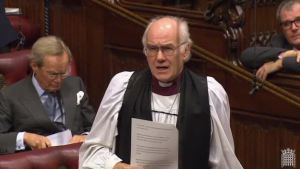
 On 10th December 2018, the Prime Minister’s statement on the UK’s exit from the European Union was repeated in the House of Lords. The Bishop of Chester, the Rt Revd Peter Forster, asked a question in response:
The Lord Bishop of Chester: My Lords, I want to take the House back to the concept of a backstop. Is not the nature of a backstop that it must be a backstop? A backstop that one party can unilaterally abrogate somehow ceases to be a backstop. How can you negotiate away a backstop and it still remain a backstop? Continue reading “Bishop of Chester asks Government about nature of backstop in EU Withdrawal Agreement”
 The Lord Bishop of Chester: My Lords, the Minister’s answers have related largely to child sexual abuse, but this is not a child case—it is a case of a vulnerable adult. I know it is a difficult issue, but I wonder whether a culture in which it is acceptable to pay for sexual services does not encourage some of the regrettable attitudes we have seen in these dreadful cases.
 The Lord Bishop of Chester: My Lords, I wholeheartedly endorse and support what has been said about this strategy. I know from my pastoral work how the effects of crime can resonate throughout people’s lives, not least when it comes to sexual abuse that happened a long time ago. Nevertheless, can the noble and learned Lord comment on the term “victim” and when its use is appropriate and when it is not?
 On 2nd July 2018 Baroness Evans of Bowes Park repeated a Statement on the European Council that had been made by the Prime Minister earlier that day in the House of Commons. The Bishop of Chester, the Rt Revd Dr Peter Forster, asked a question about regional disembarkation platforms, which are proposed centres for dealing with migrants and refugees seeking to enter the EU:


You must be logged in to post a comment.