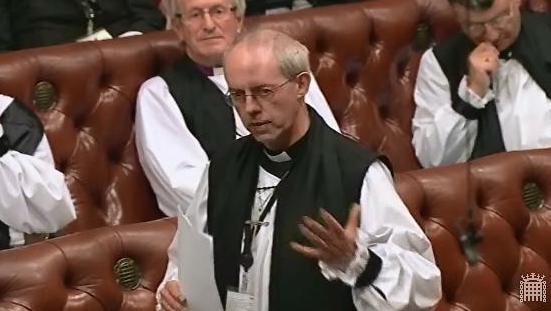
Bishop of Birmingham takes part in Archbishop’s debate on banking reform

“More competition can be seen in the regional banks that may be emerging. From my own interest in the Church Commissioners, I know that the proposed Williams & Glyn’s Bank, which is emerging from the 300 RBS branches, may have an opportunity to demonstrate how to be a good bank in the terms that we have already heard about, but at the same time that it will be freed from some of the responsibilities of the bigger banks and respond to people’s needs locally.”

On 5th December 2013, the Bishop of Birmingham took part in the Archbishop of Canterbury’s debate on the work of the Parliamentary Commission on Banking Standards. You can read the Archbishop’s opening and closing speeches here.

01.04.14 Bishop of Birmingham

The Lord Bishop of Birmingham: My Lords, I welcome warmly the noble Lord, Lord Carrington, to your Lordships’ House and congratulate him on a most succinct but wise and constructive maiden speech. His knowledge of finance and banking is exemplary. We have already heard from my friend the most reverend Primate of the noble Lord’s service in the other place, notably as chair of the Treasury Committee. He also brings a wealth of experience in banking. The particular bank mentioned, Gatehouse, of which he is deputy chairman, has this remarkable attention to Islamic finance. As someone who serves in Birmingham, that is of course well known and much appreciated.

Continue reading “Bishop of Birmingham takes part in Archbishop’s debate on banking reform”

Bishop of Derby takes part in debate on apprenticeships

On 28th November 2013, the Bishop of Derby took part in Baroness Wilcox’ debate on what action the Government are taking to increase the take-up of apprenticeships among young people. In his speech, he spoke of the need for education to assist in the development of good citizens and a high-calibre workforce based on vocation. He also raised the importance of employees being bale to train the right people for the right roles and the need to ensure that all young people have access to employment.
Bishop of DerbyThe Lord Bishop of Derby: My Lords, I, too, congratulate the noble Baroness, Lady Wilcox, on securing this debate on this very important theme. The Richards review and the statement by the Minister of State for Skills and Enterprise make clear that there are three areas that we need to look at and hold together.

The first is the big context about the importance of using education and training, of which apprenticeship is part, to make good citizens and a proper workforce for the 21st century. That is the theme of vocation: developing people to have a sustainable working life. The second area is the need for employers to be able to train and recruit the kind of people they need for their particular industry. The third area is the fact that there are a large number of young people who lack the opportunity to engage with the world of work. Those three themes frame this debate. Continue reading “Bishop of Derby takes part in debate on apprenticeships”

Archbishop of Canterbury takes part in Report Stage of Financial Services (Banking Reform) Bill

On 26th and 27th November 2013, the Archbishop of Canterbury, the Most Revd and Rt Hon Justin Welby, took part in both sittings of the Financial Services (Banking Reform) Bill’s Report Stage.  

Archbishop of CanterburyOn the first day of the Report Stage, he spoke about the need for the new ring-fencing structures to be supported by a ‘second reserve power’ which would give the regulator the power to fully separate all banks in the industry if one or more banks were gaming the new rules. He led a group of amendments on behalf of the Parliamentary Commission on Banking Standards, which would institute a rigorous licensing regime for significant bank employees who are not senior management. He also spoke about the need for specific measures to be developed to ensure that banks and their employees complied with anti-money laundering laws.

The Archbishop of Canterbury spoke twice during the second and final day of Report Stage. He spoke in support of Amendment 164, tabled by Lord Phillips of Sudbury, which would require a review to be undertaken into the current exemptions some banks and similar institutions enjoy from the Gaming Acts, on transactions which could be understood as gambling. He suggested that a review should examine what impact he current situation has on the culture in these institutions. He also led the debate on the Parliamentary Commission on Banking Standards’ amendment on leverage ratios. He highlighted the important role that the leverage ratio plays in the ‘tool-kit’ available to the Bank of England, and warmly welcomed the Government’s announcement that the Bank of England would undertake a review into its powers to set the leverage ratio and make recommendations on what further powers it may need.

Continue reading “Archbishop of Canterbury takes part in Report Stage of Financial Services (Banking Reform) Bill”

Bishop of Derby takes part in debate on the cost of living

“Over the past 12 months in the city of Derby, we have seen a 100% increase in the use of food banks. The point I want to make in this debate is that the shift has moved away from the normal suspects, who are, tragically, homeless people, towards families who are housed, but whose incomes are so low that they cannot feed themselves seven days a week.”

On 31st October 2013, Baroness Prosser led a take-note debate on the current cost of living and its impact on family budgets. The Bishop of Derby, the Rt Revd Alastair Redfern, took part in the debate, focusing his remarks on the response of civil society to issues of food poverty in the UK, particularly the role of churches in providing food banks. He also spoke about work and income, questions around lifestyle, and the role of the state.

Bishop of DerbyThe Lord Bishop of Derby: My Lords, I, too, congratulate the noble Baroness, Lady Prosser, on securing this debate and on setting such a good framework in her introduction. I want to look particularly at the human cost of this issue and at the family budgets of those who are at the sharp end of the struggle in trying to deal with rising living costs. I shall begin with the big picture. Earlier this year I organised a hunger summit in Derby. We looked at food poverty in what we call the developing countries, but we also looked at food poverty in our own city. We took the opportunity to launch a remodelled food bank system to provide a more comprehensive service to meet the growing food poverty that we are finding in our own back yard. That is the context in which we should begin to look at the pressure on family budgets. We were supported by the Fair Share Trust. Indeed, the noble Lord, Lord Newby, was in the House earlier this week when there was a Question about food waste, and I hope that one of the things we can do with excess food is redirect some of it towards organisations such as the Fair Share Trust so that it can be used to supplement those families whose budgets are so stretched that they cannot afford to eat properly. Continue reading “Bishop of Derby takes part in debate on the cost of living”

Bishop of Derby receives answer to question on credit union expansion (Written Answer)


On 24th October 2013, the Bishop of Derby, the Rt Revd Alastair Redfern, received an answer to a written question on the development of credit unions.

Bishop of DerbyThe Lord Bishop of Derby: To ask Her Majesty’s Government what steps they are taking to support credit unions as viable alternatives to payday lenders and other providers of high cost credit.

The Parliamentary Under-Secretary of State, Department for Work and Pensions (Lord Freud): While the majority of credit unions are not providing direct competition to payday lenders, credit unions are increasingly helping members who have become trapped with payday loans, offering them a way to consolidate and escape from the high interest rates, spreading out their debts over a longer, more affordable period.

Government has committed investment of up to £38 million in credit unions — to increase access to affordable credit for at least 1 million more people and save consumers up to £1 billion in loan repayments by March 2019.

We are also changing the maximum interest rate credit unions can charge per calendar month from 2% to 3%, coming into force on 1st April 2014.

This will enable credit unions to break even on their smaller, most expensive to issue loans, and to become more stable over the long term. This will give low income consumers greater access to reliable, affordable credit, without having to resort to more expensive means, such as home credit or payday lenders.

(via Parliament.uk)

Bishop of Birmingham supports amendment to Banking Reform Bill

“In the wake of the economic debacles following 2008, one of the greatest areas of concern among the public was the apparent lack of change in the financial fortunes of those whom they viewed as being most responsible for the banking crisis.”

On 23rd October 2013, the Bishop of Birmingham, the Rt Revd David Urquhart, spoke during the Committee Stage of the Financial Services (Banking Reform) Bill. He spoke in support of an amendment tabled by Lord Turnbull, to require that banks and other financial institutions abide by a ‘remuneration code’, implemented and enforced by the financial regulator. The amendment, based on a recommendation by the Parliamentary Commission on Banking Standards, was not pressed to a vote during Committee Stage.

01.04.14 Bishop of BirminghamThe Lord Bishop of Birmingham: My Lords, I rise to speak on behalf of the most reverend Primate the Archbishop of Canterbury. He regrets very much that he cannot be in his seat today, but it is seldom that one has the opportunity to offer Christian baptism to a young couple, particularly when their child is a future heir to the throne of this country. None the less, I know that he, like me, would want to echo the support for these amendments, which have been spoken to by the noble Lords, Lord Turnbull and Lord Eatwell. In a sense, I now regret that I am here doing my duty, because I could not have put it better myself.

In the wake of the economic debacles following 2008, one of the greatest areas of concern among the public was the apparent lack of change in the financial fortunes of those whom they viewed as being most responsible for the banking crisis. As we have heard, the salaries of senior bankers seem to remain high and bonus levels have quickly regained their old levels, while for many ordinary people and ordinary businesses across the country, it has been a matter of tightening the belt and looking very seriously at difficult household and commercial budget decisions. The submission of the Church of England’s Mission and Public Affairs Council to the banking commission said of this disparity between what I am going to talk about as two cultures that it,

“has gravely harmed the public perception of banking”. Continue reading “Bishop of Birmingham supports amendment to Banking Reform Bill”

Bishop of Ripon and Leeds calls for Government to examine reform of winter fuel allowance

On 23rd October 2013, Lord Greaves asked Her Majesty’s Government what proposals they have to reduce the level of economic inequality. The Bishop of Ripon and Leeds, the Rt Revd John Packer, asked a supplementary question:

R_LThe Lord Bishop of Ripon and Leeds: My Lords, bearing in mind the way in which wealthy pensioners, such as many in this House, are protected against the austerity cuts that other welfare recipients face, will the Government consider how to enable us to begin to bear our share of the burden, whether by taxing or means-testing the winter fuel allowance or otherwise?

Lord Newby: My Lords, one of the commission’s recommendations was that intergenerational equity could be improved if pensioners paid a higher share. That has not been the view that the Government have taken. Particularly given the very high levels of pensioner poverty, against which many noble Lords have campaigned over many years, we have taken the view that the real value of pensions should be protected during this period of fiscal consolidation. However, we accept that there may be more to be done. Indeed, for people who receive payments such as the winter fuel allowance, there are now a number of voluntary schemes under which they can make that payment available via charities so that it can be used for people on low incomes.

(via Parliament.uk)

Bishop of Ripon and Leeds calls for co-ordinated international tax transparency efforts

On 22nd October 2013, Lord Chidgey asked Her Majesty’s Government what new millennium development goals they would prefer to see introduced post-2015. The Bishop of Ripon and Leeds, the Rt Revd John Packer, asked a supplementary question:

R_LThe Lord Bishop of Ripon and Leeds: My Lords, will the Minister press for tax justice to be a distinctive international goal in ensuring that major corporations pay appropriate taxes and in channelling taxes to the countries where profits are actually made?

Baroness Northover: The right reverend Prelate is right to highlight that and he will know that the UK Government are emphasising the importance of tax being collected appropriately within the developing countries. This will be transformative. Corporate transparency is one of the aspects required and he will know that my right honourable friend the Secretary of State for BIS, Vince Cable, is working very hard on that. BIS has just consulted and is considering responses, and DfID is trying to ensure that tax regimes in the developing countries are strengthened and built on.

(via Parliament.uk)

Bishop of Derby takes part in debate on demographic change in the UK

On 17th October 2013, Independent Peer Lord Filkin led a take-note debate in the House of Lord on the Report of the Public Service and Demographic Change Committee ‘Ready for Ageing?’ The Bishop of Derby, the Rt Revd Alastair Redfern, took part in the debate, focusing his remarks on the important role civil society play in supporting the elderly. He also raised concerns about the language used to talk about the elderly and highlighted the very significant contribution played by older people in society.

Bishop of DerbyThe Lord Bishop of Derby: My Lords, I, too, thank the noble Lord, Lord Filkin, and his colleagues on the Select Committee for introducing such a comprehensive and expert report. I shall pursue the theme mentioned of the contribution of civil society.

My first point is about the language that we use and the signals that we give out. The noble Baroness, Lady Tyler, talked about the importance of a public debate. It is easy to use language such as “retirement”, which indicates something negative, about stopping and ceasing to contribute. In the diocese where I work, we have 200 clergy who are retired; 80% of them make an enormous contribution, not just filling in but front-line, active contribution to the life of the church. Some cultures use the word senior rather than the word ageing. We must be very careful how we frame the debate. I invite the Minister to comment on the language that we use and the signals that we give out, so that it is not about a problem of decline and desperation but celebrating life at different stages and in different ways. Continue reading “Bishop of Derby takes part in debate on demographic change in the UK”

Bishop of Birmingham calls for holistic approach to tackling youth homelessness

On 24th July 2013, Lord Dubs asked Her Majesty’s Government what assessment they have made of the causes of homelessness and rough sleeping in the United Kingdom. The Bishop of Birmingham, the Rt Revd David Urquhart, asked a supplementary question:

01.04.14 Bishop of BirminghamThe Lord Bishop of Birmingham: The Minister will be aware of the good practice of the multi-agency response to homelessness among 16 and 17 year-olds in Birmingham at the St Basils Youth Hub but, with the recent support expressed by the Housing Minister for the End Youth Homelessness Alliance, how will the Government meet the alliance’s challenges for family support, employment and affordable, safe housing for that category of people?

Baroness Hanham: I am aware of what the right reverend Prelate the Bishop of Birmingham is talking about. The policies of the Government will support the question that he has asked.

(via Parliament.uk)