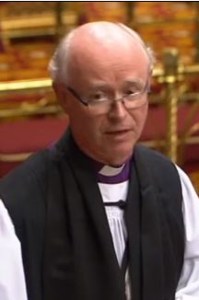
Bishop of St Albans asks Government about rural economy

On 26th November 2020 the Bishop of St Albans asked a question he had tabled to Government on tabled a question he had asked about the rural economy. The exchange is below, with the further questions asked by other Members:

The Lord Bishop of St Albans: To ask Her Majesty’s Government, further to their response to the report by the Select Committee on the Rural Economy Time for a strategy for the rural economy (HL Paper 330, Session 2017-19), what progress they have made towards their strategic vision for rural communities. Continue reading “Bishop of St Albans asks Government about rural economy”

Bishop of Worcester says Government aid cut is a broken promise to the poorest

On 25th November 2020 the House of Lords asked questions of Government on its abandonment of the legal commitment to spend 0.7% of GNI on overseas aid. The Bishop of Worcester highlighted the many pledges made to protect this, which had now been broken:

The Lord Bishop of Worcester [V]: My Lords, the 2019 Conservative general election manifesto said:

“We will proudly maintain our commitment to spend 0.7% of GNI on development”.

That was before Covid, of course. On 16 June, the Prime Minister said in the other place that spending 0.7% remained the Government’s commitment.

On 18 June, the Leader of the House reassured the right reverend Prelate the Bishop of Peterborough of the Government’s continued commitment to the 0.7% target.

In this House on 2 September, the noble Baroness, Lady Sugg, reassured the right reverend Prelate the Bishop of Bristol, with these words:

“I assure her that we will continue to be guided by our responsibilities under the International Development Act”.—[Official Report, 2/9/20; col. 354.]

In a letter to the Prime Minister last week, I drew attention to Archbishop Desmond Tutu’s words:

“A promise to the poor is particularly sacred.”

Does the Minister agree with him? Continue reading “Bishop of Worcester says Government aid cut is a broken promise to the poorest”

Bishop of Portsmouth asks about job losses due to coronavirus

On Tuesday 10th November a Government statement on the economy was repeated in the House of Lords. The Bishop of Portsmouth responded and asked a question:

The Lord Bishop of Portsmouth [V]: My Lords, I welcome the Government’s desire to protect jobs and livelihoods, but can the Minister confirm that the ​extension of the furlough scheme until March—a full five months—is based on the assumption and expectation that those jobs, or at least the vast majority of them, will be ready to return to unchanged? That is a bold assumption. If it is not the case, what strategy do the Government have now for addressing the transitional challenges for those whose jobs will disappear? This Statement was made late, in haste. Tackling the jobs issue in March is tackling it too late. Continue reading “Bishop of Portsmouth asks about job losses due to coronavirus”

Bishop of Oxford asks Government about impact of covid-19 on the gig economy

On 22nd October the Bishop of Oxford asked a question he had tabled to Government on the impact of Covid-19 on the gig economy. The exchanges and further questions from other Members, are below:

Asked by The Lord Bishop of Oxford

To ask Her Majesty’s Government what assessment they have made of the impact of the COVID-19 pandemic on the gig economy.

Baroness Penn (Con): My Lords, the Government have stood by businesses and workers with one of the most comprehensive and generous packages of support globally. We are working intensively with employers and industry groups to understand the long-term effects of Covid-19 and specific challenges to businesses and workers, including in the gig economy. Following announcements of further measures to control the spread of Covid-19, we are continuing to monitor the impact of government support in different sectors.

The Lord Bishop of Oxford [V]: I thank the Minister very much for her Answer. While the job coaches and extra provision made may improve the CVs and present conditions of those forced into the gig economy, they will do nothing to improve the security or the working conditions of those so precariously employed and poorly protected. Therefore, will the employment Bill provide a clearer definition of what counts as an employer-employee relationship? How will it stop platform employers retaining all of the profits while socialising essential costs such as sickness pay or a basic pension in old age? Continue reading “Bishop of Oxford asks Government about impact of covid-19 on the gig economy”

Bishop of Rochester asks Government to address needs of most disadvantaged in Coronavirus response strategy

On 28th July Baroness Neville-Rolfe asked Her Majesty’s Government “further to the paper by Professor David Miles, Mike Stead and Dr Adrian Heald Living with COVID-19: balancing costs against benefits in the face of the virus, published on 26 June, what plans they have to ensure that in the future fuller account is taken of the economic costs of any measures adopted to address the COVID-19 pandemic such as lockdowns.” The Rt Revd James Langstaff, Bishop of Rochester, asked a follow up question, focusing on those affected by the benefit cap and those housed in the private rented sector.

The Lord Bishop of Rochester: My Lords, this is a complex matter, because economic, social and other community matters often go hand in hand. It is clear that many who have in these circumstances been bearing economic burdens are among those who are also the most socially disadvantaged. Bearing in mind the context of the forthcoming spending review, can the Minister give an assurance that the Government will take care to address the needs of such groups, including, for example, those affected by the benefit cap and those housed in the private rented sector, where repossession cases come before the courts again from later in August?

Continue reading “Bishop of Rochester asks Government to address needs of most disadvantaged in Coronavirus response strategy”

Bishop of Chelmsford calls for vision of economy and society where everyone has a future

On 4th June 2020 the virtual House of Lords debated a motion from Lord Eatwell, “to move that the Virtual Proceedings do consider (1) the economic lessons learned from the COVID-19 pandemic, and (2) the measures necessary to repair the United Kingdom economy.” The Bishop of Chelmsford, Rt Revd Stephen Cottrell, spoke in the debate.

Bishop of Durham asks Government to take regional approach to phasing out Job Retention Scheme

On 13th May 2020 Lord Agnew of Oulton repeated a statement given by the Chancellor of the Exchequer on the COVID-19 economic support package. The Bishop of Durham, Rt Revd Paul Butler, asked a follow up question:

Durham 1Lord Bishop of Durham: The extension of the JRS is extremely welcome. Here in the north-east, we have a worryingly high infection rate and among the highest average death rates per capita. Will Her Majesty’s Government consider taking a regional approach to phasing out the JRS, ensuring that the economic and social needs of each region are reflected adequately in the Government’s ongoing support?

Continue reading “Bishop of Durham asks Government to take regional approach to phasing out Job Retention Scheme”

Archbishop of York leads Lords debate on the case for income equality and sustainability

On 6th May 2020 the Archbishop of York, Most Revd John Sentamu, led a debate in the House of Lords on the motion that the Lords “do consider the case for increasing income equality and sustainability in the light of the recent health emergency.” The Archbishop started the debate, and summed up afterwards, referring to many of the speeches made by other Members over the course of nearly three hours. Amongst the other speakers were the Archbishop of Canterbury and the Bishops of Durham and Derby. The entire debate can be read in Hansard here, and the Archbishop’s opening and closing speeches are reproduced below:

Income Equality and Sustainability: Motion to Consider

Moved by The Archbishop of York, That the Virtual Proceedings do consider the case for increasing income equality and sustainability in the light of the recent health emergency.
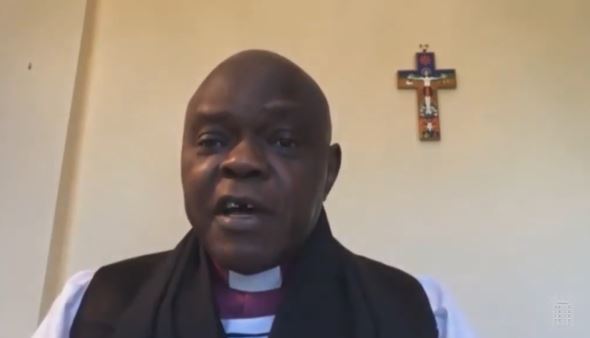
The Archbishop of York: My Lords, I am grateful to the Government Chief Whip and the usual channels for granting me this opportunity to move a Motion that is very dear to my heart—thank you. I commend Her Majesty’s Government for their rapid action in the current crisis and, through unprecedented public spending, working to protect jobs and avert millions of redundancies. It is in the light of this recent health emergency that I beseech your Lordships’ House to take note of the case for increasing income equality and sustainability.

Last Thursday, the noble Baroness, Lady Bennett of Manor Castle, opened a Question for Short Debate on Covid-19 and people living in poverty. I believe that what we are doing today has the potential to make a lasting difference. As Amelia Earhart, the first woman to fly across the Atlantic, said:

“The most difficult thing is the decision to act, the rest is merely tenacity.”

As long ago as 28 April 1909, Winston Churchill, then president of the Board of Trade, gave a speech in the other place in which he said:

“It is a serious national evil that any class of His Majesty’s subjects should receive less than a living wage in return for their utmost exertions.”—[Official Report, Commons, 28/4/1909; col. 388]

Not much has changed since. That principle remains as strong as ever in our national life. Continue reading “Archbishop of York leads Lords debate on the case for income equality and sustainability”

Bishop of Rochester responds to Chancellor’s Budget Statement

On 18th March 2020 the House of Lords debated the Budget Statement made the previous week by the Chancellor of the Exchequer. The Bishop of Rochester, Rt Revd James Langstaff, spoke in the debate:

The Lord Bishop of Rochester:  My Lords, as many have already observed, this Budget comes in extraordinarily unusual circumstances, and in relation to the issues around Covid-19, subsequent to the Budget announcement, the Chancellor has brought forward a number of measures which have been largely well received, and no doubt others will need to follow. While voluntary action in our communities will form much of the day-to-day response to those who are the most vulnerable and potentially isolated across our nation, the sustaining of public services and of businesses is vital for both our social and economic well-being; other speakers have already begun to address some of those issues.​

Following the most reverend Primate the Archbishop of Canterbury is always a risky business, and other noble Lords have already spoken with considerable knowledge of these matters, so I shall focus my remarks on one or two specific issues and areas which were already matters of concern, and where that concern is perhaps greater because of the circumstances in which we now find ourselves.

On children and young people, I hugely welcome the long-overdue extension of higher-rate housing benefit for care leavers until the age of 25, thus giving stability in their accommodation beyond their 22nd birthday. This is something that the Church of England organisation the Children’s Society and other charities have campaigned for over some time, and it is most welcome. Also welcome is the £2.5 million for research on family hubs. However, what is not in the provisions of the Budget or subsequent provisions is sufficient funding to address the urgent need for every child to achieve a good start in life, and that is becoming more urgent in the light of the current circumstances. Continue reading “Bishop of Rochester responds to Chancellor’s Budget Statement”

Archbishop of Canterbury calls for vision of a ‘we’ society, alongside spending in response to coronavirus budget measures

On 18th March 2020 the House of Lords debated the Budget Statement made the previous week by the Chancellor of the Exchequer. The Archbishop of Canterbury, Most Revd Justin Welby, spoke in the debate:

The Archbishop of Canterbury: My Lords, a Budget is social morality in numbers. Whatever we say we believe about the dignity of human beings and about the existence or otherwise of society, the reality of our belief is demonstrated by the way we act, and especially by the way we act with money. The crisis through which we are passing will change this nation in deep and unpredictable ways, as the noble Lord, Lord Oates, has just said. Like a nuclear explosion, the initial impact is colossal, but the fallout lasts for years and will shape us in ways we cannot even begin to predict at the moment.

The Budget and the extra package announced yesterday must be both adequate in amount and sufficient in their aims to ensure that this country emerges confident from overcoming the virus—positively better than before it began. We will overcome the virus. The noble Lord, Lord Tunnicliffe, commented that small groups all over the country are showing fresh signs of community spirit and collaboration, and it is from those small groups, through to the large-scale government measures, that things will change.

Continue reading “Archbishop of Canterbury calls for vision of a ‘we’ society, alongside spending in response to coronavirus budget measures”