
On 4th June 2020 the virtual House of Lords debated a motion from Lord Eatwell, “to move that the Virtual Proceedings do consider (1) the economic lessons learned from the COVID-19 pandemic, and (2) the measures necessary to repair the United Kingdom economy.” The Bishop of Chelmsford, Rt Revd Stephen Cottrell, spoke in the debate.
Tag: economy
Bishop of Durham asks Government to take regional approach to phasing out Job Retention Scheme
On 13th May 2020 Lord Agnew of Oulton repeated a statement given by the Chancellor of the Exchequer on the COVID-19 economic support package. The Bishop of Durham, Rt Revd Paul Butler, asked a follow up question:
 Lord Bishop of Durham: The extension of the JRS is extremely welcome. Here in the north-east, we have a worryingly high infection rate and among the highest average death rates per capita. Will Her Majesty’s Government consider taking a regional approach to phasing out the JRS, ensuring that the economic and social needs of each region are reflected adequately in the Government’s ongoing support?
Archbishop of York leads Lords debate on the case for income equality and sustainability
On 6th May 2020 the Archbishop of York, Most Revd John Sentamu, led a debate in the House of Lords on the motion that the Lords “do consider the case for increasing income equality and sustainability in the light of the recent health emergency.” The Archbishop started the debate, and summed up afterwards, referring to many of the speeches made by other Members over the course of nearly three hours. Amongst the other speakers were the Archbishop of Canterbury and the Bishops of Durham and Derby. The entire debate can be read in Hansard here, and the Archbishop’s opening and closing speeches are reproduced below:
Income Equality and Sustainability: Motion to Consider
Moved by The Archbishop of York, That the Virtual Proceedings do consider the case for increasing income equality and sustainability in the light of the recent health emergency.

The Archbishop of York: My Lords, I am grateful to the Government Chief Whip and the usual channels for granting me this opportunity to move a Motion that is very dear to my heart—thank you. I commend Her Majesty’s Government for their rapid action in the current crisis and, through unprecedented public spending, working to protect jobs and avert millions of redundancies. It is in the light of this recent health emergency that I beseech your Lordships’ House to take note of the case for increasing income equality and sustainability.
Last Thursday, the noble Baroness, Lady Bennett of Manor Castle, opened a Question for Short Debate on Covid-19 and people living in poverty. I believe that what we are doing today has the potential to make a lasting difference. As Amelia Earhart, the first woman to fly across the Atlantic, said:
“The most difficult thing is the decision to act, the rest is merely tenacity.”
As long ago as 28 April 1909, Winston Churchill, then president of the Board of Trade, gave a speech in the other place in which he said:
“It is a serious national evil that any class of His Majesty’s subjects should receive less than a living wage in return for their utmost exertions.”—[Official Report, Commons, 28/4/1909; col. 388]
Not much has changed since. That principle remains as strong as ever in our national life. Continue reading “Archbishop of York leads Lords debate on the case for income equality and sustainability”
Bishop of Rochester responds to Chancellor’s Budget Statement
On 18th March 2020 the House of Lords debated the Budget Statement made the previous week by the Chancellor of the Exchequer. The Bishop of Rochester, Rt Revd James Langstaff, spoke in the debate:
 The Lord Bishop of Rochester: My Lords, as many have already observed, this Budget comes in extraordinarily unusual circumstances, and in relation to the issues around Covid-19, subsequent to the Budget announcement, the Chancellor has brought forward a number of measures which have been largely well received, and no doubt others will need to follow. While voluntary action in our communities will form much of the day-to-day response to those who are the most vulnerable and potentially isolated across our nation, the sustaining of public services and of businesses is vital for both our social and economic well-being; other speakers have already begun to address some of those issues.
Following the most reverend Primate the Archbishop of Canterbury is always a risky business, and other noble Lords have already spoken with considerable knowledge of these matters, so I shall focus my remarks on one or two specific issues and areas which were already matters of concern, and where that concern is perhaps greater because of the circumstances in which we now find ourselves.
On children and young people, I hugely welcome the long-overdue extension of higher-rate housing benefit for care leavers until the age of 25, thus giving stability in their accommodation beyond their 22nd birthday. This is something that the Church of England organisation the Children’s Society and other charities have campaigned for over some time, and it is most welcome. Also welcome is the £2.5 million for research on family hubs. However, what is not in the provisions of the Budget or subsequent provisions is sufficient funding to address the urgent need for every child to achieve a good start in life, and that is becoming more urgent in the light of the current circumstances. Continue reading “Bishop of Rochester responds to Chancellor’s Budget Statement”
Archbishop of Canterbury calls for vision of a ‘we’ society, alongside spending in response to coronavirus budget measures
On 18th March 2020 the House of Lords debated the Budget Statement made the previous week by the Chancellor of the Exchequer. The Archbishop of Canterbury, Most Revd Justin Welby, spoke in the debate:
The Archbishop of Canterbury: My Lords, a Budget is social morality in numbers. Whatever we say we believe about the dignity of human beings and about the existence or otherwise of society, the reality of our belief is demonstrated by the way we act, and especially by the way we act with money. The crisis through which we are passing will change this nation in deep and unpredictable ways, as the noble Lord, Lord Oates, has just said. Like a nuclear explosion, the initial impact is colossal, but the fallout lasts for years and will shape us in ways we cannot even begin to predict at the moment.
The Budget and the extra package announced yesterday must be both adequate in amount and sufficient in their aims to ensure that this country emerges confident from overcoming the virus—positively better than before it began. We will overcome the virus. The noble Lord, Lord Tunnicliffe, commented that small groups all over the country are showing fresh signs of community spirit and collaboration, and it is from those small groups, through to the large-scale government measures, that things will change.
Bishop of London on need for improved rural services, and role of churches
 On 8th October 2019 Lord Foster of Bath (LD) moved a motion “that this House takes note of the Report from the Select Committee on the Rural Economy Time for a strategy for the rural economy (HL Paper 330)”. The Bishop of London, Rt Revd Sarah Mullally, contributed to the debate:
The Lord Bishop of London: My Lords, you may well ask what the Bishop of London is doing adding her voice to a debate on our strategy for the rural economy. Despite having spent most of my adult life in London, my five years in the West Country and latterly as the Bishop of Crediton in Devon demonstrated to me the challenges of rural life.
Continue reading “Bishop of London on need for improved rural services, and role of churches”
Bishop of Birmingham speaks about banking reform
 On 3rd September 2019 the Bishop of St Albans led a debate on a motion to ask the Government “what assessment they have made of the implementation of the recommendations of the Parliamentary Commission on Banking Standards and the opportunities for further banking reform”. The Bishop of Birmingham, Rt Revd David Urquhart, also made a contribution:
Lord Bishop of Birmingham: My Lords, I am grateful to my right reverend friend for leading this debate and I welcome the Minister to his new role. I want to focus on the recommendations in the original report—the references in paragraph 138 of the summary, volume 1—which looked at culture change. The response of the banking industry to that challenge came through a report produced by Sir Richard Lambert, which said that if the banks didn’t face up to this, there will be further intervention, regulation and direction. As a result, the UK Banking Standards Board was set up in 2015. I declare my interests in that I am a founder member of that board and also part of the ad hoc Financial Exclusion Committee which has been referred to already.
Continue reading “Bishop of Birmingham speaks about banking reform”
Bishop of Leeds asks Government about progress in Israel-Palestine conflict resolution
 On 8th July 2019 the Bishop of Leeds, Rt Revd Nick Baines, received written answers from the Government in reply to three questions about the Israeli-Palestinian conflict:
The Lord Bishop of Leeds: (i) HL16758 To ask Her Majesty’s Government what is their assessment of the Peace to Prosperity workshop convened by the United States in Bahrain. Continue reading “Bishop of Leeds asks Government about progress in Israel-Palestine conflict resolution”
Church Commissioners written answers: Church tourism and local economy
 On 26th June 2019 the Second Church Estates Commissioner, Rt Hon Dame Caroline Spelman MP, answered two written questions from Jim Shannon MP (Strangford) on Church-based tourism and community development:
Jim Shannon MP: 271461 To ask the right hon. Member for Meriden, representing the Church Commissioners, what steps the Church of England has taken to promote tourism to its churches and cathedrals.
Dame Caroline Spelman: The Church of England welcomes the Government’s new Tourism Sector Deal, which encompasses all our churches and cathedrals and will give a significant boost to our cultural heritage. Cathedrals in England attract over 10 million visitors a year, the majority as tourists.
The Church supports the work of the Churches Visitor and Tourism Association on several initiatives that help the public learn more about their local churches:
Continue reading “Church Commissioners written answers: Church tourism and local economy”
Church Commissioner Questions: serious youth violence, clergy recruitment in London, cathedrals and the economy, employee pay gap, responsible investments, mobile phone masts, Christian persecution
On 20th June 2019 MPs asked questions of Rt Hon Dame Caroline Spelman MP, the Second Church Estates Commissioner. Questions were asked about serious youth violence, clergy recruitment in London, the contribution of cathedrals to the local economy, employee pay gap, responsible investments, mobile phone masts, and persecution of Christians:
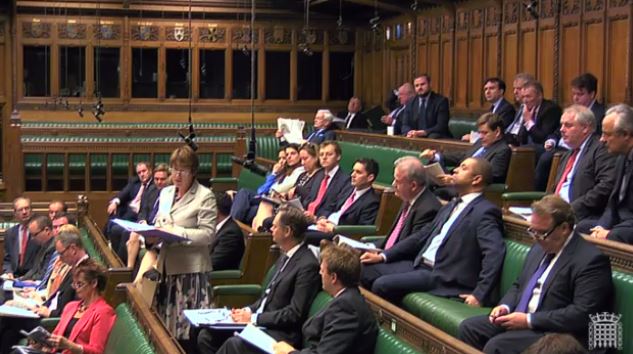
The right hon. Member for Meriden, representing the Church Commissioners, was asked—
Serious Youth Violence
Daniel Kawczynski (Shrewsbury and Atcham) (Con)
1. What steps the Church of England is taking to help tackle serious youth violence; and if she will make a statement. [911477]
Vicky Foxcroft (Lewisham, Deptford) (Lab)
7. What steps the Church of England is taking to help tackle serious youth violence; and if she will make a statement. [911484]
The Second Church Estates Commissioner (Dame Caroline Spelman): The Church was represented at the knife crime summit organised by the Prime Minister at No. 10 earlier this year, and the General Synod will be debating this subject at its session next month. There is no question but that this issue is of the utmost seriousness, as too many young lives are being lost.


You must be logged in to post a comment.