Bishop of Peterborough backs plain packaging for cigarettes

“It is our duty and responsibility in this place to care for what we in the church call the “common good”—to care for the well-being of society and, not least, of young people.”- Bishop of Peterborough, 16/3/15

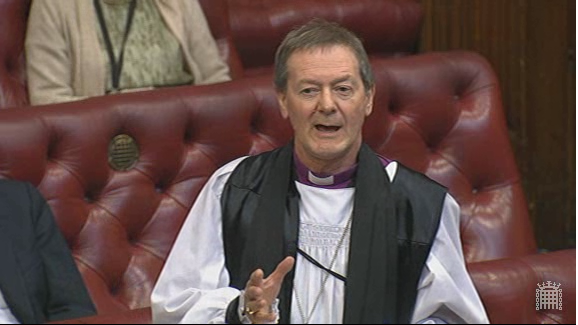
On 16th March the Bishop of Peterborough, Rt Revd Donald Allister, spoke in a debate on the motion to approve the ‘Standardised Packaging of Tobacco Products Regulations 2015’, to introduce plain packaging for cigarettes. The Bishop argued that the measure is necessary to safeguard the health of young people in the UK. The motion to approve the Regulations was passed.
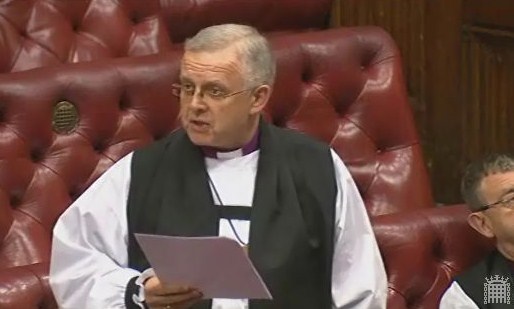
14.02 PeterboroughThe Lord Bishop of Peterborough: My Lords, I, too, was not planning to speak, but I am most grateful to the Minister for bringing this measure before us. I will make a very simple point. Packaging is designed to make the contents of the package attractive. This is about changing culture and changing the way that people think about tobacco and smoking. We all know the health arguments—they are indisputable and very clear. However, many young people, in particular, are still led astray and into dangerous behaviour—into self-harming of a very subtle but difficult sort.

Continue reading “Bishop of Peterborough backs plain packaging for cigarettes”
Archbishop of Canterbury praises UK contribution to tackling Ebola in West Africa

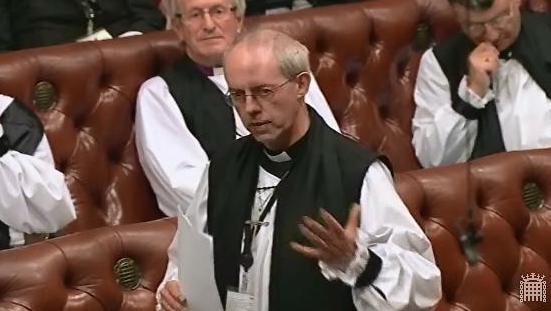
On 4th February 2015, Lord Collins of Highbury asked Her Majesty’s Government what recent progress they have made on tackling Ebola in West Africa. The Archbishop of Canterbuy, the Most Revd and Rt Hon Justin Welby, asked a supplementary question:

Archbishop of CanterburyThe Archbishop of Canterbury: My Lords, during a pastoral visit to Sierra Leone in mid-December, I heard affirmation of the extraordinary commitment of British forces and British work in that country. There was much expression of admiration and gratitude. There was also much concern about future outbreaks of Ebola. What thinking have the Government given to how future outbreaks might be prevented?

Baroness Northover: I am very pleased to see the most reverend Primate in his place—a number of us were extremely concerned when he came back from Sierra Leone and was not himself well, so it is great to see him here. He is absolutely right: the international community is focusing on trying to ensure that we do not find ourselves in this situation again. The WHO has looked at its own reform and other international bodies will too, but it is vital that we learn the lessons of this particular epidemic.

(via Parliament.uk)

Questions to the Church Commissioners on the Archbishop of York’s Book ‘On Rock Or Sand’, Medical Ethics, the Anglican Communion, Financial Eduation, Women Bishops and Bats

Church Commissioners

In Church Commissioners Question TIme on Thursday 29th January 2015, the Rt Hon. Sir Tony Baldry MP answered questions on the Archbishop of York’s Book ‘On Rock Or Sand’, Medical Ethics of Mitochondrial Transfer, the Anglican Communion, Financial Education, Women Bishops and Bats in Churches

Continue reading “Questions to the Church Commissioners on the Archbishop of York’s Book ‘On Rock Or Sand’, Medical Ethics, the Anglican Communion, Financial Eduation, Women Bishops and Bats”

Bishop of Derby: focus on grassroot responses to maternal mortality

On 15th January 2015, the Bishop of Derby, the Rt Revd Alastair Redfern, took part in a question for short debate in the House of Lords, led by Baroness Hayman, on what progress has been made in reducing maternal and neonatal mortality in the developing world; and what plans they have to build on this work post-2015. The Bishop spoke of the situation in India, which has an ecumenical partnership with Derby Diocese, where one-third of global neonatal deaths occur. He noted that poverty, lack of education about basic hygine, attitudes towards women and girls and a lack of necessary infrastructure all contribute to high levels of maternal and neonatal mortality. He spoke of the grassroots responses to these conditions that he had observed in visits to India, and welcomed the partnership between DfID and development agencies such as Christian Aid, which work to channel funds to these effective local efforts.

DerbyThe Lord Bishop of Derby: My Lords, I too congratulate the noble Baroness, Lady Hayman, on securing this debate and on introducing it with such expertise and such a challenging sense of the statistics. Millennium development goals 4 and 5 are not being met and, as other speakers have said, the consequences are horrendous. My contribution will be from my own experience working with people at the grass roots, and I will then tease out what the implications of that experience should be.

I work in the diocese of Derby, in England, and we are twinned with the Church of North India, which extends from Calcutta to Mumbai—the whole of north India is twinned with our diocese in an ecumenical link. I work with people in a number of Indian communities where this issue is enormous. In 2012, one-third of global neonatal deaths happened in India. The highest rate of first-day mortality is in India. That is the context in which we are working with our partners, through whose eyes we discern some factors. Continue reading “Bishop of Derby: focus on grassroot responses to maternal mortality”

Bishop of St Albans leads debate on A&E pressures

On 15th January 2015, the Bishop of St Albans, the Rt Revd Alan Smith, led a question for short debate in the House of Lords on the pressures facing accident and emergency services. In his opening speech, the Bishop called for the House to disregard the media frenzy and political partisanship of the past week, and instead take a level-headed look at the issue – moving the debate away from scapegoating ‘inappropriate attender’ and seeking rather to find new ways of linking those within the health system with the most appropriate services for their needs.

Bishop of St AlbansThe Lord Bishop of St Albans: To ask Her Majesty’s Government what is their assessment of the pressures facing accident and emergency services.

The Lord Bishop of St Albans: My Lords, I come to this debate not as a doctor with specialist medical knowledge nor with any special insights into the complex processes which hospital managers have to manage. I approach it as someone from an institution, the church, which has been concerned for healing, in its broadest sense, from its very foundation and I live opposite what is left of the great medieval monastery of St Albans, which for centuries was a centre of healing, with its infirmary and herbarium. In my present role, I have regular contact with the hospitals across Hertfordshire, Bedfordshire, Luton and Barnet, which make up the diocese of St Albans. Continue reading “Bishop of St Albans leads debate on A&E pressures”

Bishop of Ely takes part in debate on A&E services

On 15th January 2015, the Bishop of Ely, the Rt Revd Stephen Conway, took part in the Bishop of St Albans’ debate on the pressures facing accident and emergency services. Speaking to the experiences of Addenbrooke and Hinchingbrooke Hospitals, which is in his diocese, he noted that demand for services was continuing to increase. He called for greater integration and more joined-up working between different parts of the health sector.

14.10.16 Bishop of Ely 1The Lord Bishop of Ely: My Lords, I am very grateful to the noble Lord, Lord McColl, for reminding me how pleased I was to be off my trolley in February 2013, when I was admitted as an emergency patient to Addenbrooke’s Hospital in Cambridge. Were it not for the skill and dedication of the surgeons and nurses—and the grace of God—I would not be here now. Like the right reverend Prelate the Bishop of St Albans, I pay tribute to the dedication of staff in our hospitals, not least Addenbrooke’s, from which no one needing emergency treatment is turned away. Continue reading “Bishop of Ely takes part in debate on A&E services”

Bishop of Chester calls for clarity on mesothelioma research funding

On 9th December 2014, Lord Alton of Liverpool asked Her Majesty’s Government, following the decision of the High Court that the consultation on mesothelioma legal fees was unlawful, and the lack of new funding for mesothelioma research, what is their policy with regard to combating mesothelioma and supporting victims. The Bishop of Chester, the Rt Revd Peter Forster, asked a supplementary question:

14.03 Bishop of ChesterThe Lord Bishop of Chester: My Lords, I encourage the Minister to answer the first part of the Question asked by the noble Lord, Lord Alton, about why the percentage of the precept was reduced from the promised 3% to 2.2%.
Lord Faulks: The position with insurers is that they have provided money. I will have to write to both noble Lords and the right reverend Prelate about what has happened to that particular sum. The question of the use of research funds is difficult. We think that research funds should be spent in the most effective way, and we think that publicly funding research is much more appropriate than hypothecating against insurers’ particular sums.
(via Parliament.uk)

Bishop of St Albans – Sex-Selective Abortion (Written Answers)

On 5th December 2014, the Bishop of St Albans, the Rt Revd Alan Smith, received answers to two written questions on the topic of sex-selective abortion.

Bishop of St AlbansThe Lord Bishop of St Albans: To ask Her Majesty’s Government how they intend to ensure greater accuracy in gathering gender-correlated abortion statistics.[HL3171]

The Parliamentary Under-Secretary of State, Department of Health (Earl Howe) (Con): Sex of the fetus is not recorded on the HSA4 forms submitted to the Chief Medical Officer; the gender of the fetus is not known for most abortions.

The Department’s latest analysis of birth ratios data published in May found no evidence of sex selection taking place in the United Kingdom. However, we will continue to monitor birth ratios and consider any other evidence that comes to light. Continue reading “Bishop of St Albans – Sex-Selective Abortion (Written Answers)”

Bishop of Bristol takes part in debate on Assisted Dying Bill

On 7th November 2014, the House of Lords held the Committee Stage of Lord Falconer of Thoroton’s Assisted Dying Bill. The Bishop of Bristol, the Rt Revd Mike Hill, spoke to two amendments that he sponsored and co-sponsored. The amendments sought to strengthen the decision-making process surrounding the application and ingestion of the drugs that would be used to enable someone to commit suicide. Following a short debate on the amendments, Lord Falconer agreed to bring back amendments at Report Stage dealing with the period of time between application and ingestion. However, he did not agree to make further changes to his Bill, as he claimed that the Bishop’s concerns were dealt with elsewhere in the Bill.The Bishop did not press his amendments to a vote.

14.03 Bishop of BristolThe Lord Bishop of Bristol: My Lords, I may not be the only one who is a bit confused about what is happening. I stand to speak in support of Amendment 12 tabled by my noble friend Lord McColl, but I would like to address noble Lords’ attention to Amendment 77, which stands in my name. I rather hoped it might have been grouped with Amendment 85, but they stand separately grouped now. I would like to reserve the right to come back to Amendment 85 at a later occasion and I hope a later occasion will occur for that to happen.

Amendment 77 deals with something slightly different. Quite rightly, most of our debate today has focused on the decision to apply for assisted suicide and to sign the declaration. However, it is fair to say that the request for assistance with suicide involves two different and discrete decisions: first, there is the decision to apply for it, and then there is the decision to ingest fatal drugs. The Bill makes it clear that there has to be a minimum of 14 days between the application and the actual ingestion of the drugs, except in the case of somebody who is given a prognosis of a month or less and then the time lag reduces to six days. Continue reading “Bishop of Bristol takes part in debate on Assisted Dying Bill”

Written Questions – Disabled Students’ Allowances

On 14th July 2014, the Bishop of St Albans, the Rt Revd Alan Smith, received answers to two written questions, on the subject of Disabled Students’ Allowances.

Bishop of St AlbansThe Lord Bishop of St Albans: To ask Her Majesty’s Government which criteria they will use, under the proposed changes to the Disabled Students’ Allowance, to distinguish between the need for higher specification or higher cost computers where a student needs one by virtue of their disability, as opposed to a need because of the way in which a course is delivered.

Lord Ahmad of Wimbledon: The criteria for determining when Disabled Student Allowances (DSAs) will contribute to the cost of higher specification or higher cost computers will be set out in guidance that will be published alongside the appropriate regulations in the autumn. Support under DSAs will continue to be available if the need for a higher specification or higher cost computer is by virtue of the student’s disability, rather than how the course is being delivered by the Higher Education Institution (HEI). If access to a higher specification or higher cost computer is essential to all students on that course, regardless of whether they are disabled or not, then provision of such computers would be a matter for the HEI.

Continue reading “Written Questions – Disabled Students’ Allowances”