Bishop of St Albans highlights need to build positive relationships with faith communities

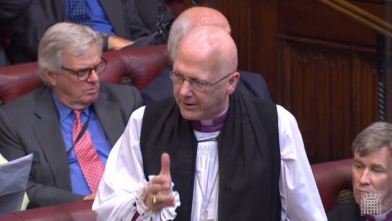
St Albans 2On Tuesday 13th December 2016, UKIP Peer Lord Pearson asked the Goverment “whether, as part of their strategy against Islamic terrorism, they will encourage United Kingdom Muslim leaders to re-examine the Muslim tenet of abrogation.” The Bishop of St Albans, the Rt Revd Alan Smith, asked a follow up question. Continue reading “Bishop of St Albans highlights need to build positive relationships with faith communities”

Bishop of Gloucester on building strong local communities of shared values

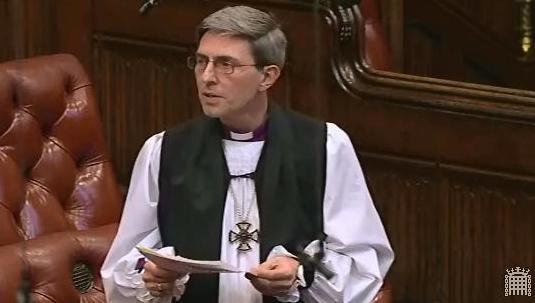
On the 2nd December 2016 the Bishop of Gloucester, the Rt Revd Rachel Treweek, spoke in the debate led by the Archbishop of Canterbury on shared  values and their role in shaping public policies. She highlighted the compassionate hospitality which this country has shown generations of refugees alongside the work she is undertaking in Gloucestershire to build community, standing ‘with’ rather than ‘othering’ people to promote human flourishing. 

gloucesterThe Lord Bishop of Gloucester: My Lords, I thank my noble friend the most reverend Primate the Archbishop of Canterbury on his foresight in tabling this debate on shared values. I also add my own congratulations to the noble Lord, Lord McInnes of Kilwinning, and the noble Baroness, Lady Bertin, on their poignant and insightful maiden speeches.
In the diocese of Gloucester, I have recently been talking to young people about body image and reflecting with them on how their true worth begins deep within, the place from which true values emerge and are lived. Last Saturday, I hosted a huge community party in Cheltenham to publicly launch our new vision for the diocese of Gloucester. The vision has emerged from conversations in local communities, urban and rural, involving about 6,000 people, churchgoers and otherwise, discussing what sort of church they want to see in their communities.The vision is one of human flourishing and transformation, emanating from those words of Jesus from the gospel of John:

“I have come that they may have life, and have it to the full”.

That is a good starting place when it comes to talking about values. Continue reading “Bishop of Gloucester on building strong local communities of shared values”

Bishop of Winchester calls for universities to confront and combat anti-Semitism

On 27th October 2016 the House of Lords held a short debate on a question from Baroness Deech, “to ask Her Majesty’s Government what steps they propose to take to combat anti-Semitism, in particular in universities.” The Bishop of Winchester, Rt Revd Tim Dakin, spoke in the debate:

Bishop of WinchesterThe Lord Bishop of Winchester: My Lords, I also thank the noble Baroness, Lady Deech, for initiating this debate.

Despite there being Jewish societies in over 60 universities, a study in 2011 found that half of all Jewish students in the UK attend only eight universities. Safety in numbers seems to be key, as Nottingham, Leeds, Birmingham and Manchester all boast Jewish societies with over 1,000 members. None the less, we know that Jewish staff and students experience anti-Semitism in a significant number of higher education institutions today. As the recent Universities UK task force report on hate crime makes clear, anti-Semitism is a practice for which there is no place in universities, nor in the Church or society at large. Continue reading “Bishop of Winchester calls for universities to confront and combat anti-Semitism”

Bishop of Chelmsford condemns hate crime, calls for better religious literacy

On 29th June 2016 Lord Ahmed repeated to the House of Lords a Government statement made in the House of Commons about hate crime. The Bishop of Chelmsford, Rt Revd Stephen Cottrell, asked a follow up question about religious literacy and education.Chelmsford 251115

The Lord Bishop of Chelmsford: My Lords, perhaps I may ask the Minister two specific questions about religious literacy and religious education. First, I welcome the Statement and the responses from the other Front Benches, and of course to express my own great dismay at the incidents that we have experienced in recent days. As I said in the House on Monday, the diocese where I serve includes some of the most multicultural parts of this country. I have heard many disturbing stories, and even more of them here today.

My first question relates to religious education. We have discovered in recent days something that is already there within us and that has been stirred up and legitimised by some of the debate, yet religious education has less of a place in the national curriculum than it used to. I wonder whether this is another opportunity for the Government to look again at the place of religious education in schools.

My second question is about religious literacy. I serve on this House’s Select Committee on Communications. We have recently completed a report on the renewal of the BBC charter. Religious broadcasting has almost disappeared from public service broadcasting, and the BBC no longer has a commissioning editor for religious broadcasting. Surely this is a time when we need to do more about this. It is a very practical matter that the Government could address. Continue reading “Bishop of Chelmsford condemns hate crime, calls for better religious literacy”

Church Commissioners: Near Neighbours

On 5th May 2016 the Second Church Estates Commissioner, Rt Hon Caroline Spelman MP, answered a written question from Karl McCartney MP, on Near Neighbours:

Karl McCartney (Lincoln): To ask the right hon. Member for Meriden, representing the Church Commissioners, what progress has been made on the Near Neighbours programme. [904799]

Caroline SpelmanMrs Caroline Spelman: The Church Commissioners welcome the Government’s recent announcement of a further £1.5 million for the Near Neighbours programme, which is administered by the Church Urban Fund.

This third round of funding for Near Neighbours will help it build on its successful track record of delivering projects up and down the country to transform local areas by strengthening relationships between those of different religious and ethnic backgrounds on issues of shared concern.

The Near Neighbours programme has offered small grants between £250 and £5,000, providing seed capital for local groups and organisations who are working to bring together neighbours, to develop relationships across diverse faiths and ethnicities in order to improve their communities.

The Near Neighbours grants fund has so far awarded seed capital worth £3.66m to over 1,120 projects. These projects have impacted the lives of 941,000 people and 71% of projects have continued to run after the initial seed capital was spent. All Near Neighbours projects are designed to change hearts and minds by bringing together different communities within a neighbourhood so that they can work together on issues of shared concern and common values.

More information on Near Neighbours can be found on its website at: https://www.cuf.org.uk/how-we-help/near-neighbours

(via Parliament.uk)

Church Commissioner questions: same sex marriage, Near Neighbours, Iraq, apprenticeships, ethical investment

On 5th May 2016 MPs asked questions in the House of Commons to Rt Hon Caroline Spelman MP, on behalf of the Church Commissioners. Questions were asked on same sex marriage, Near Neighbours, Iraq, apprenticeships and ethical investment:
Spelman CCQs June 2015 4 Continue reading “Church Commissioner questions: same sex marriage, Near Neighbours, Iraq, apprenticeships, ethical investment”

Bishop of Worcester “stigmatising Muslim communities not conducive to community cohesion”

worcesterOn the 27th January 2016 Lord Pearson of Rannoch asked the Government “what assessment they have made of the risk that Christians could be recorded as having committed an anti-Muslim hate crime from April 2016 by preaching the divinity of Christ or by reading aloud sections of the Bible in public, such as 1 John, Chapter 4, verses 1 to 3.” The Rt Revd John Inge, Bishop of Worcester, asked a follow-up question criticising the phrasing of Lord Pearson’s question and highlighting the  contribution of religion to the enrichment of public life. The transcript in full is available below.

The Lord Bishop of Worcester: My Lords, does the Minister agree with me that Questions phrased in this manner are not conducive to building positive relations between faith communities, in particular with Muslim communities, as we are endeavouring to do in the church at a time when Muslims are feeling unfairly stigmatised? Does he further accept that Muslims, and people of all faiths, greatly enrich our society and make a significant contribution to the common good? Continue reading “Bishop of Worcester “stigmatising Muslim communities not conducive to community cohesion””

Bishop of Rochester highlights work of faiths in promoting community cohesion

On 26th November 2015 the House of Lords debated a motion from Baroness Mobarik: “To ask Her Majesty’s Government, in the light of the attacks in Paris on 13 November, what steps they plan to take to foster links between communities, as part of their counterterrorism strategy.” The Bishop of Rochester, Rt Revd James Langstaff, spoke in the debate:


RochesterThe Lord Bishop of Rochester: My Lords, I, too, am very grateful to the noble Baroness, Lady Mobarik, for initiating the debate and for the opportunity to speak in it. I am grateful, too, to the noble Baroness, Lady Eaton, for saying some of the things about Near Neighbours that I might have said. That will save me having to do it. It is good to have other advocates of these things.

The point has been made already, not least by the noble Lord, Lord Harris, that the important issues raised in the debate, although perhaps prompted by part of the current world situation, have been there for many generations. Many of us have been working away at them for a good many years. None the less, one of the strands in the Government’s counterterrorism strategy, published last month, has been the building and strengthening of community links within and between communities. It is a very important strand that clearly builds on things that many of us have been involved in before. In many ways it is the most difficult strand, because it requires perseverance and hard work over many years. It requires commitment in local communities and all the things that lead to fruitful engagement. Continue reading “Bishop of Rochester highlights work of faiths in promoting community cohesion”

Bishop of Sheffield asks about the Government’s counter extremism strategy

On the 5th November Lord Pearson of Rannoch asked Her Majesty’s Government “whether, as part of their counter-extremism strategy, they will encourage a national debate about the nature of Islam, including whether the Muslim tenet of abrogation remains valid today.” The Bishop of Sheffield, Rt Revd Steven Croft, asked if the Government planned for education and faith dialogue to form part of the strategy. Lord Ahmad responded for the Government highlighting the work of the Near Neighbours scheme.

14.03.27 Bishop of SheffieldThe Lord Bishop of Sheffield: My Lords, I strongly agree with the question raised by the previous speaker and the Minister’s reply. Does the Minister agree that encouraging education and dialogue across a broad front should be a key part of our strategy, including: encouraging relationships not only between the faith communities but between all the faith communities and civil society; encouraging agencies such as the Islamic Society of Britain—which does such powerful good work in education in schools and other areas; raising the levels of religious literacy at all levels; further analysis of why people of faith do, in a minority of cases, resort to violence; and building on the excellent work of the noble Lord, Lord Sacks, in his recent book Not in God’s Name? Continue reading “Bishop of Sheffield asks about the Government’s counter extremism strategy”

Bishop of Coventry asks about support for interreligious dialogue centre in Vienna

On 4th November 2015 the Bishop of Coventry, Rt Revd Christopher Cocksworth received a written answer to a question about support for the King Adbdullah Bin Abdulaziz International Centre for Interreligious and Intercultural Dialogue in Vienna.


Bp Coventry May 2015

The Lord Bishop of Coventry: To ask Her Majesty’s Government what support, financial or otherwise, they have provided to the King Adbdullah Bin Abdulaziz International Centre for Interreligious and Intercultural Dialogue in Vienna. Continue reading “Bishop of Coventry asks about support for interreligious dialogue centre in Vienna”