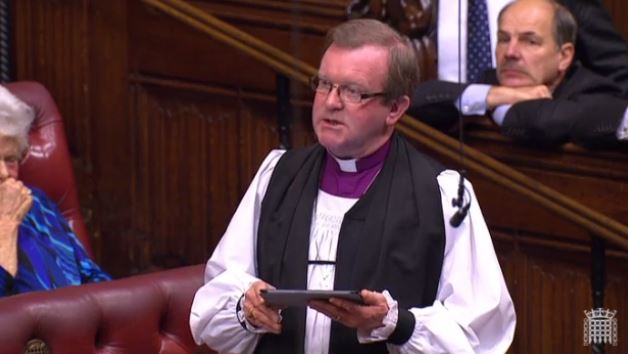
Bishop of Portsmouth highlights uncertainties for Higher Education of EU withdrawal

My background covers different sorts of universities: Hertfordshire and Portsmouth, Oxford and Cambridge, and Durham and Manchester. I studied in three, taught economics in two, was a chaplain in another and have been a governor in two. I draw your Lordships’ attention to my entries in the register of interests.

In such very varied universities, the present excruciating uncertainty following the Brexit vote is having a significant impact in a range of areas.

Continue reading “Bishop of Portsmouth highlights uncertainties for Higher Education of EU withdrawal”

Bishop of Portsmouth says social mobility needs to be about more than helping people to ‘just manage’.

“It is hard, and sometimes impossible, to seek a new or better job or to support your children in their education if your daily preoccupation has to be with getting by.” – Bishop of Portsmouth, 27/10/16 

BishPortsspeechtaxcredits

On 27th October 2016 the House of Lords debated a motion from Lord Holmes of Richmond “To move that this House takes note of Her Majesty’s Government’s plans to promote social mobility.” The Bishop of Portsmouth, Rt Revd Christopher Foster, took part in the debate:

The Lord Bishop of Portsmouth: My Lords, in these few minutes I should like to set the concern and aspirations for social mobility—already so well introduced by the noble Lord, Lord Holmes, and other noble Lords—in the context of the challenges faced by many people, some in my own diocese, who face the daily grind and trial of simply getting by for the day or, at best, the week. The Prime Minister has referred to the need to focus on “just managing” families, and I agree with her, but surely the task is to help make it possible for them to do better than just manage, enabling their energy to be taken up not just in dealing with the everyday challenges but in improving life chances for themselves and their families, including social mobility. Continue reading “Bishop of Portsmouth says social mobility needs to be about more than helping people to ‘just manage’.”

Bishop of Portsmouth asks Government to look at impact on schools of increasing business rates on small solar panels

portsmouth241016On 27th October 2016 Baroness Featherstone asked Her Majesty’s Government “whether they will reverse their decision to end the business rate exemption for small solar panels from April 2017”. Baroness Featherstone said “I urge the Government to look at the impact on schools and parish councils, which will be devastating”. The Bishop of Portsmouth, Rt Revd Christopher Foster, asked a follow up question: 

The Lord Bishop of Portsmouth: My Lords, may I press the Minister a little further on the impact—perhaps, I am hoping, the unintended impact—of this decision on some small schools? Is it really intended that small schools should pay business rates, often after significant community fundraising to install solar panels to increase awareness among children and young people of climate-change issues? Continue reading “Bishop of Portsmouth asks Government to look at impact on schools of increasing business rates on small solar panels”

Bishop of Portsmouth supports National Citizen Service Bill

portsmouth241016On 25th October 2016, the Government’s National Citizen Service Bill was debated at Second Reading in the House of Lords. The Bishop of Portsmouth, Rt Revd Christopher Foster, supported the Bill, and talked about the desirability of widening access to the National Citizen Service.

The Lord Bishop of Portsmouth My Lords, I too welcome and support this Bill, not only because of the impact, actual and potential, on building the confidence and contribution of participants but also for its intention to both formalise and improve the accountability and functioning of the NCS. It may seem obvious for us to support a scheme with such clear aims to encourage young people to engage with their communities and take responsibility for their transformation, and one that claims some positive impact on community cohesion.
Continue reading “Bishop of Portsmouth supports National Citizen Service Bill”

Bishop of Portsmouth asks Government for assurances about safety of child refugees in Calais


portsmouth241016On Monday 24th October, Lord Roberts of Llandudno asked Her Majesty’s Government “what steps they are taking to fulfil the obligation under the Immigration Act 2016 to accept unaccompanied child refugees before the camps at Calais and Dunkirk are demolished on 31 October.” The Bishop of Portsmouth, Rt Rev Christopher Foster, asked a follow up question.


The Lord Bishop of Portsmouth: Can the Minister confirm that Her Majesty’s Government will ensure sufficient co-operation with the French Government and sufficient assistance from our own Government for the support of unaccompanied child refugees in France? Can she also confirm that no child will at any time be left in unsafe circumstances? Continue reading “Bishop of Portsmouth asks Government for assurances about safety of child refugees in Calais”

Queen’s Speech: Bishop of Portsmouth responds on the economy and life chances

On 25th May 2016 the House of Lords held the fourth and final debate on the Queen’s Speech. The Bishop of Portsmouth, Rt Revd Christopher Foster, spoke in the debate on the Government’s proposals for the economy and life chances.

BishPortsspeechtaxcreditsThe Lord Bishop of Portsmouth: My Lords, in responding to the gracious Speech, I am delighted to welcome, first, the maiden speech of the right reverend Prelate the Bishop of Newcastle and to congratulate her. To be in the House and on this Bench today is a pleasure. We are colleagues again here, as we were in St Albans diocese some years ago. We have a shared conviction that the work of the Church and of government is to support the welfare of all people, reminding ourselves that welfare is properly understood not in the restricted sense in which we so often use it in our debates about benefits and eligibility but as the well-being of all people in the whole of their lives. Bishop Christine has powerfully reminded us of the perspective from her diocese and the north-east. Continue reading “Queen’s Speech: Bishop of Portsmouth responds on the economy and life chances”

Budget debate: Bishop of Portsmouth calls on Government to ‘set economic course with a stronger moral compass’

On 23rd March 2016 the House of Lords debated the 2016 Budget statement. The Bishop of Portsmouth, Rt Revd Christopher Foster, spoke in the debate:

Portsmouth budget 2The Lord Bishop of Portsmouth: My Lords, in contributing to this debate and responding to the Chancellor of the Exchequer’s Budget Statement last week, to the subsequent events and to the debate in the other place, I welcome some proposals, express some surprise, and register disappointment—indeed, shock—at some of the measures announced. First, it is good to congratulate the Chancellor and Government on the intention to raise the tax free personal allowance to £11,500 this time next year. Lifting about 1.3 million people out of income tax is, of itself, welcome, although there are some potential drawbacks to which I will return a little later. Continue reading “Budget debate: Bishop of Portsmouth calls on Government to ‘set economic course with a stronger moral compass’”

Welfare Reform Bill: Bishop of Portsmouth welcomes child poverty proposals and presses Government on two-child limit

On 29th February 2016, the House of Lords considered changes made in the House of Commons to the Government’s Welfare and Work Reform Bill. Earlier, MPs had voted to reject an amendment to the Bill tabled by the Bishop of Durham and passed by the House of Lords, which made it a duty of the Secretary of State to report annually on income measures of child poverty. In its place Lord Freud, Minister for Welfare Reform, tabled an alternative Government amendment in the Lords, to require government to annually publish the child poverty income measures, without requiring a report to be laid before Parliament. The Bishop of Durham, the Rt Revd Paul Butler, and the Bishop of Portsmouth, the Rt Revd Christopher Foster, both welcomed this concession by Government. Lord Freud’s speech introducing that amendment can be seen here. The Bishop of Durham’s response can be seen here.The Bishop of Portsmouth’s response is below, in which he also pressed the Minister on points he had made at earlier stages about the two-child limit and impact on those who are bereaved or fleeing domestic violence. 

BishPortsspeechtaxcreditsThe Lord Bishop of Portsmouth: My Lords, I, too, am grateful for the Government’s decision to publish under obligation the three HBAI low-income measures, along with the further measure of children in persistent poverty. In welcoming this response to the clear wish of the House, I will not detain the House with my commentary on the tortuous routes to this wise and welcome decision, tempting though that is; we are in Lent and bidden not to succumb to temptation. As we have so powerfully and carefully considered in this House the plight particularly of children in poverty, I recall that the Minister said that he expected the Government to come under further pressure—I paraphrase—and I do not want to disappoint him. Continue reading “Welfare Reform Bill: Bishop of Portsmouth welcomes child poverty proposals and presses Government on two-child limit”

Welfare Reform Bill: Bishop of Durham welcomes commitment to publish child poverty data

On 29th February 2016, the House of Lords considered changes made in the House of Commons to the Government’s Welfare and Work Reform Bill. Earlier, MPs had voted to reject an amendment to the Bill tabled by the Bishop of Durham and passed by the House of Lords, which made it a duty of the Secretary of State to report annually on income measures of child poverty. In its place Lord Freud, Minister for Welfare Reform, tabled an alternative Government amendment in the Lords, to require government to annually publish the child poverty income measures, without requiring a report to be laid before Parliament. The Bishop of Durham, the Rt Revd Paul Butler, and the Bishop of Portsmouth, the Rt Revd Christopher Foster, both welcomed this concession by Government. Lord Freud’s speech introducing that amendment can be seen here. The Bishop of Durham’s response is below. The Bishop of Portsmouth’s response can be seen here.

Bp Durham June 2015 bThe Lord Bishop of Durham: My Lords, throughout our debates on the Bill, we have all consistently expressed our desire to see child poverty in our nation reduced and, ultimately, eradicated. We have different views about how this might best be achieved, and about the impact the Bill will have. I continue to have deep concerns about its impact. I fear that it will lead to more children and families being poor. Continue reading “Welfare Reform Bill: Bishop of Durham welcomes commitment to publish child poverty data”

Armed Forces Bill: Bishop of Portsmouth highlights support for service families and work of military chaplains

On the 11 February 2016 the Bishop of Portsmouth, the Rt Revd Christopher Foster, spoke during the second reading debate on the Government’s Armed Forces Bill. He highlighted the work of the Church of England to support the military covenant, the need to support service families and the significant work of military chaplains.

BishPortsspeechtaxcreditsThe Lord Bishop of Portsmouth: My Lords, by happy coincidence, this debate takes place almost exactly on the anniversary of the signing of the Armed Forces corporate covenant by the right reverend Primates the Archbishops of Canterbury and York. There has been excellent work with the Minister in developing the impact of that covenant, and it is a pleasure to mark that anniversary today and anticipate the maiden speeches this afternoon.

This Bill properly clarifies the obligations and responsibilities of those serving in the Armed Forces and strengthens provision for maintaining good order and handling any instances of indiscipline with proper regard for justice. These provisions and the contributions that we have heard already remind us, although they are often technical, that individuals in our Armed Forces serve, and occasionally offend, in situations of stress and danger.The House will not be surprised therefore if I briefly draw attention to the importance—and I hope the Minister in summing up can confirm this—that we should all give to the areas of pastoral and family support for those who volunteer to serve us and the nation in this way in the Armed Forces, even when their behaviour falls below highest standards. Continue reading “Armed Forces Bill: Bishop of Portsmouth highlights support for service families and work of military chaplains”