
 On 15th March 2016, Baroness Lister moved an amendment to the Government’s Immigration Bill which would extend the period for those transitioning from asylum support to work or benefits from 28 to 40 days. The Bishop of Norwich, the Rt Revd Graham James, spoke in support of the amendment. Lord Bates responded on behalf of the Government. Continue reading “Immigration Bill: Bishop of Norwich backs move to extend transitional asylum support for those given leave to remain”
Tag: refugees
Immigration Bill: Bishop of Norwich moves amendment requiring best interests assessment for refugee children
 On 15th March, the Bishop of Norwich, the Rt Revd Graham James, moved an amenment to the Immigration Bill that would ensure a best interests assessment was undertaken for an child separated from their parents due to an immigration appeal. Lord Keen of Elie responded on behalf of the Government.
Bishop of Coventry leads Lords debate on political solution to war in Syria
On 8th March 2016 the Bishop of Coventry, Rt Revd Christopher Cocksworth, led a short debate in the House of Lords “To ask Her Majesty’s Government what is their current assessment of the prospects for a political solution to the civil war in Syria.” The Bishop’s speech opening the debate is below, alongside the Minister’s response. All speeches made in the debate can be viewed here.
 The Lord Bishop of Coventry: My Lords, today’s short debate enables us to return to the prospects of a political solution to Syria’s catastrophic civil war—a civil war which now represents the world’s greatest humanitarian disaster and most dangerous geopolitical hotspot. The timing of this debate could not be more critical because, thankfully, we are now seeing tentative steps towards a cessation of hostilities in Syria and fragile efforts to resume face-to-face negotiations. The coming days and weeks will be difficult but when set against five years of utter desolation and destruction, these signs of hope represent an opportunity that must not be missed. Continue reading “Bishop of Coventry leads Lords debate on political solution to war in Syria”
Bishop of Southwark asks Government about help for Iraqi refugees in Jordan
On 2nd March 2016 the Bishop of Southwark, Rt Revd Christopher Chessun, received answers to three written questions on the plight of Iraqi refugees in Jordan.
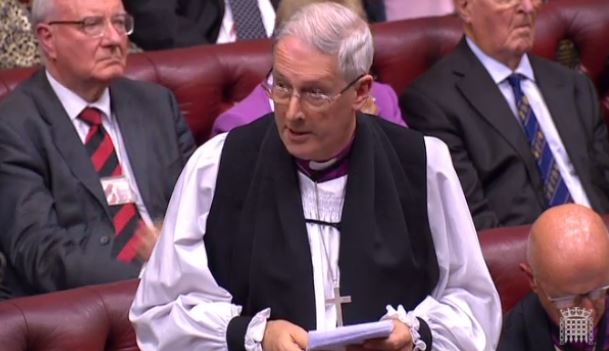
The Lord Bishop of Southwark: To ask Her Majesty’s Government what assessment they have made of the conditions facing Iraqi refugees in Jordan. [HL6275]
Baroness Verma: The situation for many refugees in Jordan is challenging, irrespective of nationality. Services are provided by the international community and the Government of Jordan based on a system of prioritisation of the most vulnerable and Iraqi refugees are included in this system. Like all refugees, Iraqis are registered by the Office of the United Nations High Commissioner for Refugees (UNHCR) and access assistance from UN agencies, international NGOs and national NGOs. Partners assess vulnerability in Jordan at individual, community and household levels. These vulnerability assessments take into account positive coping strategies and support networks, which are understood to be better established among the Iraqi community, including through religious institutions such as mosques and churches. Continue reading “Bishop of Southwark asks Government about help for Iraqi refugees in Jordan”
Archbishop calls on Government to do more for unaccompanied children at Calais ‘Jungle’ camp
On 1st March 2016 Baroness Sheehan asked Her Majesty’s Government “what views they have expressed to the government of France about the bulldozing of the south section of the Calais “Jungle” camp.” The Archbishop of Canterbury, Most Revd & Rt Hon Justin Welby, asked a follow up question:
 The Archbishop of Canterbury: My Lords, while we would all agree that the situation is difficult for the French authorities, I am sure we also feel that it is significantly more difficult for the 300 unaccompanied children. I recently visited the Marsh Academy near Romney Marsh and saw a school and community fostering and caring with the utmost compassion for significant numbers of unaccompanied children. Given that example, does the Minister agree that issues of compassion should easily trump those of administrative efficiency and tidiness, and narrow definitions of family links, and that we should, therefore, take more children very quickly?
Continue reading “Archbishop calls on Government to do more for unaccompanied children at Calais ‘Jungle’ camp”
Bishop of Durham asks about EU regulations for reuniting refugee families
 On 29th February 2016, the Home Office Minister in the House of Lords, Lord Bates, repeated a statement on Child Refugees in Calais. The Bishop of Durham, the Rt Revd Paul Butler, asked a supplementary question.
The Lord Bishop of Durham: My Lords, can the Minister confirm how tight or loose are the parameters on family relationships under Dublin being used in this? That is one of the concerns of those working on this in the NGOs—how tight or how loose the family ties can be defined as. Continue reading “Bishop of Durham asks about EU regulations for reuniting refugee families”
Bishop of Rochester asks about unaccompanied refugee children
On 8th February 2016, Lord Roberts of Llandudno asked the government “what action they are taking to relieve the situation of unaccompanied refugee children.” The Bishop of Rochester, the Rt Revd James Langstaff, asked a follow up question.
 The Lord Bishop of Rochester: My Lords, as one of the bishops from Kent, may I take the Minister back to his previous answer? In fact, some 1,300 unaccompanied refugee children are housed in Kent, and the local authorities and the voluntary agencies are under very significant pressure. May I push him a little as to whether, in the light of the somewhat unencouraging response from other local authorities, Her Majesty’s Government intend to do anything else to ensure a more effective national dispersal programme—given that we are talking not just about this moment, but about the likely 10 years that will be needed to get a young person from the point of arrival to full integration, with all the work in education, language and healthcare needed to go with that, and the considerable investment required? Some assurance would help my colleagues in Kent. Continue reading “Bishop of Rochester asks about unaccompanied refugee children”
Bishop of Durham tells Peers of support on offer for unaccompanied child refugees
 On 25th January 2016, the Bishop of Durham, the Rt Revd Paul Butler, responded to a statement in the House of Lords regarding the plight of unaccompanied refugee minors.
The Lord Bishop of Durham: My Lords, I declare an interest as one of the co-chairs of the National Refugee Welcome Board. Is the Minister aware that the organisations Home for Good and Coram have somewhere between 9,000 and 10,000 families already offering to take unaccompanied minors? Of course, they have to have all the safeguarding checks and they will not all be suitable, but there is a vast body of people already willing to offer to help to resettle unaccompanied children in this country. The National Refugee Welcome Board is committed to working with the Government to try to help in that, with those organisations.
Lord Bates: That is a very generous welcome and one that we appreciate very much indeed. We are conscious that a lot of the people who are coming in the first wave are those who are most in need; those who have been victims of torture, with acute medical needs, and those most at risk. They may not be appropriate for the type of generous hospitality being suggested. But certainly as the scheme progresses we will very much want to call on that active and typical generosity on behalf of the British people.
(via Parliament.uk)
Immigration Bill: Bishop of Southwark speaks about reduced support for asylum seekers and new powers for immigration officers
On the 22nd December 2015 the Bishop of Southwark, the Rt Revd Christopher Chessun spoke during the Second Reading debate of the Government’s Immigration Bill. Bishop Christopher spoke about the proposals for new powers for immigration officers and voiced concern about further reductions in support for those whose asylum claims have been refused. He also drew on his recent visit to the Calais migrant camp.
 The Lord Bishop of Southwark: My Lords, the Bill is the latest in a list of substantive immigration legislation that this House has considered in recent years. Since the Nationality, Immigration and Asylum Act 2002 we have had five further pieces of primary legislation in this area, yet Her Majesty’s Government have published no White Paper on immigration since 2002—no considered, detailed overview and proposals through which we might consider all aspects relating to immigration before embarking on major legislation. The Explanatory Notes are helpful but they are no substitute for a White Paper. Continue reading “Immigration Bill: Bishop of Southwark speaks about reduced support for asylum seekers and new powers for immigration officers”
Bishop of St Albans asks Government about private sponsorship schemes for Syrian refugees
On 17th December 2015 Lord Roberts of Llandudno asked Her Majesty’s Government “whether they will follow the example of the government of Canada in welcoming further Syrian refugees”. The Bishop of St Albans, Rt Revd Alan Smith, asked a follow up question:
 The Lord Bishop of St Albans: My Lords, I congratulate the Government on the first 1,000 refugees being brought in. I hope that this will continue apace. On the Question of the noble Lord, Lord Roberts, which draws on the experience of Canada, since 1979 the Canada private sponsorship programme has enabled 200,000 refugees to be settled in that country. Privately sponsored refugees are likely to make up around 40% of those coming in over the forthcoming months. It is a good example of big society, whereby churches and community groups are given responsibility for working with resettlement programmes. Have Her Majesty’s Government looked into the experience of Canada, and are they considering developing similar programmes in the UK based on that good experience? Continue reading “Bishop of St Albans asks Government about private sponsorship schemes for Syrian refugees”


You must be logged in to post a comment.