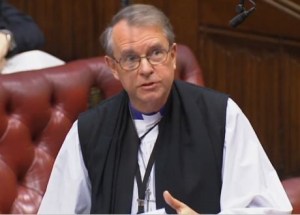
On 20th March, a vote took place on a Regret Motion tabled by Labour’s Lord Bassam of Brighton to Regulations changing entitlement to free school meals. The Bishop of Portsmouth took part. His speech in the debate is here. Continue reading “Votes: Changes to Free School Meals Entitlements”
Tag: universal credit
Bishop of Portsmouth warns of cliff-edge consequences for poor families, of changes to free school meal rules
On 20th March 2018 the House of Lords debated the motion ‘
that this House regrets Her Majesty’s Government bringing forward changes in entitlement to free school meals through the Free School Lunches and Milk, and School and Early Years Finance (Amendments Relating to Universal Credit) (England) Regulations 2018 which will undermine work incentives in Universal Credit and leave up to a million poor children unable to claim free school meals; and calls on Her Majesty’s Government not to implement the Regulations until a full poverty impact assessment has been completed and considered by both Houses, and not before six months has elapsed (SI 2018/148). The Bishop of Portsmouth, Rt Revd Christopher Foster, spoke in the debate:
The Lord Bishop of Portsmouth: My Lords, it normally gives me great pleasure to speak in your Lordships’ house, but this evening I speak with some sorrow. I am hoping that the proposals made by the Government—involving, I am sure, the Treasury, the Department for Education and the Department for Work and Pensions—are perhaps the result of the complexity of those interlocking interests and have inadvertently left what surely cannot be intended. The consequences of this policy run counter to everything that the Government have said about the principle of universal credit, which I and many others have supported. If the consequences are unintended then I shall be delighted and relieved to hear the Minister say so.
Bishop of Newcastle asks Government about proposals to tackle child hunger

On 14th March 2018, Lord Kirkwood of Kirkhope asked Her Majesty’s Government “what assessment they have made of the effect on Universal Credit work incentives of the recently announced proposals for passporting family entitlement to free school meals.” The Lord Bishop of Newcastle, Rt Revd Christine Hardman, asked a follow-up question:
The Lord Bishop of Newcastle: My Lords, we have years of clear evidence that tackling child hunger improves outcomes at school and improves achievement and social mobility. What assessment have the Government made of the impact of these proposals on child hunger and on our investment in our children’s futures?
Continue reading “Bishop of Newcastle asks Government about proposals to tackle child hunger”
Bishop of Durham receives answers to further written questions on Child Tax Credits
Budget – Bishop of Portsmouth points to great silence on social care
On 4th December 2017 the House of Lords debated the Chancellor’s 2017 Autumn Budget Statement. The Bishop of Portsmouth, Rt Revd Christopher Foster, spoke in the debate, focusing on the lack of news on social care and on defence, and calling on Government to take further action on Universal Credit:
The Lord Bishop of Portsmouth: My Lords, one of the duties in which I take particular pleasure is chairing the governors at Ripon College, Cuddesdon, just outside Oxford, a theological college at which men and women are prepared for ministry. It is known by those associated with it more colloquially as a vicar factory. Notices around the college remind the residents that, after night prayer or Compline, they are expected to abide by what is known as the great silence. It is not, I suspect, adhered to with the same severity as in years past. Indeed, one has a sense that the silence masks all kinds of feverish activity, all of it associated with theology, of course.
Last week’s Budget was characterised by a great silence on two issues, and that silence too hides, I suspect, feverish activity and fevered discussions on social care and defence.
Continue reading “Budget – Bishop of Portsmouth points to great silence on social care”
Bishop of Coventry asks Government about funding for debt advice services
On 22nd November 2017 the House of Lords heard the repeat of a statement made by the Secretary of State for Work and Pensions on Universal Credit. The Bishop of Coventry, Rt Revd Christopher Cocksworth, responded to the statement:
The Lord Bishop of Coventry: My Lords, I share with the Minister and the House a bit of local information. We find ourselves in an interesting situation in Coventry, with rising employment and yet a 30% increase in usage among those in the city—mostly single males—among whom universal credit has been rolled out. Like others, I very much welcome the changes and I am sure they will help enormously but, at the same time, I still have reservations about whether they have gone far enough and address other issues that some of us on the ground have identified. Continue reading “Bishop of Coventry asks Government about funding for debt advice services”
Autumn Budget 2017 – response from Bishop of Birmingham
Press release from the Church of England website:
Responding today (22nd November 2017) to the Chancellor’s Autumn Budget Statement, the Bishop of Birmingham, Rt. Revd David Urquhart, Convenor of the Lords Spiritual, said:
“The Chancellor’s Budget has gone some way to deal with the immediate problems facing our economy, housing and NHS, but it could have gone much further to help the many at the sharp end struggling to get by.
“Across the country churches support and are in touch with those who experience poverty or financial difficulty as a result of low pay, illness, or debt. The Budget statement provided an opportunity to make a difference to the lives of the most disadvantaged at a time when the cost of living is rising. The country faces substantial financial challenges and the growth forecast downgrades are worrying. But whilst the Chancellor has limited room for manoeuvre, there is more that could have been done to alleviate the situation of those who are struggling to manage. Deficit reduction is important, but should be achieved in ways that promote fairness, generosity, and sustainability. Bishops frequently raise these issues in the House of Lords and in meetings with ministers, and will continue to do so. Continue reading “Autumn Budget 2017 – response from Bishop of Birmingham”
Bishop of Durham calls for urgent changes to “flawed system” of universal credit
On 16th November 2017 the House of Lords debated a motion from Baroness Hollis of Heigham “That this House takes note of the impact of Universal Credit on claimants.” The Bishop of Durham, Rt Revd Paul Butler, spoke in the debate:
The Lord Bishop of Durham: My Lords, I, too, congratulate the noble Baroness, Lady Hollis, on securing this debate and on her introduction.
Universal credit originally set out to simplify a fragmented, complex system and to reduce poverty through the simple, noble philosophy of making work pay. While it still has the potential to transform this broken system, its current shape risks undermining these two core objectives for the neediest in the nation and thus failing British families. Almost every week, I receive heart-breaking stories about how the transition to UC is devastating the lives of claimants. What does the five or six-week waiting period, which is often longer, actually look like for a family or single parent with young children? Continue reading “Bishop of Durham calls for urgent changes to “flawed system” of universal credit”
Bishop of St Albans leads debate on risks of rising household debt
On Monday 13th November the Bishop of St Albans, Rt Revd Alan Smith, led a debate in the House of Lords on the levels of household debt in the UK. His opening speech is below, along with the responding speech of the Government Minister (all the speeches in the debate can be read here).
The Lord Bishop of St Albans: To ask Her Majesty’s Government what is their assessment of the risks posed by current levels of household debt in the United Kingdom.
The Lord Bishop of St Albans: My Lords, I am deeply concerned—as I know are many other Members of this Chamber—about rising levels of household debt in this country. Households in the UK are taking on far more debt than they used to and overall are taking on more debt than they bring home in income. While the ratio of household debt to income has not yet eclipsed the 160% peak hit in early 2008, it currently hovers around 140%, a dramatic shift from the ratio of 95% in 1997.
Of course there are good reasons why families in this country choose to take on debt—perhaps to buy a house or another form of secured debt—but, nevertheless, we know that for some people the prospect of saving for a house is inconceivable and that those who are lucky enough to purchase a house take on an extremely high level of mortgage debt. This burden, especially for young people, should be recognised. Continue reading “Bishop of St Albans leads debate on risks of rising household debt”
Bishop of Durham asks for evidence for employment claims about Universal Credit
On 30th October 2017 the Bishop of Durham, Rt Revd Paul Butler, received a written answer to a question on Universal Credit:
The Lord Bishop of Durham: To ask Her Majesty’s Government, further to the remarks by the Secretary of State for Work and Pensions on 9 October (HC Deb, col 4), whether they will publish the evidence supporting his statement that the roll-out of Universal Credit will mean that 250,000 more people will be in work. Continue reading “Bishop of Durham asks for evidence for employment claims about Universal Credit”
On 6th March 2018 the Bishop of Durham, the Rt Rev Paul Butler, received an answer to three written questions on Child Tax Credits, following up written questions asked in
You must be logged in to post a comment.